
Ask just about any college student what Facebook is, and not only will they tell you, but they’ll probably also recount some of the site’s recent actions.
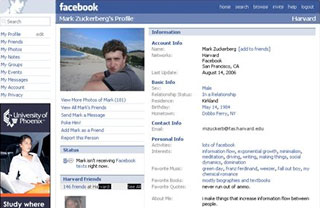 For those who don’t know, Facebook recently revamped its website to feature “news feeds”. These are similar to RSS feeds, except that in this case the information is about what the user’s friends have recently added to or removed from their profiles – as well as what events they’re attending, whether they added someone as a friend, or what group they recently joined.
An hour or so after this feature was launched; a Facebook group was created to protest the changes. After a day, they had over 300,000 members, and after two days the group had over 700,000 members – all angry about the new “feature”.
When someone joins a social networking site, they are joining on the basis that the information they post is public information – they are essentially creating a personal ad for themselves. This is the basis for the argument that supports the new features – all the information displayed in the feeds is public information, and only your friends can see it. If you didn’t want your friends to see something, you shouldn’t be linked as friends with them in the first place.
However, many members felt these features went too far. The feed broadcasts that you declined the invitation to join the “save the trees” group to all of your friends and throws in their face that you posted pictures of the party you went to last week. Further, it makes stalking someone much easier.
Facebook users felt that they should have the right to a tiny bit of privacy even on a relatively open forum. So after several days, Facebook introduced stricter privacy controls that let community members choose who can see their profile and what information people can see in your feed.
To be clear, even from the beginning you could manually remove each item in your feed by clicking the ‘x’ button next to it on your profile page. This wasn’t the solution that Facebook users were looking for, though, and some are still annoyed with the new privacy options, claiming that the site should remove the feature entirely.
It isn’t completely over, as Facebook plans to open up to regional networks. This means that just about anyone living in a specific area can join and befriend someone from another network. While they can’t see someone’s profile at a college (or another network) without actually being their “friend”, it breaks the exclusivity that helped make Facebook so popular and successful – along with the simplicity of use that features such as status (what you’re currently doing; e.g., “Adam is currently in class”), notes (a weblog) and, of course, feeds, already helped to destroy.
Whether people end up migrating to another, more exclusive site remains to be seen.
The general problem with social networking online is that just about anyone can know a lot about you in a very short amount of time. Facebook was so successful at dealing with this because its system used your college email address to verify that you are indeed a student at the school. Myspace, Bebo, and others didn’t have this check in place and therefore ended up with a completely different atmosphere and user base.
Will Facebook last? Probably, in some form or another, but college students survived for years without it, and they can and most likely will do so again if Facebook continues to alienate its users.
Keywords: #facebook #socialnetworking #privacy
Short link: http://goo.gl/uh0I1O
searchword: facebook
