Jef Raskin, the Visionary Behind the Mac
2005.01.19
Interface pioneer and Mac visionary Jef Raskin died of cancer on Saturday, February 26, 2005. He was 61. Read our obituary.
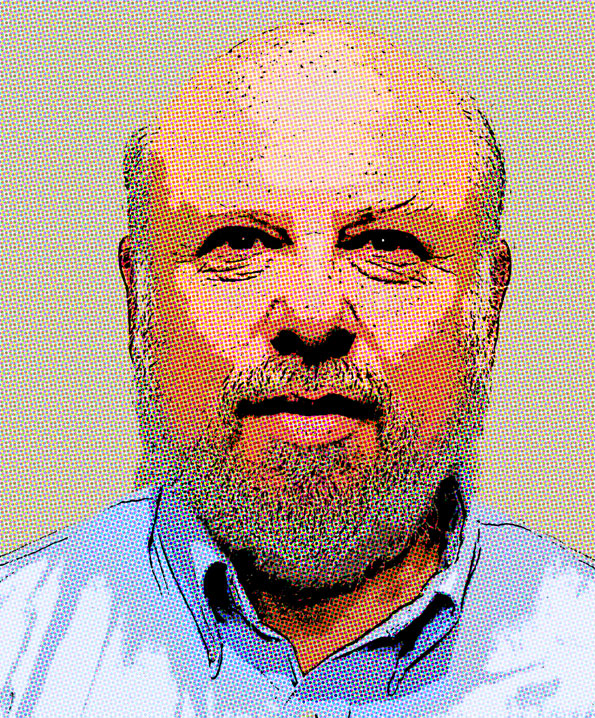
Jef Raskin founded the Macintosh project at Apple, which led to the development of the Apple Mac and the popularisarion of the graphical user-interface. He was Apple employee #31 and left the Macintosh team in mid-1981 after Steve Jobs took over the project.
Jason Walsh: Before the Mac you were a professor of music. As a musician you presumably appreciate complex but specific tools for use by virtuosos. Your major contribution to computing, the Macintosh, seems to point in the other direction - simplicity of use. How do you square these facts?
Jef Raskin: I was never a professor of music. I was, however, a music graduate student and later a professional musician. I'd love to simplify musical instruments; we can do better than the present awkward keyboard arrangement on pianos, for example. And I did design software that allowed me to compose and edit printed music much more easily than doing it by hand. However, like the QWERTY keyboard, some things are so embedded in our culture that it is futile to try to change them. I have made changes in the world that are beyond what most people thought was possible, and I hope that my judgment continues to be good as to what is possible to change and what is not.
I do not see any conflict to square.
JW: You originally managed Apple's publication unit. How did you convince the company to allow you to pursue the Macintosh project?
 JR: I convinced the chairman of the board at the
time, Mike Markkula, of the correctness of my vision. I avoided the
supposed "visionaries" in the company who could not understand my idea
but presented a business case: People would buy a product that they
could readily and happily use. I wrote forward-looking white papers
such as "Computers by the Millions" so that management could see what
the computing world would be like in the coming decade. People who want
to know exactly what I was saying in 1979 can read it and other
writings of mine at www.jefraskin.com or see the particular
document at http://humane.sourceforge.net/published/holes.html
JR: I convinced the chairman of the board at the
time, Mike Markkula, of the correctness of my vision. I avoided the
supposed "visionaries" in the company who could not understand my idea
but presented a business case: People would buy a product that they
could readily and happily use. I wrote forward-looking white papers
such as "Computers by the Millions" so that management could see what
the computing world would be like in the coming decade. People who want
to know exactly what I was saying in 1979 can read it and other
writings of mine at www.jefraskin.com or see the particular
document at http://humane.sourceforge.net/published/holes.html
It ends with a question: What will millions of people do with them?
I answered that with another essay from the same year that is the appendix to "Holes in the Histories" on www.jefraskin.com or surf directly to http://humane.sourceforge.net/published/millions.html.
JW: Perhaps the longest surviving legacy of your original Mac design is the "appliance" nature of the all-in-one Macs. Do you think this simplicity of design has been key to making the Mac as popular as it is?
JR: Yes, but unfortunately, the Mac is now a massive mess. A third party manual (Pogue's 'The Missing Manual') is nearly a thousand pages and is far from complete. Apple now does development by accretion, and there is very little difference (but there's still some difference) between using a Mac and a Windows machine.
JW: Many individuals - notably Steve Jobs, Jonathan Ive, Jerry Manock, and Harmut Esslinger - have become noteworthy through Apple's industrial design. Considering that the key to Apple's success in this area is largely due to your insistence on the Mac having an all-in-one appliance-like form factor, do you feel that your contribution in this area has been ignored?
JR: [This is] not an important issue.
JW: Several people have suggested that whilst you are indisputably the father of the Mac, it would have been a significantly different machine had it followed your original plans. Some have argued, for instance, that it would have had a text interface. Is this the case?
JR: No. I designed it to be graphical from the ground up. But the text portions of the interface, which I also cared about, would have been cleaner. People have put together my dislike of the mouse (confusing dislike for a particular input device with dislike for graphic input devices in general; I personally prefer trackballs and tablets) and my careful attention to text handling to a false legend of my wanting a text-based machine. Andy [Hertzfeld, a major developer on the early Mac team], unfortunately, has not generally gone back to the original documents, and he's interviewed lots of people about the history of the Mac, but not me. His website is, as a result, full of errors.
JW: How do you rate today's Mac UI, both in the context of its competitors and against your original vision for computers with the Mac?
JR: I think I have answered most of this already. My original vision is outdated and irrelevant today. The principles of putting people first and designing from the interface to the software and hardware are as vital today as they were then.
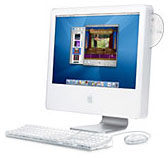 JW: What do you make of the new
iMac G5? Was the original
iMac a step back onto the correct path for the Mac?
JW: What do you make of the new
iMac G5? Was the original
iMac a step back onto the correct path for the Mac?
JR: iMac G5? The unfoldable portable-shaped box on a stalk? I think it is a practical and space-saving design. But it's the interface that needs fixing. You soon forget what the box looks like and care only about getting something done. Apple has forgotten about this key concept, so all the beautiful packaging is ho-hum and insignificant in the long run.
JW: What did you make of Jobs and Wozniak? They are both characterised very strongly in the press; fairly?
JR: This requires a book-length answer.
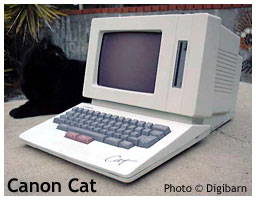 JW: Several years after leaving Apple, you
designed the Canon
Cat, famously mis-marketed by that company. Was this a major
disappointment to you? Do you feel that computers would be
significantly different today if the Cat had been a success?
JW: Several years after leaving Apple, you
designed the Canon
Cat, famously mis-marketed by that company. Was this a major
disappointment to you? Do you feel that computers would be
significantly different today if the Cat had been a success?
JR: Disappointment? Yes. Would things have been different? Probably.
JW: Some of the UI concepts from the Cat - notably the leap keys - are found in your latest project, The Humane Environment. Do you feel that THE offers an opportunity to think about computing in a different way?
JR: Not thinking about computing in any way. What it is is a way of not having to think about computers at all and concentrate all your attention on what you want to accomplish.
JW: Would you care to elaborate on your current project, the Humane Environment?
JR: It would take too much space to describe in a comprehensible manner. This is not because it is complicated; it is not. THE is far simpler than what we have. But the concepts are so different than today's that few can "get it" quickly. I remember trying to explain why a computer interface needed a pointing device (such as a mouse) at Apple in the early days of the Mac. It was so different that until people saw a mouse in action they couldn't grasp it. Similarly with THE.
JW: It seems that the culmination of your work would be a computer that was invisible to the user; OSes would disappear and applications would take on functionality as required. Bill Atkinson's HyperCard application also seemed to point in this direction - do you feel that this was a missed opportunity?
JR: Well, a computer interface that, while not invisible, would not require conscious attention. HyperCard did not have the properties needed to make its use unconscious. It was wonderful in many other ways, however, and it would have been wise to keep it working on Apple's newer systems.
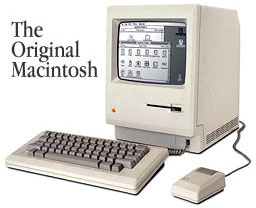 JW: The original Mac was to be sold
for $600. When it finally arrived it cost $2,500 and today the cheapest
Mac is $699. Is this a disappointment to you?
JW: The original Mac was to be sold
for $600. When it finally arrived it cost $2,500 and today the cheapest
Mac is $699. Is this a disappointment to you?
JR: Which? the $2,500, the $699? It was never supposed to be $600.
JW: Do you feel that the last 20 years have seen real progress in computing, or has it been a pointless chase of increasing power and complexity?
JR: Of course there has been immense progress, primarily in the richness of applications. The problem is that all this power is lost on many people and impedes the utility of it for the rest, because of the unnecessary complexity of using computers. This I can fix.
I would say that the quest for CPU power is not pointless, but that it has been largely defeated by bloated software in both applications and operating systems. I have heard programmers say that they don't have to write fast or compact code because the next generation of computers will be fast and big enough to compensate.
I am horrified to find that some programs I wrote in BASIC on an Apple II ran faster than when written in a modern language on a G4 dual-processor Mac with hardware that is inherently 1000 times faster.
Many current programming practices are extraordinary wasteful, and we computer users get to pay for them.
JW: Your place in history is guaranteed. The Macintosh changed the public's perception of computers forever. Are you proud of this legacy?
JR: I am only a footnote, but I am proud of the footnote I have become. My subsequent work on eliciting principles and developing the theory of interface design, so that many people will be able to do what I did, is probably also footnote-worthy. I think that in looking back at this turn-of-the-century period, the rise of a world-wide network will be seen as the most significant part of the computer revolution.
JW: Finally, what are your predictions, good and bad, for the future of, the Mac and user interfaces?
JR: I don't predict. I decide how I want the world to be and push it in that direction.
If you insist, I would say that in another decade, at least some of what I'm working on will be taken for granted by millions of computer users. For example, nearly every computer user, on every brand of computer, does click-and-drag selection and moving of objects. Yet probably not one in million stops to think that someone had to invent those and other related methods, and perhaps a dozen of those know that I invented it.
A short edit of this interview was published in the Guardian.