
July 2001 – A recent news article said that IBM had made a breakthrough in semiconductors. Typically computers have been getting faster because the transistors in the CPUs have been getting smaller. Which each decrease in size, the chips get faster or use less energy.

Normally these transistors are flat on the silicon substrate. IBM has found a way to build the transistors vertically. This means the transistors can be much smaller, since engineers can control the layers on a chip with much more precision than the width of the transistors.
The result: They expect that they could have 100 Gigahertz chips in two years without overhauling their fabrication facilities.*
Now before you get too excited, the article did say that the chips would first be used in network hardware that currently needs that kind of power, not for desktop PCs.
Still, 100 GHz!
What would you do with all that speed?
I know exactly what I would do with it. Check my email, browse the Web, write articles for Low End Mac, listen to MP3s.
Wait, I can do that already.
Without extremely demanding software, the extra speed of a 100 GHz processor would be wasted. And though I don’t like to admit it, I am often the slowest component of my computer (see Bottlenecks: What Is Your Mac’s Slowest Component?). Besides making the processor faster, IBM could make the chip much smaller and use less power. I don’t know the actual numbers, but I bet if they could make a 100 GHz chip, they could also make a little mini G3 that ran at a measly 1 GHz on AAA batteries in my Palm. Now that could be useful.
Balance
Performance in a computer is a balance of many different components. Pumping the CPU to 100 GHz in the next year would just move the bottleneck to other components of the computer. We’ve gotten used to CPU multipliers, but this would get ridiculous. Would the processor run at 500 times the memory bus speed?
To get the best performance, all the parts need to be in balance.
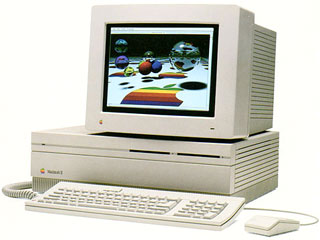 My vote for the fastest and most balanced Mac of all time is the Mac IIfx. In the age of 16-33 MHz Macs and PCs, it came along with 40 MHz of 68030 power. It’s bus also ran at 40 MHz. It had all sorts of little tweaks that made it unique and high-performance.
For example, it used 64-pin SIMMs for memory, because they could provide better throughput. It had dedicated processors to manage the serial ports and move some of the work off the CPU. And it shipped with a new graphics accelerator, the Apple 8•24GC, because every card beforehand seemed slow when used with the IIfx.
 The IIfx really is wicked fast if you use the right software. It can boot up in less than 15 seconds with System 6. All the software of it’s day runs nearly instantaneously. The only other Mac that might compete with the IIfx is the Quadra 840av, because it had an equally fast 40 MHz bus coupled with the much more powerful 68040. But I think the IIfx seems faster, since it shipped with System 6, which is so much more lightweight than System 7.
Today’s Most Balanced Mac
I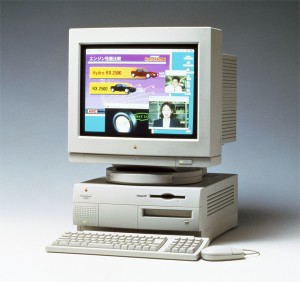 n 2001, both of those computers are considered slow, and neither could play an MP3 file. So what’s the best computer now? It may be the Power Mac 7500. When the Power Mac G3 came out, there was a change in the memory controllers that erased data in a RAM Disk during a restart. That change makes it impossible to boot from a RAM Disk. As far as I know, the last Power Macs that can boot off a RAM disk are the 7300, 8600, and 9600. (If anyone knows differently, please email me.)
A RAM Disk is important, because hard drives are a bottleneck in most computers. CPU speed and memory speed have grown much faster than hard drive transfer rates. Even drives that can transfer data quickly still have a latency (how long it takes to begin transferring data) that is hundreds of times longer than memory access. CPUs are hungry for data, so eventually the caches on the chip and the backside cache run dry, so the CPUs have to reach across the bus to the hard drive. And then the CPU waits for what seems like an eternity for the data to come to it.
For a 7500 to really compete with a new Power Mac G4, it would need a processor upgrade. Current upgrades are hindered by the slower bus speed – the 7500’s bus only goes to 50 MHz, which is less than half the 133 MHz speed of newest Power Macs. (Compare those bus speeds with the 40 MHz bus of the 1990 Mac IIfx.) But when the CPU needs data, the RAM Disk could fill that bus more quickly than a hard drive could. On the other hand, newer Macs have faster RAM, so it’s hard to guess how a 7500 would stack up against a Power Mac G4. But I’d sure like to see it try.
* As of April 2014, the fastest CPU is an 8.79 GHz AMD FX – and that required liquid nitrogen cooling. IBM may have had high hopes for its technology in 2001, but even the fastest POWER7 CPU currently runs at “only” 4.25 GHz.
Keywords: #fastestmac
Short link: http://goo.gl/Y9bFem
searchword: fastestmac
