
1999 – Most people know by now that the original Mac was not a real success. It was underpowered, had too little RAM, no way to attach a hard drive, and no expansion slots. Steve Jobs wanted the machine to be accepted as a household appliance, not as a computer, and to that end, the design succeeds.
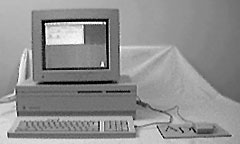
However, people who use computers want more expansion capabilities. The Mac II offered it. This beast had six NuBus slots, eight RAM slots, an FPU, room inside for two floppy drives and 5.25″ hard disks, as well as an external SCSI port and dual ADB ports. It wanted for nothing. Stock configuration was 1 MB RAM, 8-bit video card, 20 MB hard drive.
The styling of the machine was pure Snow White. This made the machine seem very powerful and very businesslike. The case was used on all three of the full-size Mac II series: Mac II, Mac IIx, and Mac IIfx.
The machine did not have built-in video. You had to purchase the video card you wanted with the machine or buy one from a third party source. The card went into one of the NuBus slots. Because of this, the machine could drive any monitor from a 12″ B&W to a million-color 21″ two-page display – it only depended on the video card installed. Also, the II started the Mac’s ability to run more than one monitor at the same time – something Windows machine still cannot do as easily. You could actually fill each of the six NuBus slots with a video card and use six monitors all at the same time! Not bad for 1987!
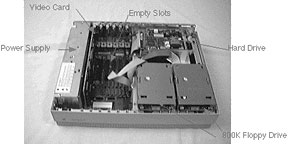 The Macintosh II was a 68020-based machine running at 16 MHz, RAM was 1 MB – 20 MB using standard 30-pin SIMMs, had an optional PMMU, and standard 6881 FPU. Hard disk was 20 MB – 80 MB, and floppy drive was 800K (dual 800K was optional). It was not 32-bit clean. Later Apple offered an upgrade for the 1.44 MB SuperDrive for the Mac II. This changed the ROMs, added a PMMU (Paged Memory Management Unit – for virtual memory use), and 1.44 MB floppy drive(s), and made the machine 32-bit clean. [Publisher’s note: Short of a Mac IIfx motherboard or the use of Mode32, neither the Mac II nor the IIx could be made 32-bit clean.]
The Macintosh IIx used the 68030 processor running at 16 MHz. RAM was 1 MB – 32 MB. The 68030 had a built in PMMU. 6882 FPU was standard. The machine was 32-bit clean. The IIx used standard 30-pin SIMMs. Hard disk was 40 MB – 80 MB. Floppy drives were 1.44 MB or 800K (dual drives were optional).
The IIfx was (is still?) a high powered machine with many hardware additions to create a very powerful system. The CPU was a 32-bit 68030 at 40 MHz that was supported by a 40 MHz 68882 FPU, 40 MHz bus speed (pretty impressive for 1990), 32K L2 cache, and custom I/O Processors for the SCSI, ADB, and serial ports (in part because the IOPs had 32 Bytes of RAM and a 2 MHz 6502 processor in them!).
All of these coprocessors allowed the main CPU to focus on crunching information rather than pay attention to the ports, etc. A benefit of this was that the serial ports could go up to 0.92 Mbit/sec. and the SCSI bus could burst to 4 MB/sec. – faster than any hard drive of the time.
Also included was a 1.44 MB floppy drive (it could handle two 1.44, or 800K drive, or any mix of the two), up to 128 MB of special fast 64-pin RAM SIMMs, stereo output (8-bit at 22 kHz), six NuBus slots, and a PDS connector for direct access to the CPU.
I have this machine with System 7.1 on it, and it is quite fast. RAM was a special 64-pin SIMM because of the wider data path and faster bus. The machine could use 4 MB – 128 MB RAM . Hard drives were 40 MB – 160 MB. Floppy drives were 1.44 MB or 800K, in any combination.
- Machine: Apple Macintosh IIfx
- Processors: Motorola 68030 @ 40 MHz, 68882 FPU @ 40 MHz
- RAM: 4 – 128 MB via 64-pin 80ns SIMMs
- Display: varied depending on video card(s) installed.
- Storage: 1.44 MB 3.5″ floppy (single or dual), SCSI hard drive 40-160 MB
- Expansion slots: six 10 MHz NuBus expansion slots, 1 PDS
- Ports: two ADB, audio out, RS-422 printer, RS-422 modem, SCSI, others depending on installed cards
- Operator input: 81 key or 101 key Apple Extended ADB Keyboard (optional)
- Cost (as shown): $10,000+ ($13,500)
- Production: 3/19/90 – 4/15/92, unknown # of units
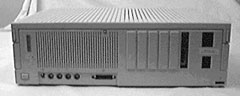 The rear of the machine showing the 6 slots and ports (left to right): power switch, sound out, ADB, ADB, printer, modem, SCSI.
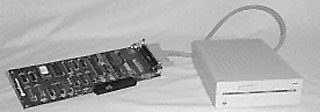 One of the interesting NuBus cards that came out from Apple for the Mac II (and SE) was the PC 5.25″ drive card and floppy drive. This NuBus card/drive combination allowed one to use an IBM 5.25″ disk for data (it could not run IBM applications) using the Apple File Exchange program.
Please note: All photographs and info are copyright 1999 Justin Mayrand – if you would like to copy items, email Justin at Mayrand Computer Services with which one and what you would like to do with it. Thanks!
Justin Mayrand posted the original version of this page to his Acornnet account in 1999. The originals have long since vanished. This page is adapted from Justin’s – images have been reduced to black & white and we’ve done a little editing. dk
