
2006 – What’s the better value, a 2.7 GHz dual processor Power Mac G5 or a 2.3 GHz Power Mac G5 with dual cores? With both currently available refurbished for the same US$2,149 price from the Apple Store, that’s a good question.
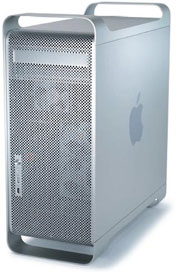 Both machines come with 512 MB of RAM and 16x dual-layer SuperDrives, but from there their specifications diverge. The 2.7 GHz model has two separate CPUs, each with a dedicated 512 KB level 2 cache and sitting on a 1.35 GHz bus. The 2.3 GHz Dual has two cores on a single chip, each with its own 1 MB level 2 cache and sitting on a 1.15 GHz bus.
The 2.3 GHz Dual has a bigger hard drive and a better video card. It also has PCI Express expansion slots, which is a better spec than the PCI-X slots found in the 2.7 GHz G5. And that can be one of the Dual’s drawbacks – there are more PCI-X cards available than PCIe ones at present.
Which Is Faster?
The big question usually boils down to performance, since most Mac users don’t make much (if any) use of expansion slots. Is the dual CPU 2.7 GHz model faster? Or does the bigger cache and dual-core architecture let the 2.3 GHz Dual keep up?
Macworld magazine ran the old 2.3 GHz and 2.7 GHz dual processor Power Macs through Speedmark 4 and compared them with the new 2.0 GHz and 2.3 GHz dual-core G5s. Here’s what they found: Except for Unreal Tournament 2004 frame rate, the 2.7 GHz model is faster than the newer dual-core model even with its PCI Express architecture.
How much faster? On the order of 10-15% faster in general, and roughly 30% faster when rendering video in iMovie HD. (For the record, the dual-core 2.3 GHz G5 edges out the dual processor 2.3 GHz G5 in all tests but one, and that one was a tie.)
So if you’re looking for raw horsepower, the Power Mac G5/2.7 GHz dual processor model beats the Power Mac G4/2.3 dual-core model. If you’re looking for the best gaming performance, however, the new dual-core G5s get the nod.
Update: Geekbench tests CPU performance and memory bandwidth. The 2.7 GHz Power Mac G5 scores 2259 in Geekbench 2, while the dual-core 2.3 GHz Power Mac G5 hits 2082. That’s only an 8.5% difference in performance. Further, the liquid cooling in top-end dual-CPU G5 Power Macs tends to be troublesome, giving another reason to consider the dual-core model.
But it’s not as simple as performance. Expandability is a huge factor for some users, and that’s where we find the biggest difference between the older dual processor Power Macs and the newer dual-core ones. PCI Express is a superior expansion bus, but it does you no good if you already have PCI-X cards or the card you want is available for PCI-X but not yet made for PCIe.
Looking forward, PCIe will displace PCI-X, just as it displace PCI on all but the entry-level Power Macs when Apple moved beyond the G4.
So while the 2.7 GHz dual processor G5 wins on raw processing power, if there’s any chance you’ll be adding a PCI-X or PCIe card to the system, that may be a bigger factor than 10-30% more horsepower. And that’s a call you’re going to have to make based on your current circumstances and future plans.
Keywords: #powermacg5
Short link: http://goo.gl/PDvUvf
searchword: powermacg5comparison
