
1997 – I’ve been using Macs since 1986, when I designed a 54-page booklet on a friend’s newly upgraded Macintosh (upgraded to a Plus with 1 MB RAM!) with Aldus PageMaker 1.0 and a LaserWriter printer. I sold Macs from 1987 to 1991, seeing the introduction of the first expandable Macs (SE and II in 1987), the first consumer Mac (LC), the first totable (Portable), and the first PowerBooks.
Since 1992, I’ve been working with Macs, first as a book designer (using Quark XPress and FrameMaker) and assistant troubleshooter, now as an information systems manager. I’ve known Macs from all sides: as salesman, owner, user, support person, and evangelist.
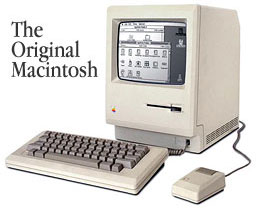
The Macintosh began with a great idea that was slightly ahead of its time and technology. It has grown into the best personal computing platform on the planet and remains a hop, skip, and jump ahead of the Wintel world.
Apple makes a great operating system. They and the Mac cloners make great hardware. But Apple keeps losing its focus, making too many models and tying up too much money in dated inventory.
If I ran Apple computer, at least the hardware division….
Apple would have four desktop cases: a compact case with room for hard drive, floppy, CD-ROM, and one more drive (Zip, Jaz, optical, whatever); two midrange cases (desktop and minitower) with two accessible drive bays and 2-3 PCI slots; and a power tower with room for 5-6 PCI cards and six or more drives.
Each case would remain the same for several years, allowing Apple to recoup the investment in design and production – and allowing Apple to have three standard motherboards, making complete motherboard upgrades possible. (This strategy worked well with most Apple case designs. This strategy was not employed with the IIsi, one of Apple’s few orphan cases.)
Every motherboard would have a removable, user replaceable CPU, preferably in a ZIF socket. Standard on all models: 10Base-T ethernet, 2 ADB ports, 2 GeoPorts, external SCSI connector, at least one expansion slot. Design of case and motherboard would make provision for FireWire in the future. [Publisher’s note: The first Mac with FireWire, the Blue & White Power Mac G3, didn’t ship until January 1999, nearly 1-1/2 years after this article was published.]
The power supply could be external. There would be provision for a battery, giving each user the option of a very inexpensive UPS. Actually, better than a UPS since power for the internal components wouldn’t have to be converted to AC, then back to DC. (You’d still need to convert output to AC for the monitor.)
Every model would power up from the keyboard.
Each and every computer would be available stripped. The stripped computer would include the case, the motherboard, the power supply, and the Mac OS. No CPU. No RAM. No floppy drive. No CD-ROM. No mouse. No keyboard.
Reasons for this:
- Users of older Macs could transfer drives (but probably not RAM) to new computer.
- New buyers could add components as needed. (After all, the Macintosh really is plug-n-play.)
- Power users could customize to their needs: larger, faster hard drives; one or more CPUs, etc.
- Businesses could install only needed components.
- This gives the security conscious an option for a Mac without a floppy drive.
- Apple doesn’t have to project what combination of RAM, hard drive size, CD-ROM speed, VRAM, etc. the end user might want.
- This would make it easier for Apple to run a fire sale on 4x CD-ROMs, 1.2 GB hard drives, and other items that don’t seem competitive this year.
- This makes room for third party components, probably increasing the hardware market by promoting the idea of upgrades.
- This gives dealers more potential profit, keeping them in business to continue selling the Macintosh way.
Power Macintosh V-series
The V-series (V for victory, vintage, VIC-20) would be reminiscent of the Commodore VIC-20 and 64, an integrated computer/keyboard. (Remember when the computer contained a keyboard?) Size would be as close to that of the Extended Keyboard as practical. It would use an eraser-head TrackPoint pointer like IBM’s ThinkPad. It includes an ADB port for a mouse, two GeoPorts, and a Comm Slot II. Built-in hard drive. Possible bay on one end for floppy, Zip, PC Card cage, etc. This would be targeted as the cheapest Mac made, even if that means using a lowly 200 MHz CPU.
With ethernet and a fast modem option, this could be the NC (network computer) everyone wants. Also perfect for computer labs.
Power Macintosh C-series
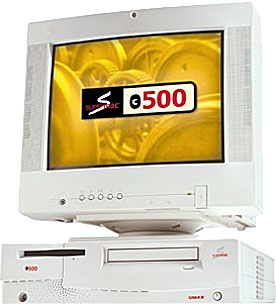
Umax SuperMac C500
The C-series (C for compact, convenient, consumer) would have a case much like the Performa 6300 or Umax SuperMac C500, but with room for an internal Zip drive. I like the “works in a drawer” concept of the 6300, but price is a consideration. It should have a built-in comm slot for an internal modem. No PCI slots.
Power Macintosh M-series
The M-series (M for middle) would be based on a modified Power Mac 7300. The current case comfortably holds a hard drive, floppy, CD-ROM, and one additional 3.5″ device (Zip, internal drive, etc.). Room for another device would be nice, especially if it could be a 5.25″ bay. Possible devices to fill this slot include DVD, CD-R, SyQuest, Jaz, SyJet, DAT, and optical drives. Basic case could be same size as current case, rearranged with second 5.25″ bay above CD-ROM and floppy drive moved over current 3.5″ bay.
Power Macintosh E-series
Okay, you can’t forget the education market. If they don’t want the separate CPU and monitor of the V-series, this replaces the 5000-series using the same motherboard as the C- and M-series with a 15″ multisync monitor.
Power Macintosh T-series
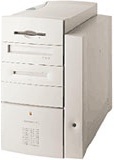 The T-series (T for tower) would accept the same motherboard as the M-series. The only significant difference is the tower case, perhaps similar to the Beige G3 minitower.
Power Macintosh X-series
The X-series (X for experimental, extreme, exceptional, just plain fast) would be based on the 8600/9600 case. Room for 6 PCI cards and several internal and front-accessible drives. Why mess with a good thing?
Apple has shown incredible foresight with the Power Mac G3 and the G3 motherboard. Cases are about what I propose for the C- and M-series, with the motherboard identical in each. The motherboard will support a 466 MHz PPC 750 on a 66 MHz bus – and more bus speed in the future.
Design things right and Apple could offer several options: one or two chassis per motherboard, several CPU options. Chic or geek, platinum or black, desktop or tower.
