
1986 marked the replacement of Mike Murray as head of marketing with Jean-Louis Gassée. Gassée started Apple’s French division and drove it in a few years to become one of the most successful divisions in Apple. Unlike Steve Jobs’ vision of an information appliance, Gassée hoped that the Macintosh would turn into an open platform that would be easily expanded and developed for.
- Macs Get Slots: The Mac SE and Mac II
- A Faster SE, a Smaller Mac II
- A/US, Apple’s First Unix
- The Mac Portable
- Lisa Trashed
- Knowledge Navigator and Pocket Crystal
Macs Get Slots: The Mac SE and Mac II
Apple introduced two new models in March 1987. Both models shipped in Apple’s new “platinum” gray and their cases included “Snow White” design features (see my previous article for more on the Snow White Language). They also had an improved version of SCSI.
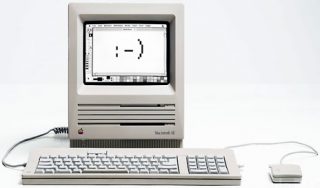 The Macintosh SE was an upgraded version of the Mac Plus. It was the first compact Macintosh that didn’t feature the signatures of its creators inside the case. Its most important features were the inclusion of a processor direct expansion slot (PDS) and space for an internal hard drive or a second internal floppy drive.
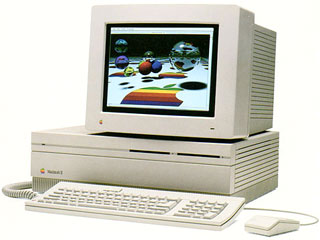 The first “open” Macintosh was the Macintosh II, which had six NuBus expansion slots. The computer was expandable, but unlike the SE (which used a proprietary PDS slot), the Mac II used a standard slot, the NuBus architecture from Texas Instruments. Developed by MIT in the late 1970s, NuBus was to be part of a next-generation workstation called NuMachine. The workstation was never released, but NuBus was licensed to Texas Instruments.
Unlike the popular ISA (Industry Standard Architecture) slots used by PCs of the era, NuBus was completely 32-bit compatible. The architecture was also easier to develop for. Many other standards required that the programmers manually assign static amounts of resources to each card, but NuBus cards were capable of doing it on the fly. Though it was technically advanced, the standard was only adopted by two companies, Apple and NeXT.
Besides the NuBus slots, the Macintosh II was innovative in other ways. It was the first Mac capable of driving a color display and the first to use the new Motorola 68020 processor that was able to address much more RAM than the 68000. Unlike the SE, which could only be upgraded to 4 MB of RAM, the Mac II could be upgraded to 68 MB, although users had to wait for higher density memory to reach that level.
All of these features were crammed into a large (18.7″ wide, 14.5″ deep, 5.5″ high) case, another Macintosh first. The case had an advanced cooling system that funneled air out the sides and through the floppy drive. This made it impossible to tip the Mac II over on its side and use it as a tower unless you elevated it.
Two later model that used the same enclosure, the IIx and IIfx.
A Faster SE, a Smaller Mac II
Named in part for the processor it used, the SE/30 (January 1989) was an SE with a 68030 processor, the same CPU found in the Macintosh IIx. It had a 1.4 MB SuperDrive (the floppy SuperDrive became standard on the original SE in August 1989), and its display was capable of drawing in grayscale, although that required a special PDS video card. (The 68030 PDS was incompatible with the 68000 PDS found in the SE.) The SE and SE/30 also refined the SCSI interface, which was now faster and more stable.
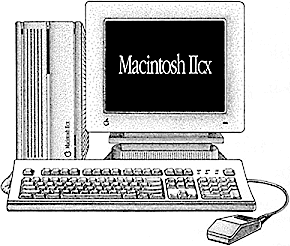 The first Mac with a minitower design was the Mac IIcx, which was essentially a three-slot Mac IIx. The machine had detachable rubber feet that allowed it to be used horizontally (as a desktop) or vertically (as a minitower). It was very popular and was the best selling Macintosh of the year.
A/UX, Apple’s First Unix
Apple started porting Unix System V to the Macintosh to take advantage of the power of the Mac II. It was not the first version of Unix available for an Apple computer (Microsoft’s version of Unix, Xenix, was available for the Lisa), but it was the first one to be integrated with the Mac OS.
Instead of an ordinary window manager like CDE, Apple ported the Finder to A/UX and made the Macintosh Toolbox available to application developers. This allowed them to create Unix apps that looked like Mac apps. Apple released this new Unix, called A/UX, in 1989. It was not meant as a consumer OS, and it cost Apple hundreds of thousands of dollars to license the Unix name and code. Apple sold A/UX for slightly less than US$1,000 and only bundled it with one computer, the Workgroup Server 95 (1992).
After many complaints from software developers, Apple stopped developing non-OS programs using the Apple brand. All other software products were spun off into a new division called Claris. Claris released “Pro” updates to the popular MacWrite and MacPaint software and began developing an office suite that could challenge Microsoft in the market. Scared to lose Microsoft as a developer, Apple priced the suite out of reach of most consumers.
The office suite never caught on, but another product that Claris released was ClarisWorks, which required System 7.
Originally devised by two developers as an alternative to the clunky integrated suites available from Microsoft and Beagle Bros., what would become ClarisWorks was acquired from StyleWorks (the company had previously developed GSWorks for the Apple IIGS) and rechristened ClarisWorks.
ClarisWorks was unique because of its integration. Other integrated suites bundled three or four programs that were not very integrated but were sold as a package. ClarisWorks, like many desktop publishing apps, worked on the idea of frames. A user could start a blank document and include spreadsheet elements, bitmap images, and word processing without using another program.
The Mac Portable
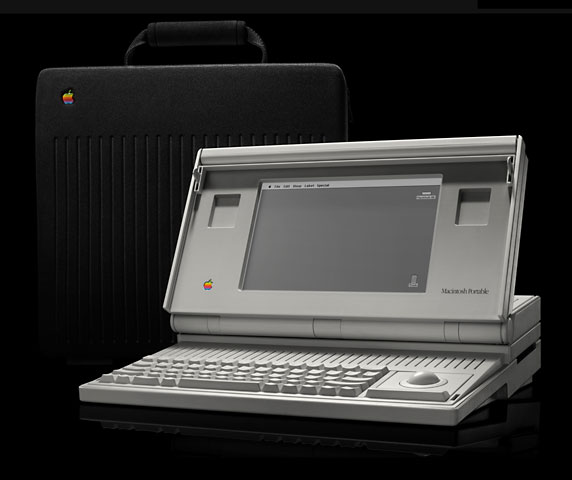 Released at the same time as the Mac IIci (an upgraded IIcx with onboard video), the Mac Portable was Apple’s first totally portable machine. The earlier Apple IIc (see my previous article) was available with a battery and LCD display, but they were not included with the basic model.
With a 16 MHz 68000 processor, the Portable was the fastest machine from Apple to use the 68000 processor. Unlike DOS based laptops, which might have CGA (320/640 x 200) or VGA (640 x 350) graphics, the Mac Portable had a high resolution 640 x 400 active-matrix display and an integrated trackball, which could be swapped out for a numerical keypad. The trackball could even be positioned on the left for left-handers.
Unlike its PC competitors, the Portable did not use a NiCad battery – it used a lead-acid battery, like those used in cars and motorcycles. This gave the computer an unheard of 12 hours of battery life. One drawback of the design is that it cannot run from its AC adapter; it needs a battery with a charge or some re-engineering.
In order to fit all of these features into a portable enclosure, the Mac Portable was much heavier than comparable DOS machines. It weighed nearly 16 pounds, was 4″ deep, and cost US$6,500.
It failed to sell well.
Lisa Trashed
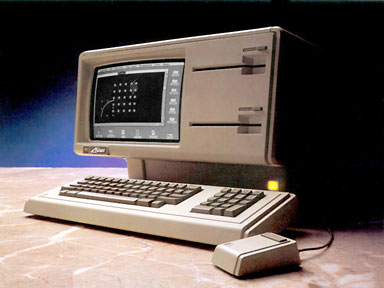 Apple had released the Macintosh XL in 1985 as a way to sell surplus Lisas. It had a very high resolution 12″ display (720 x 364 vs. the Mac’s 9″ 512 x 384), more RAM (512 KB, upgradeable to 2 MB), and an internal hard drive. The XL did not have a built-in Mac ROM; instead, it used a software package called MacWorks XL, which emulated the Mac OS on top of Lisa hardware (like the Macintosh Application Environment).
The Macintosh XL was very unsuccessful, in part because Lisa was only a 5 MHz computer to begin with. Introduced in January, it was discontinued in April. Apple sold its stock of XLs to Sun Remarketing, who changed the machines into Macs. By 1989, Apple decided to buy back all of the machines and bury them in a Utah landfill.
Knowledge Navigator and Pocket Crystal
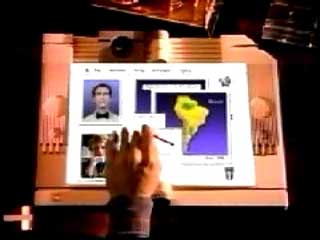 Apple had two other portable projects underway. The first was called Knowledge Navigator, and the other was called Pocket Crystal.
Knowledge Navigator (video links below) was meant to be a replacement for the personal computer. Instead of manipulating a contemporary user interface, a user would consult an assistant. The assistant would be connected to a global network and manage email, news, and any other information the user wanted.
Pocket Crystal was a personal communicator similar to PDAs. It would use a system called TeleScript, which allowed messages to perform actions. They could pull fresh information from a server to ask a question or anything the developer could think up.
Both of these projects would eventually bear fruit. The Knowledge Navigator’s scope narrowed, and it became the Newton. The Pocket Crystal was spun off (Apple executives feared that it would gut Newton sales) and was eventually marketed as Magic Cap by General Magic.
Links, Apple Knowledge Navigator
- Knowledge Navigator, Wikipedia
- Knowledge Navigator video, Jim Lengle, Boston University, small, medium speed connection
- Knowledge Navigator video, Digibarn, 61 MB download
Other Links
- Jean-Louis Gassée, Wikipedia
- Xenix
- Claris, Wikipedia
- ClarisWorks
- Sun Remarketing
- Lisas buried in a Utah landfill
- Newton, Wikipedia
- Magic Cap
Bibliography
Some of the sources used in writing this article:
- Apple: The Inside Story of Intrigue, Egomania, and Business Blunders, Jim Carlton
- Infinite Loop, Michael Malone
- The Second Coming of Steve Jobs, Alan Deutschman
- Apple Confidential 2.0, Owen Linzmayer
- Odyssey: Pepsi to Apple . . . a Journey of Adventure, Ideas & the Future, John Sculley
- Wikipedia
keywords: #macse #macii #macse30 #maciix #maciicx #maciici #macportable #claris
short link: https://goo.gl/2zanW8
