
2007 – Just before the Intel transition began, Apple was having a problem with their notebooks. No, I’m not referring to the lack of a G5-equipped PowerBook, but to the parity that was shared between the consumer and professional models.
Despite Apple categorising the two notebook lines, iBooks and PowerBooks, as being worlds apart in the tasks they were designed for, the truth was somewhat different. The PowerBooks of 2005 offered a G4 processor, Bluetooth, built-in wireless networking, and 512 MB of RAM. The iBooks of 2005 offered all these things as well. The result was a professional model that potentially cost hundreds of pounds more, yet you weren’t really getting that much extra for the price.
Sure, you did get an aluminium case, a larger screen and hard drive, and a better graphics card. My point is that the difference was tiny compared to when the original 12″ 300 MHz clamshell iBook was released in 1999 as a complement to the 14″ 333-400 MHz PowerBook G3.
This situation was starting to become embarrassing by 2003, as a lack of a G5 PowerBook would mean that every subsequent G4 iBook upgrade would bring it closer to being just a white PowerBook. Apple was running out of features to leave out.
I believe this was one of the compelling reasons behind the switch to Intel – a new scalable architecture that would allow Apple to redress the balance between consumer and professional notebook lines.
In January 2006, Steve Jobs introduced the first MacBook Pro, the Intel-based dual-core replacement for the underpowered 1.67 GHz PowerBook G4.
The Intel iBook
It was obvious to everybody that Apple would soon be releasing an Intel-equipped replacement for the iBook, and I had my own thoughts as to what form this would take. There had been rumours of a widescreen iBook circulating in late 2005, substantiated by Asustek (Apple’s notebook manufacturer) prepping their plants to accommodate such a device. As such, I was sure that the new Intel iBook would include a widescreen of some sort. It would also be in the same white polycarbonate case as the iBook to maintain the consumer styling.
The Intel Core Solo would be the CPU of choice, as this had just made an appearance on similarly placed PC notebooks and was an improvement on the G4 chip, yet this would avoid encroaching on the dual-core power enjoyed by the MacBook Pros.
I felt that Apple would include the Front Row remote, as this was fast becoming a standard across the entire Mac range, but the iSight webcam would not be included, as this would add expense to the model and negate another advantage of the MacBook Pro.
It would retain all of the ports of the previous iBook, including sticking to a mini-VGA interface as opposed to DVI, and it would adopt the new MagSafe power connection. DVD burning would still be a feature, but without the dual-layer capability of the MacBook Pro, again to help keep a technological distance between the two ranges.
Enter the MacBook
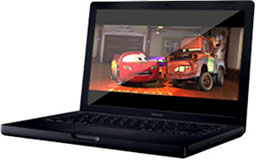 The reality was somewhat different. When I first saw the specs of the original MacBook a year ago, I was dumbstruck. It totally eclipsed the machine that I had envisioned – as well as adding a few features that would have been impossible for me to anticipate. The MacBook retains most of the features from the Pro model, with the only significant omissions being screen size (which was to be expected) and a graphics card (less forgivable). Apple were even innovative enough to include a high-end black model, which became the subject of many Internet articles regarding its stunning looks and controversial pricing (the “black tax”).
I have just purchased a black MacBook, and overall I’ve been more than impressed. Compared to my previous 2004 17″ PowerBook, the performance increase has been huge. With a fully loaded OS X 10.4 Tiger installation and just 512 MB of RAM, I had become accustomed to seeing the spinning beach ball frequently during use. With the advent of this MacBook, I now rarely see it – and it’s not just because of the 2 GB of installed RAM.
The MacBook’s architecture runs rings around the PowerBook, and pretty much anything I ask the MacBook to do, it does without leaving me waiting. The Dashboard zooms into view instantly whenever I summon it, no matter how much I have going on at the time, FFMpegX encoding speeds are possibly double that of the PowerBook, and my frequently used apps, such as iTunes and Opera, load with just a couple of bounces in the Dock. Add to that the fun of Photo Booth and the built-in iSight.
Better still, with VMWare I can run my favourite flavour of Linux, Kubuntu, in a window within OS X without having to partition my hard drive. And it runs at near native speeds.
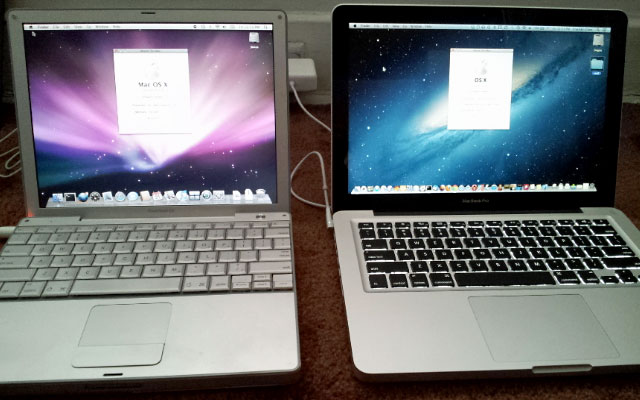
12″ PowerBook G4 and 13″ MacBook Pro (image by Franklin Chen)
Sure, I have sacrificed a few inches of screen space, but I think I prefer a smaller notebook. As much as I loved it, my old 17″ PowerBook G4 was something of a drag for me to lug around; it was a heavy and slightly unwieldy beast. The MacBook reminds me of the 12″ PowerBook – a beautiful tiny Apple machine – but without its lack of screen space. The screen is much brighter as well; before I sold on my 17″ model, a side-by-side comparison showed the MacBook to be significantly brighter.
All in all, I’m left with a notebook that feels so much more than a cut down consumer version of the MacBook Pro.
Two Nits to Pick
Okay, I do have a couple of gripes. The video system is lacking, I don’t see why Apple couldn’t include a 64 MB dedicated video card, still not a match for the MacBook Pro but better for games than the Intel GMA 950.
The jury is still out on the keyboard design; at the moment, it doesn’t seem to feel quite as comfortable to use as the one on the PowerBook G4. I’m hoping this will pass the more I use it.
Overall the MacBook is an awesomely designed consumer portable, and anyone considering a notebook upgrade should not dismiss it because it’s supposedly of consumer grade, not even if you are what Apple would consider a “professional user”.
Don’t underestimate the power of the MacBook; it’s more than meets the eye!
Keywords: #macbook #13inchmacbook
Short link: https://goo.gl/OnMfL5
