
Since Brazil didn’t allow the import of microcomputers until 1993, anything users wanted had to be made in and for the local market. For those who wanted a Macintosh, Unitron created the Mac 512, essentially a clone of the 512 KB “Fat Mac”.
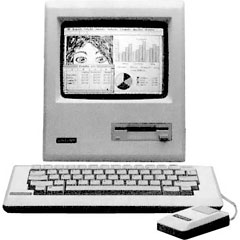
Unitron Mac 512, the first Macintosh clone.
Rainer Brockerhoff from Brazil writes, “It’s a long story, but here are the highlights. Facts are as they were told to me at the time, but I’ve no way of verifying the political parts.
“The clone was made around 1985 by Unitron, a Brazilian company that had a very successful line of Apple II clones. Initially the plan was to make a Brazilian Mac under license from Apple; however, Apple would not accept less than a 51% share of the operation, which at that time was specifically prohibited by Brazilian law.
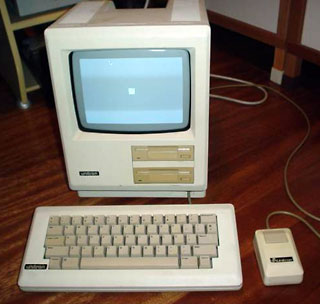
Unitron Mac 512 with two floppy drives.
“Unitron went ahead anyway, getting a $10M loan from a government bank, and, with help from university laboratories and National Semiconductor, they succeeded in reverse-engineering the ‘custom’ Mac chips: the diskette controller (which was simply a one-chip version of the Apple II controller board), the real-time clock, and the PAL chips.
“At the same time, a software team reverse-engineered the ROM, based on the ‘Inside Mac’ specifications. I was a consultant for that team and eventually did most of the Toolbox managers . . . everything was coded in C, except for some critical device drivers and the QuickDraw emulator which were done in Assembly language. As a result, the resulting ROM was originally double the size of Apple’s . . . in fact, in the final shipping version it was substituted by static RAM, which was loaded from a special pre-boot floppy.
“Meanwhile Apple had somehow obtained an early hardware prototype which still contained an actual Mac ROM, used for compatibility testing of the chips. They promptly cried foul and pressured the Brazilian government through the State Department. Faced with threats of import barriers for Brazilian shoes and oranges (so they tell me) the government quickly backed down. At the time, a special license was required to manufacture computers in Brazil. The Unitron seems to be the only case where two contradicting reports were filed by the official appraisers: a technical report which lauded the project as a sterling example of reverse-engineering and technical ingenuity and a political report which denounced the project as a contemptible theft of trade secrets.
 “Needless to say the project was canceled – over 500 machines had already been made and were ready to ship – and Unitron took a serious financial hit (they’re still paying off interest on that loan).
“The chip designs were later sold to a Taiwanese company which also made noises about producing a Mac clone. There was a write-up in Byte magazine at the time, but I can’t find their name right now. The lawyers descended on that company, too, and they weren’t heard from again.
“The chip designs were later sold to a Taiwanese company which also made noises about producing a Mac clone. There was a write-up in Byte magazine at the time, but I can’t find their name right now. The lawyers descended on that company, too, and they weren’t heard from again.
“Unitron was subsequently downsized. Today they make industrial electronic equipment and still produce small numbers of Apple II clones, which apparently are still used as stage lighting controllers and similar stuff.”
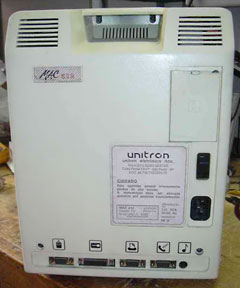
Another version (later?) didn’t use the Motter Tektura typeface.
There are claims that Unitron did not reverse engineer Apple’s ROMs, but instead cloned the ROMs with a few minor changes. These claims are probably based on the prototype the contained Mac ROMs and was used for compatibility testing. The Mac 512 had 128 KB of ROM, twice as much as the Fat Mac.
Rainer notes that the ROM code was written in a mix of C and assembly language.
Details
These specifications are based on the fact that the Unitron is a clone of the Fat Mac.
- introduced 1985; discontinued
- works with any system through 4.1
- CPU: 8 MHz 68000
- performance: 0.8 (relative to SE); 0.7 MIPS
- ROM: 128 KB
- RAM: 512 KB
- 9″ b&w screen, 512 x 342 pixels
- keyboard attached via coiled telephone-like cable
- mouse attached via DB-9 connector
- DB-9 serial ports
- floppy: 800 KB single sided Chinon drive with eject button
- floppy connector on back of computer
- size (HxWxD): 13.6″ x 9.6″ x 10.9″
- weight: about 18 lbs.
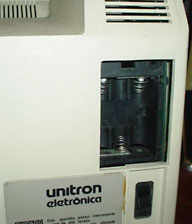
- PRAM battery: 3 AA
- Gestalt ID: unknown, probably 1 like the Mac 128K and 512K
- addressing: 24-bit only
Further Reading
- Meet the Unitron Mac 512 – the World’s First Macintosh Clone, Adam Rosen, Cult of Mac, 2014.02.21
- Unitron Mac 512, Benj Edwards, Macworld, 2013.01.13
- Unitron Mac 512 (rough English translation by Google Translate), Blog do Chester, 2004.03.14. Chester gets his hands on the rare Unitron Mac 512 and gets it up and running.
- Conheça Unitron Mac 512 a primeira cópia de um Macintosh (rough English translation by Google Translate), GameVicio, 2010.12.05.
- Mac 512 Unitron, Tabajara Labs. Numerous exterior and interior photos.
- Unitron Mac 512, Old-Computers.com.
- Unitron Mac 512, Merlintec Computers.
Keywords: #macclone #unitron512 #unitronmac512
Short link: http://goo.gl/6azDZJ


