
Dan Bricklin (born 1951) codeveloped VisiCalc with Bob Frankston in the late 1970s while he was a student at the Harvard Business School. VisiCalc is widely credited for fueling the rapid growth of personal computers in business. He is currently president of Software Garden, Inc., a small consulting firm and developer of software applications that he founded in 1985.
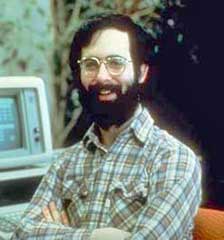
Bricklin started programming in FORTRAN in the mid 1960s while still in high school. He attended college at MIT, receiving a BS in Electrical Engineering/Computer Science in 1973. There he worked at the Laboratory for Computer Science, where he met Bob Frankston. After MIT, Dan worked at Digital Equipment Corporation (DEC). He was project leader of the WPS-8 word processing software. In 1976, he left DEC and worked at FasFax Corporation. In 1977, he returned to school, this time receiving an MBA from Harvard in 1979.
It was during his tenure as a graduate student that he conceived the idea and design for the electronic spreadsheet, teaming up with his friend Bob Frankston to do the programming. Together they founded Software Arts, Inc., in 1979, where Dan served as chairman from 1979 to 1985. The product they produced, VisiCalc, is credited with being one of the main catalysts that brought about the rapid growth of the personal computer industry.
LEM: What did you work on before VisiCalc?
Dan Bricklin: At MIT, among other things, I implemented two versions of an APL system for the Multics system, once as a junior member of a two person team and then once as head of a total rewrite with a few more people. (Multics was the major precursor to Unix.)
At DEC, I worked on a video editing system for computerized typesetting, and then was project leader of the implementation of their first word processing system around 1975. Next I worked on maintaining and upgrading a microprocessor-based cash register system used in the fast food business. Finally, I went to Harvard Business School where I came up with the idea for VisiCalc.
LEM: When you thought of VisiCalc, did you think it would be as successful as it was? Or was it just meant to be a small project?
DB: I hoped it would be very successful, but the idea that there would be a computer on every work desk was something we all knew should happen – but given the slow acceptance of computers for everyday use in the office over the years, we knew such penetration had many barriers, and we had to be “practical” in out thinking.
I mean, I’ve been told since I was a child in the 1950s and early 60s that within ten years we’d have TV sets we could hang on the wall. That didn’t become a reality to most people until just the last year or two – over 40 years later.
I knew using VisiCalc was an obvious thing for most of business as I was taught it, but then word processing was also obvious, and it was taking off very slowly. You hope for big success (if you don’t think your product is that important, why do it?) but try to be practical just in case.
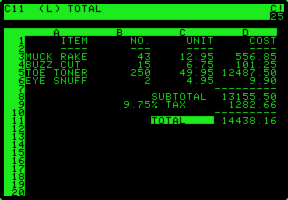 JC: Who had the task of showing VisiCalc to Apple? I’ve read that Steve Jobs was shown a floppy disk that read “this is going to be a revolution” on the label?
DB: That story, if true or not, will have to come from Dan Fylstra, our publisher. Bob Frankston and I were not involved in the relationship with Apple until well after the Apple II version shipped. Apple was not involved in the design of the product at all in any direct way, other than we were first implementing on their hardware.
The main special thing about the Apple II was that it was easier to buy floppy drives for it at the time than their competition. From a software viewpoint for a product like VisiCalc, the TRS-80 and PET and upcoming Atari were just variations, and we could have coded for them first if Personal Software had wanted.
LEM: Did you and Bob Frankston ever plan to publish VisiCalc on your own under the Software Arts name? Why did you go with Personal Software, Inc. instead? Did you ever think Apple would be interested in publishing the VisiCalc?
DB: We knew the people at Personal Software and, as a software company, were aiming for more than one manufacturer. Personal Software helped fund our development and understood the product’s value. They also were heavily involved in all aspects of the marketing and sales, in which we at Software Arts played a quite secondary role.
The idea of independent software companies (independent of hardware manufacturers) was the way things worked back then in the mini and mainframe world. While we were two companies (Software Arts and Personal Software), together we had all you needed and more or less could be viewed as one company from outside at that point. The natural thing would be for us two to merge, and we very soon started looking into that, but for various reasons that never came to be, and we each developed capabilities in the area of the other. Our contract with Personal Software pretty much kept us out of publishing it under our own name until we ended it years later.
LEM: Why did Lotus 1-2-3 outsell VisiCalc?
DB: It was a better product for the IBM PC and was marketed better at the time. For various reasons, we (Software Arts and Personal Software) could not compete quick enough with it. We had a great product in VisiCalc Advanced Version, but it only ran on the Apple III and later the Apple IIe.
LEM: Did you have any involvement with VisiOn and VisiOn Calc?
DB: No.
LEM: What did you do after VisiCalc?
DB: I started a one-person (later two-person) company named Software Garden and developed Dan Bricklin’s Demo Program. It was used for prototyping character-based software (think “IBM PC”, green screen 3270s, etc.) as well as for training and sales. It was quite popular, winning awards, etc. Many software people know me only for Demo (and later Demo II and Demo-it). I also wrote a printing utility called PageGarden.
Later I helped found Slate Corporation, which developed software (including a pen-centric spreadsheet) for GO’s Penpoint, Microsoft Windows, and the Apple Newton. Those machines didn’t sell, so that company had few customers.
Later I founded Trellix Corporation, which developed Web authoring systems, both client-based and later server-based.
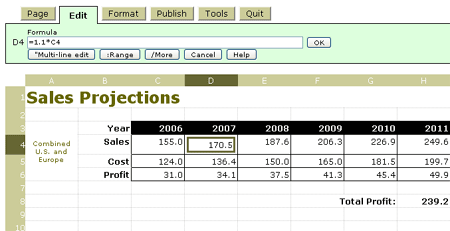 I’m back now at Software Garden doing consulting and writing various Open Source programs, including ListGarden (an RSS creator) and wikiCalc. They both run on multiple platforms, including Windows, Linux, and OS X. I also produced a training video I sell called “A Developer’s Introduction to Copyright and Open Source”.
LEM: Google have recently developed an online spreadsheet. What do you think about this? Is online software the way ahead?
DB: Online software is already very important. It is the main way we do search and a lot of commerce. It is a major way people do email, etc. Google has apparently been buying the basis of their products for text authoring and other such apps (Writely, their spreadsheet, Jotspot) and seeing where they could go with them.
I think most software companies are looking into how online software fits into most product areas. However, a powerful client platform is important. A browser that can run something like Google Spreadsheet or YouTube or even most any nice looking Web page with lots of CSS formatting is a quite sophisticated piece of code running on hardware much more powerful than most anything anybody had even in a datacenter years ago.
I’m sure we’ll continue to find some applications that work best being hosted on the client, but more and more applications need some or all of what they do to be online.
LEM: At the moment you are working on wikiCalc. Do you think this is going to be as big as VisiCalc was in the 70s and early 80s?
DB: VisiCalc was the “killer app” that got many people to buy personal computers. There is no way wikiCalc will be the one reason that will get people who don’t have a reason to have a personal computer to buy one today. wikiCalc is not so much a new class of software as VisiCalc was (after all, in many ways it is just some sort of combination of wiki and spreadsheet, as its name implies).
wikiCalc is important because it is Open Source, so people can run it on their own machines, experiment with it, and even contribute to its improvement. It is a test bed for experimenting with online spreadsheet ideas, including working both client-side without a persistent Internet connection as well as only server-side or a mixture of the two. VisiCalc had probably a little less than a million users. In today’s world, who knows how many people will use wikiCalc. A million isn’t that many. Even my Demo program, as a runtime for demos and training, was “bigger” than VisiCalc in terms of number of users, as was some of the Trellix products.
LEM: Do you think there will ever be another killer app like VisiCalc that has such a huge impact on the computer industry and the world as a whole?
DB: Every few years some new software product comes out that has a huge impact. Desktop publishing, email, Internet routing, browsing, Google-style search, user content like blogging/YouTube/podcasting, MP3 playing (and ripping) software. There’s no reason for that to stop.
LEM: Thanks for your time.
Further Reading
- Dan Bricklin’s Web Site
- Dan Bricklin, Wikipedia
- VisiCalc and the Rise of the Apple II, Tom Hormby, Low End Mac
- wikiCalc
Short link: http://goo.gl/T1sQA1
searchword: danbricklin

Pingback: VisiCalc, la primera hoja de cálculo electrónica | unocero