Low End Mac
Search LEM 
Donate · Amazon.com · MacResQ · Advertise
Other Cobweb sites: Low End Living · Reformed.net

Quicklinks: · Power Macs · 'Books · Early Macs · Week's Best Deals · Best Buys · OS Downloads

iBasics

Speed Up Internet Explorer

Low End Mac Reader Specials

Memory To Go Special: MacPro 8 Core Memory 4GB kit $192 / 2GB kit $109. MacBook Pro / MacMini / iMac Intel Core2 DUO 2GB $44 1GB $23--Free shipping available.

Download Typestyler, still the Ultimate Styling Tool for Internet, Print and Video Graphics. Works great in Classic with a Native OS X Version on the way. Free Tryout: www.typestyler.com

LA Computer Company: LA Computer Company: Specials on AppleCare, Apple Displays, MacBooks, iMac's, MacBook Pros, Laptop and iPod accessories and more. Apple A/C Adapters for laptops starting at $25.00 Call 1-800-941-7654 or Click Here.

Other World Computing: OWC Mercury Elite FW800/FW400/USB2/eSATA TOP-RATED Solutions offer High Performance, Reliable storage for all your data storage needs. Industry leading 2yr limited + up to 5yr HD Mechanism Warranty too! Up to 2.0TB(2000GB), 500GB specials from $199.99

Mac users can finally play Party Poker for Mac. Not only that, they can also learn how to play PokerStars for Mac.

Laptop Hardware Provided by TechRestore - Overnight Mac & iPod Repairs.

Compare products like desktop computers, laptops, and LCD TVs side by side! All the information and reviews to make the best purchasing decision for a new cell phone GPS products or MP3 players. The Ciao network makes searching products easy for you.

NEW MacPro Memory 800Mhz With Apple Spec Heat Sink 2GB Kit $104 / 4GB Kit $184 / 8GB Kit $362 Click to Maximize your Macs...

- 2001.02.21

Since the release of version 5, Internet Explorer became the Mac world's number one browser, with many Netscape users dumping the Navigator or Communicator 4.x in order to get Microsoft's latest offering. In any case, Explorer is very popular in the Mac crowd, and a few of you may want to maximize its performance. Here are tips to achieve this.

Make it breathe

First off, you need to know that the amount of memory that you allocate to an application is likely to play a role in its overall performance. The more memory you give it, the more breathing space you give it when it has to face demanding tasks. In this spirit, you should allocate Explorer more memory than its default amount. How much? The more the better, as long as you can afford it. I would recommend giving it between 20 MB to 25 MB. Those are reasonable amounts to make things work better. More than 25 MB may not give tangible results.

To do it, find the application's icon in the Internet Explorer folder, and click on it once. Make sure to quite IE before doing it! Go to the Finder's menu bar and highlight Get Info, and select the Memory submenu. You can do the same via contextual menus (control-click and selecting Get Info --> Memory). It should give you this window.

About Internet Explorer

Once you do that, you need to increase the number in the Preferred Size field. The number is in kilobytes, and it takes 1024 of them to make a megabyte (MB). Grab a calculator and decide how many megs you want to allocate. Say that you want to allocate 20 MB. Twenty times 1024 equals 20480, and all you have to do is to type that as the Preferred Size.

The cache

In Explorer, the cache is the file where the browser stores the information for the Web pages you visit. It saves them there, retrieves them from there when you go back to pages in the same session, and retrieves information from there if IE finds out that a page or an image hasn't been updated since the last visit.

As a result, this use and "consultation" of the cache can slow you down if the cache is not stored at the right place. To make it short, your cache will perform as fast as the place where it is stored. You have two choices. You can store it in RAM, or on the hard disk. IE chooses a folder in your System Folder by default. Your RAM is the fastest memory on your computer, so put it to good use! You should definitely put your Explorer cache in RAM. It speeds things up when visiting Web pages and does wonders when hitting the Back button.

My favorite way to achieve this is to create a RAM Disk on my desktop and store the "cache.waf" file in there.

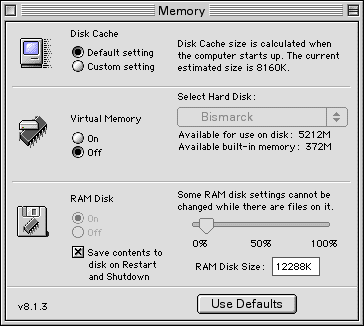
The first step to this is to create the RAM Disk. Go to the Apple Menu, highlight the Control Panels item and in the submenu, select Memory.

Memory Control Panel

Once there, you can easily set up a RAM Disk. All you need to do is to click on the On radio button and set its size. Again, 1024K equals 1 MB, therefore you need to calculate the amount you wish to allocate. I would recommend a bit more than 10 megabytes for the RAM Disk and a browser cache of 9 megabytes. In fact, this is what I use. Note that you need to make your RAM Disk slightly bigger than your browser's cache. Make sure to click the "Save contents to disk" checkbox, since your cache will easily be stored in your RAM Disk each time you shut down and start up. Use the sliding button to adjust the amount. Once done, close the window and restart. (Yes, you do have to restart for your Mac to create the disk cache at startup.RAM Disk)

After restarting, you should see the RAM Disk icon on your desktop.

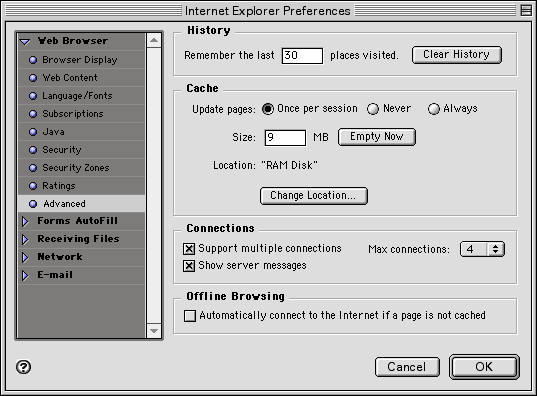
We are not done yet. You need IE to use the RAM Disk in order to really enjoy the speed. Launch Internet Explorer. Open the Preferences from the Edit menu, and then click on the advanced category, under Web Browser. You will see the Cache rectangle, where you have to click on Change Location. You will get a navigation window, where you have to go to the desktop and highlight the RAM Disk icon. Click on Choose. Quit Internet Explorer. Launch it again and start browsing. Enjoy the speed boost!
The History

The first two measures already increased the performance of IE, but we are not done yet. We can make sure that this gained speed is sustained through time, which requires us to do a bit of history. Pun intended. In the same Advanced Preferences as before, we need to take down the number of places visited, because the more IE remembers, the slower it gets. The default setting is way too high. I would recommend about 30 places, just enough to back to the last few pages where you went.

I know that it is annoying not being able to go back to the pages you visited a week ago, but the tradeoff will prevent IE from slowing down all the time. Your best bet is to store URLs in your Favorites or in a separate URL handler if you have any reason to think that you may one day be tempted to go back to a certain site. You want some speed, don't you?

A Word about Virtual Memory

We are basically done here. If you applied the three measures I recommended and took two aspirins with a good night of sleep, your browser speed headaches should be gone. Can it get better? Yes, if you have been using virtual memory so far. As I already explained, your RAM performs faster than your hard disk. If you wish to do one more thing to make Internet Explorer (and your whole Mac!) faster, then turn off virtual memory (VM) from the Memory control panel and restart.

I know, there is more to virtual memory than the speed difference between RAM and a hard disk drive. With VM on, your Mac will handle a some things in a smarter way without loading everything into RAM, which will slow you down if your RAM is almost full and your Mac out of elbow room. One fact remains: if you can afford the RAM, this is not a problem! Just turn VM off, pile up the RAM chips, and increase the amounts of memory given to your applications.

This advice on virtual memory is optional, but IE and your Mac as a whole could really benefit from it. See you in the fast lane of browsing! LEM

Recent Content on Low End Mac

  • BlackBerry's bold challenge to iPhone, Zune sales still flat, 3G iPhone launch nigh, and more, iNews Review, 05.16. Also a new Google Reader for the iPhone, an iPod-based supercomputer, remote Mac access from iPhone and iPod touch, new cases, and much more.
  • Open source virtualization for Macs, iMac shutdowns, Psystar reviews, and more, Mac News Review, 05.16. Also aluminum iMac USB power concerns, Penryn iMac twice as powerful as fastest G5 iMac, Radeon vs. GeForce in top-end iMac, Odysseus email client in beta, and more.
  • Limited USB bus power in Santa Rosa Macs, 1 TB in your 'Book, MacBook cooler, and more, The 'Book Review, 05.16. Hitachi first to market with 320 GB 7200 rpm notebook drive, Apple to refund for sparking power adapters, 10 hour external MacBook Air battery, bargain 'Books from $150 to $2,699, and more.
  • Best iPhone deals, Low End Mac Deals, 05.16. New 8 GB iPhone, $399; 16 GB, $499.
  • Best iBook G4 deals, Low End Mac Deals, 05.16. Used 12" 1.07 GHz Combo w/AP, $350; 1.33 GHz w/o AP, $400; 14" 933 MHz w/AP, $400; 1.07 GHz, $425; 1.33 SuperDrive, $450; 1.42, $500.
  • Best Mac Pro deals, Low End Mac Deals, 05.16. Refurb 2.66 GHz 4-core, $1,888; 2.8, $1,999; 3.0, $2,299; 8-core '07, $2,499; new 2.8 4-core, $2,199; 8-core, $2,598 after rebate; 3.0 '08 $3,399 a/r; 3.2, $4,169 a/r.
  • Mac Pro beats HP and Dell at their own game: Price, Frank Fox, Stop the Noiz, 05.16. Whether comparing the top-end or low-end of Mac Pro options, comparable models from Dell and HP cost more.
  • Mac of the Day: PowerBook 500 Series, May 1994 - 25-33 MHz 68040 powered PowerBooks with smart batteries, grayscale and color displays.
  • List of the Day: G-Books is for G3 PowerBooks and iBooks.
  • May 16 in LEM history: 98: iMac: A second look - 00: Raised in a 6-color world - 01: The exclusivist Mac - Troubleshooting your Mac - 02: MP3 and the Mac - SE/30 catharsis - 03: Don't confuse a pretty interface for an easy OS - SCSI and OS X on a beige G3 - 05: The Apple III and Lisa era - Bigger, faster, more: Enough! - G4 upgrade for iMac A-D - 06: MacBook - PowerBook 3400: Surprisingly useful and spry - 07: MacBook value equation - 3 GB in a MacBook
  • Leopard is the way to go, even on most old G4 Macs, Carl Nygren, My Turn, 05.14. The useful and just cool features in Mac OS X 10.5 make this the biggest step forward in the history of the Mac OS.
  • Windows on Macs: Three paths for integration, Jason Packer, Macs in the Enterprise, 05.14. Mac users have three routes for running Windows apps: Run Windows using Boot Camp or virtualization, or use a compatibility layer such as WINE.
  • Mac OS 9 still nice, anticipating Odysseus, PowerBook 1400 upgrades, and more, Charles W. Moore, Miscellaneous Ramblings, 05.14. Also rebuilding PowerBook batteries, FastMac vs. NuPower replacement batteries, and only one G4 upgrade left for WallStreet PowerBooks.
  • Up-to-date or low-end, we need technology in our schools, John Hatchett, Recycled Computing, 05.14. Modern computers are great educational tools, but sometimes less distracting options (like no Internet) make more sense.
  • Best iMac G4 deals, Low End Mac Deals, 05.14. Used 15" 800 MHz Combo, $320; SuperDrive, $380; 1 GHz Combo, $400; SD, $485; 17" 1.25 GHz, $459; 20", $750.
  • Best Mac OS X 10.0-10.3 deals, Low End Mac Deals, 05.14. Mac OS X 10.0.3, $40; 10.1, $49; 10.2, $60; 10.3 DVD, $50; CD, $100; 10.1 Server, unlimited users, $109; 10.3 Server, $130.
  • Best MacBook Air deals, Low End Mac Deals, 05.14. 1.6 GHz, 80 GB, $1,694 after rebate; 1.8 GHz, $1,994 a/r; 1.6 GHz, 64 GB SSD, $2,689 a/r; 1.8 GHz, $2,950 a/r; SuperDrive, $99.
  • 10 cult Macs adored by collectors, Tamara Keel, Digital Fossils, 05.13. Macs are not only noted for their longevity, but also by the passion which collectors have for some of the most interesting models ever made.
  • Low End Mac's Compleat Guide to the Lombard PowerBook G3, Charles W. Moore, 'Book Value, 05.13. With the Lombard PowerBook, Apple abandoned the legacy ADB and serial ports for USB, trimmed 20% from WallStreet's weight, and hit 400 MHz.
  • Best PowerBook G3 deals, Low End Mac Deals, 05.13. Used 14" WallStreet G3/266 MHz, $90; Lombard G3/400 MHz, $200; Pismo G3/400 MHz, $300; 500 MHz, $350.
  • Best Apple TV deals, Low End Mac Deals, 05.13. Refurb 40 GB Apple TV, $199; new, $210; refurb 160 GB, $279; new, $319.
  • Best Xserve deals, Low End Mac Deals, 05.13. Used 1 GHz dual G4, $1,399; close-out 2.0 dual-core Xeon, $1,999; refurb 2.66, $2,799; 3.0, $3,499; new 2.8 GHz quad, $2,888; 8-core, $3,299; 3.0, $4,059.
  • More links in our archive.

Michel Munger is a journalist who lives in Montréal. He discovered the Mac in 1994, and his work on a PC reminds him every day why he embraced Apple's platform. Munger has also authored some MacDaniel columns.

You can learn more about him on his personal website.

Recent columns by Michel Munger

Recent Content on Low End Mac

  • Mac of the Day: PowerBook 500 Series, May 1994 - 25-33 MHz 68040 powered PowerBooks with smart batteries, grayscale and color displays.
  • List of the Day: G-Books is for G3 PowerBooks and iBooks.
  • Channels
     Power Macs
     iMac Channel
     iBook/PowerBook
     MacInSchool
    Computer Profiles
     iMac
     Power Mac
     PowerBook/iBook
     Performas
     Mac Clones
     Older Macs
     LisaNeXT
    Editorial Archive
    Mac Daniel's Advice
    Email Lists
    LEMchat (uses AIM)
    Online Tech Journal
    Consumer
     advice, reviews
     guides, deals
    Software
    Apple History
    Best of the Web
     Best of the Mac Web surveys
    Miscellaneous Links
     Best Used Mac Buys
     Used Mac Dealers
     Video Cards
     Mac OS X
     Mac Linux
     Macspeak
     RAM Upgrades
    About Low End Mac
    Site Contacts

    Open Link

    Support LEM

    Affiliates

    The Apple Store
    .mac
    iTunes Store
    Club Mac
    MacMall
    MacResQ
    ExperCom
    eBay
    Amazon.com
    PayPal
    PCMall
    PC Zone
    Crucial Memory

    Our advertising is handled by BackBeat Media. For detailed price quotes and advertising information, please contactat BackBeat Media (646-546-5194). This number is for advertising only.

    All iBasics articles ©2001-2005 by Michel Munger. Entire Low End Mac website copyright ©1997-2008 by Cobweb Publishing, Inc., unless otherwise noted. All rights reserved. Advice presented in good faith, but what works for one may not work for all. Please report errors to .
      LINKS: We allow and encourage links to any public page as long as the linked page does not appear within a frame that prevents bookmarking it.
      Access our RSS news feed at http://lowendmac.com/feed.xml.
      Email may be published at our discretion; email addresses will not be published without permission, and we will encrypt them in hopes of avoiding spammers. If you prefer your message not be published, mark it "not for publication." Letters may be edited for length, context, and to match house style.
      PRIVACY: We don't collect personal information unless you explicitly provide it. For more details, see our Terms of Use.
      Low End Mac is an independent publication and has not been authorized, sponsored, or otherwise approved by Apple Inc. Apple, the Apple logo, Macintosh, iBook, iMac, eMac, iPod, PowerBook, MacBook, Mac Pro, Apple TV, and AirPort are registered trademarks of Apple Inc. Additional company and product names may be trademarks or registered trademarks and are hereby acknowledged.