
On 2006.10.24, Apple moved the MacBook Pro line to Intel’s newer Core 2 Duo CPU, claiming “up to 39% faster” performance than the model it replaced. Part of that comes from the more efficient CPU, and part from an 8% faster CPU.
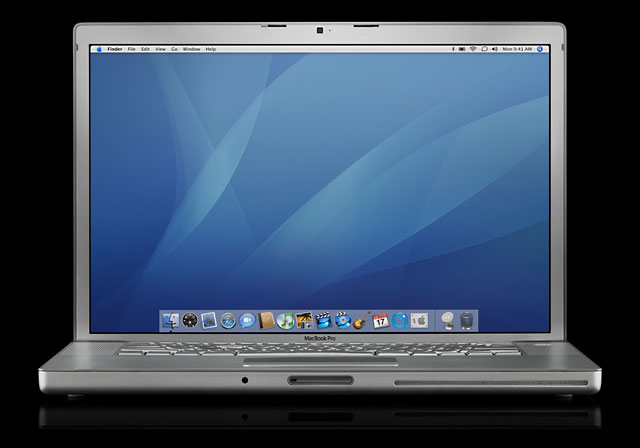
The 15″ MacBook Pro gains FireWire 800, an unfortunate ommission in the original 15″ MacBook Pro. Memory has been doubled to 1 GB standard on the 2.16 GHz model and 2 GB on the 2.33 GHz one, and the memory ceiling is now 3 GB, up from 2 GB in the earlier MacBook Pro. Also, a 120 GB 5400 rpm hard drive is standard, with 160 GB and 200 GB options.
This model shipped with Mac OS X 10.4.8 Tiger and supports OS X 10.7 Lion, but not 10.8 Mountain Lion or later.
The Late 2006 MacBook Pro looks almost exactly like the earlier 15″ MacBook Pro, but the FireWire 800 port is the clue that you’re looking at the newer model. One more change is moving from a 4x SuperDrive that couldn’t burn dual-layer DVDs to a 6x one with dual-layer support.
Note that the built-in display is only capable of 18-bit color, not the full 24-bit color you might expect.
Intel-based Macs use a new partitioning scheme known as GPT. Macintel models can only boot from GPT hard drives; APM (Apple’s old partitioning scheme) hard drives cannot be used to boot them. Further, Power PC Macs running any version of the Mac OS prior to 10.4.2 cannot mount GPT volumes.
On the plus side, Macintel models are the only Macs that can boot OS X from a USB hard drive. That should make a lot of Mac users happy, although it may be the beginning of the end for external drives with dual FireWire 400/USB 2.0 support.
Battery life is comparable to the 15″ PowerBook G4.
Closed Lid Mode: All Intel ‘Books support “lid closed” (or clamshell) mode, which leaves the built-in display off and dedicates all video RAM to an external display. To used closed lid mode, your ‘Book must be plugged into the AC adapter and connected to an external display and a USB or Bluetooth mouse and keyboard (you might also want to consider external speakers). Power up your ‘Book until the desktop appears on the external display and then close the lid. Your ‘Book will go to sleep, but you can wake it by moving the mouse or using the keyboard. The built-in display will remain off, and the external monitor will become your only display.
To resume use of the internal display, you need to disconnect the external display, put the computer to sleep, and then open the lid. This will wake up your ‘Book and restore use of the built-in display.
- Join our MacBook Group. or MacBooks Forum.
- Our Tiger Group is for those using Mac OS X 10.4.
- Our Leopard Group is for those using Mac OS X 10.5 and 10.6.
Details
- introduced 2006.10.24 at US$1,999 (2.16 GHz) and US$2,499 (2.33 GHz); replaced by LED Backlit model 2007.06.05.
- Part no.: MA609 (2.16 GHz), MA610 (2.33 GHz)
- ID: MacBookPro2,1
Mac OS
- Requires Mac OS X 10.4.8 to 10.7 Lion, not compatible with 10.8 Mountain Lion
- Mac OS X 10.6 Snow Leopard compatibility
- Grand Central Dispatch is supported.
- 64-bit operation is supported.
- OpenCL is not supported with the Mobility Radeon X1600 GPU.
Core System
- CPU: 2.16/2.33 GHz Intel Core 2 Duo (Merom), soldered in place, no upgrade options
- Bus: 667 MHz
- Performance:
- Geekbench 2 (Leopard): 2869 (2.33 GHz), 2689 (2.16 GHz)
- Geekbench 2 (Tiger): 2975 (2.33 GHz), 2781 (2.16 GHz)
- RAM: 1 GB on low-end model, 2 GB on high-end model, expandable to 3 GB using PC2-5300 DDR2 RAM
- Level 2 cache: 4 MB shared cache on CPU
Video
- GPU: ATI Mobility Radeon X1600 on PCI Express with dual-link DVI support
- VRAM: 128 MB on 2.16 GHz model, 256 MB on 2.33 GHz model.
- Video out: DVI connector (VGA supported with included adapter; S-video and composite video supported with optional adapters)
- display: 15.4″ (38 cm) 16-bit 1440 x 900 110 ppi color active matrix
- supports 1280 x 800, 1152 x 720, 1024 x 768, 1024 x 640, 800 x 600, 720 x 480, and 640 x 480 pixels at 16:10 aspect ratio; 1024 x 768, 800 x 600, and 640 x 480 pixels at 4:3 aspect ratio; 720 x 480 at 3:2 aspect ratio
- allows mirroring to external display or extended desktop mode
Drives
- Hard drive: 120 GB 5400 rpm SATA standard, optional 160 GB 5400 rpm and and 200 GB 4200 rpm drives
- optical drive: 6x dual-layer SuperDrive writes DVD±R at up to 6x, DVD±RW at up to 4x; reads DVDs at 8x (double-layer at 6x), writes CD-R at 24x, writes CD-RW at 10x, reads CDs at 24x
Expansion
- USB: 2 USB 2.0 ports, one on each side
- FireWire 400: 1 port
- FireWire 800: 1 port
- Ethernet: 10/100/gigabit
- WiFi: 802.11g AirPort Extreme built in
- Modem: optional v.92 56k external USB modem
- Bluetooth: BT 2.0 built in
- IR receiver: supports Apple Remote
- ExpressCard/34: 1 slot
- expansions bays: none
- WiFi: 802.11g AirPort Extreme built in
- Bluetooth: BT 2.0 built in
- ExpressCard/34: 1 slot
Physical
- size: 9.6 x 14.1 x 1.0″ (259 x 357 x 25.9 mm)
- Weight: 5.6 pounds (2.54 kg)
- battery: 60 watt-hour lithium-polymer
- AC adapter: 85W MagSafe
Online Resources




