
The Early 2011 15″ and 17″ MacBook Pro models have moved from dual-core CPUs to quad-core, which makes them a lot more powerful despite lower clock speeds. As with last year’s models, these CPUs support TurboBoost, which lets individual cores run beyond their rated speed, and hyperthreading, which lets the each core appear to the operating system as two cores.
 The hot new technology this time is Thunderbolt, a 10 Gbps data connection that uses the Mac’s Mini DisplayPort. Thunderbolt is 12 times as fast as FireWire 800, over 20 times as fast as USB 2.0, and twice as fast as USB 3.0, which Apple seems in no hurry to adopt. Thunderbolt can be used for video, hard drives, and networking, and adapters let you connect FireWire and USB devices.
Base CPU speeds are 2.0 and 2.2 GHz, and there’s a 2.3 GHz build-to-order option for those who demand the most power.
Apple has improved AirPort performance by building three WiFi antennas into the Early 2011 MacBook Pros, allowing three channels with 150 Mbps bandwidth for a maximum bandwidth of 450 Mbps.
The new models are rated at only 7 hours of battery power, down from 8-9 for last year’s models, due to changes in the way Apple measures battery life. In testing, the Early 2011 models generally match or outperform the 2010 models.
These are the first Macs to use Intel HD 3000 Graphics, and for the first time it’s coupled with AMD Radeon HD graphics. As before, it automatically switches between GPUs on the fly. The Intel GPU uses 384 MB of system memory, while the Radeon GPU has its own dedicated video memory (256 MB on the 2.0 GHz model, 1 GB on the 2.2 GHz one).
The entry-level 2.0 GHz model has the same $1,799 price as the previous entry-level model, and the “better” 2.2 GHz model retails for $2,199, the same price as last year’s top-end configuration.
For those who need more pixels than the standard 1440 x 900 display provides, Apple has a $100 build-to-order option for a 1680 x 1050 screen. You can get that in an antiglare finish for an additional $50. (Apple does not have an antiglare option for the standard display.)
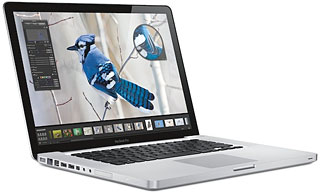
The 15″ MBP design puts all the ports (and a battery indicator) on the left side, leaving the right side for the SATA SuperDrive.
The glass trackpad is the same one found in the previous generation of MacBook Pro models. It supports 1-, 2-, 3-, and 4-finger gestures. The entire trackpad functions as the mouse button.
The new MBP uses the same keyboard as before, complete with backlighting. The black keys look sharp with the aluminum enclosure.
The new model comes in 2.0 and 2.7 GHz versions. 500 and 750 GB hard drives are standard, with 128, 256, and 512 GB solid state drive (SSD) options. 4 GB of RAM is standard, and 16 GB is the maximum.
Editor’s note: The next two paragraphs are from the profile of the previous version of the MacBook Pro. At this time we do not know if they apply to the new model.
Note that the built-in display is only capable of 18-bit color, not the full 24-bit color you might expect.
Unlike early MacBooks, where every USB port could provide 500 mA of power, only one USB port provides full power – the port closer to the front.
The Apple Remote is a US$20 option.
Closed Lid Mode: All Intel ‘Books support “lid closed” (or clamshell) mode, which leaves the built-in display off and dedicates all video RAM to an external display. To used closed lid mode, your ‘Book must be plugged into the AC adapter and connected to an external display and a USB or Bluetooth mouse and keyboard (you might also want to consider external speakers). Power up your ‘Book until the desktop appears on the external display and then close the lid. Your ‘Book will go to sleep, but you can wake it by moving the mouse or using the keyboard. The built-in display will remain off, and the external monitor will become your only display. Since all video RAM is now dedicated to the external monitor, you may have more colors available at higher resolutions.
To resume use of the internal display, you need to disconnect the external display, put the computer to sleep, and then open the lid. This will wake up your ‘Book and restore use of the built-in display.
Intel-based Macs use a partitioning scheme known as GPT. Only Macintel models can boot from GPT hard drives. Both PowerPC and Intel Macs can boot from APM (Apple’s old partitioning scheme) hard drives, which is the format you must use to create a universal boot drive in Leopard. Power PC Macs running any version of the Mac OS prior to 10.4.2 cannot mount GPT volumes. PowerPC Macs won’t let you install OS X to a USB drive or choose it as your startup volume, although there is a work around for that.
Details
- introduced 2011.02.24 at US$1,799 (2.0 GHz quad-core i7, 500 GB hard drive) and US$2,199 (2.2 GHz quad-core i7, 750 GB hard drive); add $100 for hi-res 1680 x 1050 display, $150 for antiglare hi-res display; $250 2.3 GHz upgrade option for 2.2 GHz model; replaced by slightly faster model 2011.10.24.
- Part no.: MC721 (2.0 GHz), MC723 (2.2 GHz)
Mac OS
- requires Mac OS X 10.6.6 Snow Leopard or later. macOS 10.14 Mojave and later are not supported.
- Mac OS X 10.6 Snow Leopard compatibility
- Grand Central Dispatch is supported.
- 64-bit operation is supported.
- OpenCL is supported.
- OS X 10.8 Mountain Lion compatibility
- AirPlay Mirroring is supported.
- AirDrop is supported.
- Power Nap is not supported.
Core System
- CPU: 2.0/2.2 GHz quad-core Intel Core i7
- Level 2 cache: 6 MB shared cache
- Bus: 1066 MHz
- RAM: 4 GB, expandable to 16 GB using DDR3 SO-DIMMs
- Performance (2.0/2.2/2.3 GHz)
- 64-bit Geekbench: 8699/9823/10166
- Speedmark 6.5: 175/209/212
- Xbench 1.3: unknown
Video
- GPU: Intel HD Graphics 3000 and AMD Radeon HD 6490M with automatic graphics switching (HD 6750M in 2.2 GHz model)
- VRAM, Intel HD: uses 384 MB of system memory
- VRAM, 2.0 GHz model: 256 MB
- VRAM, 2.2 GHz model: 1 GB
- Video out: Thunderbolt port, which is backward compatible with Mini DisplayPort (VGA, DVI, HDMI, and DisplayPort supported with optional adapters)
- display: 15.4″ (38 cm) 16-bit 1440 x 900 110 ppi color active matrix; 1680 x 1050 build-to-order option
- supports 1440 x 900, 1280 x 800, 1152 x 720, 1024 x 640, 800 x 600, 720 x 480, and 640 x 480 pixels at 16:10 aspect ratio; 1024 x 768, 800 x 600, and 640 x 480 pixels at 4:3 aspect ratio; 720 x 480 at 3:2 aspect ratio
- allows mirroring to external display or extended desktop mode
Drives
- Hard drive: 320/500 GB 5400 rpm SATA standard, 7200 rpm and solid state drives (SSD) optional (128, 256, or 512 GB) on 6 Gbps SATA bus
- optical drive: 8x dual-layer SuperDrive writes DVD±R and DVD+R at up to 8x, DVD-RW at up to 4x; dual-layer DVD±RW at up to 4x; reads DVDs at 8x (double-layer at 6x), dual-layer and DVD-ROM at 6x; writes CD-R at 24x, writes CD-RW at 16x, reads CDs at 24x on 3 Gbps SATA bus
Expansion
- Thunderbolt: 1 port
- USB: 2 USB 2.0 ports, only 1 high-powered device device allowed
- FireWire 400: none
- FireWire 800: 1 port, backward compatible with FireWire 400
- Ethernet: 10/100/gigabit
- WiFi: 802.11n AirPort Extreme built in, three antennas support up to 450 Mbps bandwidth
- Modem: No longer offered by Apple
- Bluetooth: BT 2.1 built in
- ExpressCard/34: none
- SD Card Slot: 1
- expansions bays: none
- IR receiver: supports Apple Remote
Power
- battery: 77.5 Watt-hours, 7 hours of wireless productivity
- AC adapter: 85W MagSafe
Physical
- size: 9.82 x 14.35 x 0.95″ (249 x 364 x 24.1 mm)
- Weight: 5.6 pounds (2.54 kg)
Online Resources
Keywords: #mbp15early2011 #early2011mbp15
Short link: http://goo.gl/5ttXou
searchwords: mbp15early2011, early2011mbp15




