
2000: Rolleiflex, a name from photography’s golden era, embraces the digital camera revolution
When I made part of my living as a wedding and portrait photographer back in the 1970s, my workhorse camera was a Rolleicord Vb twin-lens reflex (TLR), the no-frills, entry-level version of the wonderful Rolleiflex. With its razor-sharp Schneider Xenar lens and 2-1/4″ square negative format, that old Rollei recorded many superb images.
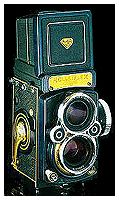
Rolleiflex TLR
From its introduction in 1928, the Rolleiflex was the camera of choice for professionals, and for many advanced amateur photographers as well, for over 30 years. Last summer, Time magazine published an obituary photo of former Look and People magazine photographer, Stanley Tretick, taken at the height of his photojournalism career, with a Rolleiflex hanging from his neck.
Personally, I still rate the whisper-quiet, relatively light, twin lens reflex as the ideal film camera platform. I loved composing on the full negative-sized ground glass focusing screen, even though the image was upside down and reversed. Because you looked down into the ground glass, you could stand facing one direction with the camera pointing elsewhere – great for candid work! The crude-but-effective “sports finder” – basically open gun sight apertures in the focusing hood worked well for action shots more than 20 feet away.
However, the skill needed to cope with the reversed and inverted focusing image, plus parallax errors in close-up work caused by the viewing and taking lenses being in separate planes, and the fact that the TLR Rolleiflex did not offer interchangeable lenses, caused it to lose ground to the heavier, noisier, more expensive, much more mechanically complex, single lens reflex Hasselblads, Bronicas, Mamiyas, and ultimately Rollei’s own medium format Rolleiflex SL 66 and SLX SLRs in the 1960s and 70s.
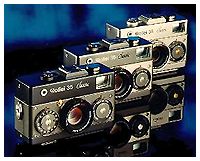
Rollei 35
Franke & Heideke, the Rolleiflex’s German makers, also pioneered the subcompact 35mm camera, with their revolutionary Rollei 35 in 1966. The little Rollei 35, with its collapsible but excellent Zeiss Sonnar lens, could fit in a shirt pocket but in no way compromised on image quality.
Sadly, both the Rolleiflex TLR and the Rollei 35 are long out of volume production (although please see the Appendix below), but Rollei is still going strong, with lines of advanced professional medium-format Rolleiflex single lens reflex (SLR) cameras, several compact 35mm cameras aimed at consumers, and megapixel digital cameras as well.
Rollei Goes Digital
Rollei entered the megapixel camera market last year with the introduction of its Rollei digital “d-series” SLR cameras. Drawing on several years of experience producing digital backs for its own Rolleiflex medium format SLRs as well as those of several competing manufacturers’ models, Rollei claims to be in a unique position to design and manufacture digital cameras capable of producing optimum photo-quality resolution that will meet or exceed the expectations of real estate, insurance, legal, law enforcement, construction, editorial, and other professionals.
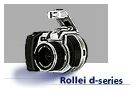
Rollei D30
Unusual features of the Rollei d-series include 30-bit color depth, uncompressed image storage, and multiple storage media and download options. The new “d flex” and “d metric” Rolleis, which were totally conceived, designed, and manufactured in Braunschweig, Germany, feature lenses specifically optimized for use in a digital system.
Rollei’s four digital ‘d’ series cameras all come with integral, non-interchangeable lenses, including two zooms, a 7mm fixed focal length, and the d 7 metric – a member of Rollei’s high-tech family of photogrammetric cameras.
The Rollei d 30 Flex
The d 30 flex flagships Rollei’s digital camera line. With its solid metal body and quiet shutter release, the Rollei d 30 flex is engineered to have the feel of a film SLR. Its 10-30mm f/2.8-4 D-VarioApogon zoom lens is high resolution and fast, with a 3x zoom range suited to most subjects, whether tight interiors, portraits, or distant objects the user wants to bring close. It’s the equivalent to 35-105mm in 35mm and motorized for fast, smooth, and convenient operation. The autofocus system is the active type, capable of functioning even in total darkness, and it can be switched off for the flexibility and freedom of full manual focusing. AF range stretches from a close 2.3 feet to infinity.
For storage media, the Rollei d 30 flex offers the user wide freedom of choice. SmartMedia Cards (from 4 MB), CompactFlash (up to 60 MB), PCMCIA cards of types I, II and III (up to 150 MB), or even a PCMCIA hard disk with a storage capacity of 520 MB.
In addition to the integral flash, which automatically switches on when there isn’t enough light (it may be manually switched off), the Rollei d 30 flex has a central contact hot shoe which can take both external flash units and accepts SCA adapters for either hot-shoe mounted flash units or studio strobes. Using an external flash meter or simple guide number computation, flash exposure is possible with external flash units. (Chip sensitivity is equivalent to ISO 100.) This makes the Rollei d 30 flex suitable for use in photo studios. The built-in flash’s high-angle tube position minimizes redeye, but just in case, there’s also a red-eye reduction mode. The flash off mode is great for available light pictures, while the auto fill-in feature produces fine flash shots even in high-contrast lighting or at night. Flash range reaches to 18 feet.
The Rollei d 30 flex bright SLR finder is complemented by a 2.5″ TFT color monitor, which allows previewing of shots while they’re still in the camera. An active Phase Comparison Autofocus system takes care of focusing in the range between 0.6 m (2 feet) and infinity. The AF system can be switched over to manual focusing. The LCD monitor provides the user with comprehensive information on all the important camera settings and exposure data such as frame number, flash mode, exposure functions, exposure compensation, battery status, date and time. From the LCD monitor, you can also erase individual shots or all your shots from the memory card and activate interval shots, single or multiple exposures and the self-timer functions.
With the feel and familiar handling of a conventional camera, the Rollei d 30 flex zoom lens reflex design delivers WYSIWYG viewing, plus a bright finder, and accurate framing with no parallax problems, even at the lens’s 2.3 ft. close focus distance. The lens also has filter threads allowing the use of protective or colored filters and close-up lenses.
Precise exposure metering results are delivered by the centre-weighted TTL integral metering system. The camera offers three exposure programs: Normal, Sport (for fast shutter speeds) and Landscape (for maximum depth of field). Exposure compensation – from +/-2 stops in one-third stop increments – lets the photographer tailor his or her metering result to the shooting situation. The electronic shutter offers a speed range of 1 /8 – 1 /10,000 sec. In addition, manual control of aperture and shutter speed is possible.
The ergonomically designed, d 30 flex features a large grip whose finger-friendly shape and rubberized coating assures convenient handling. Overall lightweight (23 ounces w/o battery or storage medium) and pleasingly compact (5.9 x 4 x 4.1 in; WxHxD), the d 30 flex is a camera most photographers will have no problem taking along no matter the destination. Powered by AA rechargeables – NiMH or NiCad – the camera also has an AC adapter.
For transferring picture data to personal computers, the Rollei d 30 flex comes equipped with parallel and serial ports as well as a SCSI interface. The camera’s video output lets you view your pictures on a TV, and this can be switched between PAL and NTSC modes.
The 2/3″ CCD-chip with 1.4 million real picture elements (1280 x 1024 pixel) delivers digital photographs with high resolution, outstanding detail and 30-bit color. RGB pictures generally have 24-bit color (3 x 8 bits), so that a description of more than 16 million colors is possible. With 30 bit color (3 x 10 bits) over 1 billion colors can be described (1024 x 1024 x 1,024 gradations per color channel).
It is in this area where Rollei’s traditional Achilles’ heel of being somewhat behind the bleeding edge of technological advancement becomes evident. When the d-30 series was introduced in February 1999, 1.4 million pixels was respectable performance in a digital camera. However, a year is an eternity in this field of warp-speed technological advances, and with the Japanese competition delivering 3, 4, and even 6 million (apparent) pixel performance this year, 1.4 million seems pedestrian, even though pixel resolution is only one of several factors in digital camera performance.
However, perhaps focusing narrowly on the moving target of high-tech advance misses the essential Rollei philosophy. Even in the slower-advancing field of film camera technology, Rollei has rarely been at the forefront of innovation. Rather, the name Rollei represents something special for those with the taste and discernment to appreciate it. Rolleis must be of high optical and mechanical precision, be easy to handle and to operate, and be durable and of lasting value.
Other “flex” cameras in Rollei’s new d line are similar in all ways to the d 30 flex except for lens focal length. They include the d 24 flex with a 12-24mm integral zoom lens and the d 7 flex with a fixed focal length 7mm f/2.8 lens. Finally, there’s the Rollei d 7 metric, a “high spec” camera that’s part of the RolleiMetric system of photogrammetry. With Rollei software and the d 7 metric, digital photos can be easily converted into files for CAD models and other computerized illustration and modeling applications used in architecture, archaeology, engineering and other fields.
Lenses for the Rollei d-series flex cameras:
- Rollei d 30 flex – 10-30mm Rollei VarioApogon
- Rollei d 24 flex – 12-24mm Rollei VarioApogon HFT
- Rollei d 7 flex – 7.3mm Rollei Apogon HFT
- Rollei d 7 metric (Digital metric camera for photogrammetric use) – 7.3mm Rollei Apogon HFT
Rollei Digital Backs for Film Cameras
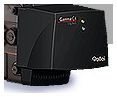 In addition to the d flex line of digital cameras, Rollei also offers digital backs for medium-format film cameras.
The Rollei Gamma C4 Digital back is available in models to fit Rollei’s own X-Act1, X-Act2, Rolleiflex 6001 Professional, 6003 Professional, 6008 E and 6008 Integral, as well as the Hasselblad 553 ELX/503 CW, Fuji GX 680, and Mamiya 645 Pro
The Gamma C4 back features:
- Single-shot and multi-shot modes
- Exposure times up to eight seconds
- Ample space in the studio due to 10m FireWire cable
- Hot plugging: Mount back with computer ON
- Terminal for Mac computer
- Alternative shutter-speed/aperture setting via software
- No mirror bounce in multi-shot mode
Specifications include:
- Sensor: CCD-Chip
- Chip size: 30 x 30 mm
- Number of pixels: 2048 x 2948
- Single-shot mode
- 11.6 MB interpolated / 24 bits per color (RGB)
- 23.2 MB interpolated / 36 bits per color (RGB)
- Multi-shot-mode
- 23.2 MB, 36 bits per color (RGB)
- 11.6 MB, 24 bits per color (RGB)
- ISO range: 25 / 15º – 200 / 24º
- Connection to the camera – Via 10m FireWire cable to controller box by means of SCSI-II cable
System requirements:
- Power Macintosh
- min. 128 MB RAM
- SCSI interface
- 24-bit graphics card
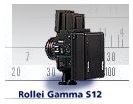
Rollei Gamma S12
The Rollei Gamma S12 digital back for use on X-Act1 and X-Act2, Rolleiflex 6001 Professional, 6003 Professional, 6008 Integral and 6008 E film cameras features:
- Digital back for scan-type photography
- High resolution and precise color separation
- Print sizes beyond DIN A3 with type 60 screen
- 35 MB file size without interpolation
- Flicker suppression allows the use of any type of lighting
- Terminal for Macintosh and PC
Gamma S12 Specifications
- Scan area – 56 x 56 mm
- Pixel number – 3500 x 3500
- File size – 36 MB / 24 bit
- ISO – 400 / 27º
Computer link – SCSI-Standard
System requirements:
- Power Macintosh
- min. 24 MB RAM
- 220 MB free memory
- SCSI interface
- 24-bit graphics card
- Windows 97/98
- 486, Pentium recommended
- min. 16 MB RAM,
- 220 MB free memory
- 24-bit graphics card
- SCSI interface
For more information about Rollei photographic products, visit the Rollei fototechnic site.
Appendix
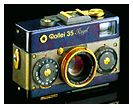
Rollei Comm 35
As I mentioned in the preamble to this article, both the classic Rolleiflex twin lens reflex and subcompact Rollei 35 cameras have been out of volume production for some time. However, to commemorate the 75th Anniversary of Rollei fototechnic, special limited editions of 900 Rolleiflex 2.8GX TLRs, and 900 Rollei 35 Classics were produced. Rollei’s US website is still listing these units as available, although the price would no doubt set you back on your heels.
The Rolleiflex 2.8GX 75th Anniversary Edition features:
- Gold plated external body parts
- F&H Corporate logo in 14-carat gold on finder hood
- Zeiss Planar 80mm f/2.8 HFT with multicoating on all lens surfaces
- Rolleinar set 2/ III close-up set
- Limited Edition final production
- Elegant Wooden presentation box
- Certificate of Authenticity with the serial number of the camera
- Anniversary book “The History of the Twin Lens Rolleiflex” bound in leather
There is also a Rolleiflex 2.8 GX Royal
- Zeiss Planar 80mm f/2.8 HFT
- Urushi Japanese hand coated lacquer technique
- Limited Edition final production
- Wooden presentation case and Certificate of Authenticity
The Rollei 35 Classic 75th Anniversary Edition features:
- Gold plated external body parts
- Solid gold anniversary plaque with a diamond on the top plate
- Zeiss Sonnar 40mm f/2.8 HFT with multicoating on all lens surfaces
- Flash Unit
- Leather camera case
- Elegant Wooden presentation box
- Certificate of Authenticity with the serial number of the camera
- Anniversary book “The History of the Rollei 35 from 1966 to 1995” bound in leather
There is also a Rollei 35 Royal
- Zeiss Sonnar 40mm f/2.8 HFT
- Urushi Japanese hand coated lacquer technique
- Limited Edition final production
- Wooden presentation case and Certificate of Authenticity
For more information on these commemorative editions of the classic Rolleis, visit: Rollei fototechnic site
keyword: #rollei #rolleiflex
