
2005 – Switching the Macintosh platform to Intel x86 processor architecture is not a panacea, but Apple’s adoption of Intel processors should not be a major source of headaches – except for the eventual lack of support for Classic Mode on Intel-based Macs.
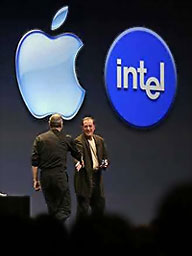 It sure made people think that hell had frozen over, but once the initial “what the in the world is going on here?” shock went away and the smoke cleared, we found reasons to believe that Apple’s move won’t translate into the end of the world.
Why should the switch be a smooth one in the first place?
Apple outlined a serious, concrete plan and rallied the industry’s biggest developers from the start. You should remember that when Apple reveals plans for a critical transition, it makes sure to have Adobe and Microsoft bosses – the “big two” – on stage with Steve Jobs to support the big move. Their Day One support is necessary to ensure that Office, Photoshop, and other software giants remain available for the platform.
It also is a classic display of certainty. If Microsoft and Adobe, along with developers of very complex applications, go forward, most others will have to follow. If you currently develop for the Mac, how can you second-guess Apple, Adobe, and Microsoft and tell them that the ship is going down?
When you add this to the Rosetta emulation layer and transition support for developers, you can believe that there is serious preparation behind the move and that everything will go according to plan.
Many technology writers – and many smart ones, by the way – criticized Apple for going public with a two-year conversion. Although Mac OS X led a “double life” in Apple’s labs, as confirmed by Steve Jobs, making a switch to Intel entirely possible, many think that announcing everything in advance may be a disadvantage.
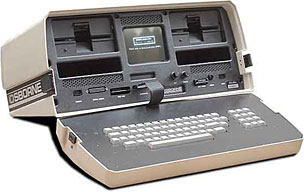 People invoke the Osborne effect. (In short, Osborne announced it was changing hardware platforms from Z-80 and CP/M to Intel 8088 and MS-DOS too long before product would be available, sales dried up, and the company died.)
When you first think of it, you may conclude that the doubters are right.
But on second thought, a public announcement and long transition period are necessary. Apple has to give enough time for all commercial software and shareware developers to “go Intel” before putting Intel-based Macs on the shelves. Apple itself probably needs extra time to finish optimizing Mac OS X and start building the Macintel hardware for large-scale production instead of secret testing and developer systems.
Could you imagine a surprise introduction of Intel Macs? Apple has to rally developers first, and that can’t be done without a public statement. The rumors were already intense enough when Apple and Intel negotiated their deal behind close doors; imagine what it would have been had Apple told the developer community, “Hey, we are switching to Intel, but please do not tell anybody.”
Everybody should also keep in mind that the computer industry always has to deal with the Osborne effect. Companies always give the media and developers a road map of things to come – and customers the promise that great products are in the pipeline. Everybody is aware that faster, meaner, and slicker hardware is constantly under development; that’s the name of the game.
Will everybody wait until their favorite software developers and Apple complete the transition to Intel before purchasing new Macs? No. Some will, as always, but if history repeats itself, there is no need to worry. The transition to the PowerPC did not force Apple out of business in the early 1990s, and the transition to Mac OS X in the early 2000s, which was a huge change, did not make Apple bankrupt.
There are reasons to buy a PowerPC Mac today. It looks like Classic will not be supported with Intel-based Macs. Some of us care about Classic because our favorite software was just fine before it was discontinued and no equivalent was released. That makes the purchase of a PowerPC-based Mac quite attractive.
On top of all this, some negative reasons justify a move to Intel. How could Apple tolerate the lack of a G5 for its PowerBooks? How could Apple keep telling people that everything is fine when IBM seems to hit a ceiling with its PowerPC processors for the Mac?
How could Apple live with those facts when it witnessed how hard IBM worked to develop 3+ GHz multicore and Cell PowerPC processors for Microsoft’s Xbox 360, Sony’s PlayStation 3, and Nintendo’s Revolution? IBM seems good at winning a company’s business, but as far as Apple is concerned, further efforts were perhaps missing.
No one should believe that Apple will become a priority on Intel’s list in terms of development. The Macintosh platform does not hold enough market share for Apple to call the shots in the x86 world, but at least it will be possible to use recent Intel chips in portables and improve performance with the desktop lines.
 Another interesting aspect of the future Macintel alliance – boy, do I hate that word – will be Apple’s image in general. While veteran Mac users shudder at the mental picture of an Intel Inside badge on their Mac, the typical uninformed computer user may see this as one less hurdle when considering the purchase of an Apple computer. This is not an argument for the convinced and faithful Mac user, but it can make a difference for the general PC-using public. Intel has prestige, whether we like it or not.
The added conformity and possibility to run Windows on Apple hardware may even please the business world. Again, while veteran Mac users may not care for this, bringing more companies to Apple would be a significant gain for the Macintosh as a platform.
Is Apple necessarily abandoning multicore processors – something that IBM has developed – by going to Intel’s camp? I am no processor expert, but Intel announced the availability of its dual-core Pentium processors for the fourth quarter of 2005. Let’s hope that the Apple can stick some of these in its Intel-based Macs. [Publisher’s note: What Apple promoted as Core Duo in early 2006 was also known as Pentium Dual-Core in the PC world. Code named Yonah, these 32-bit CPUs appeared in all first-generations Intel Macs – notebooks, iMacs, and Mac mini.]
Let’s also hope that Intel’s resourceful vendor support will help Apple to build better computers for us, the users.
Is a switch to Intel a panacea? Probably not. Even the best of transitions does not come without problems, particularly for early adopters. Expect some developers to take their sweet time to develop Intel-compatible software, so your favorite shareware may force you to wait until you get an Intel-based Mac or put up with Rosetta’s PowerPC emulation.
I also wonder just how optimized Mac OS X will be when the first Intel-based Macs hit the shelves. After a few years of struggle, it seems that Mac OS X 10.4 Tiger can finally be considered as a slick release that really moves. Will it be as fast on the first Intel Mac?
Another question that pops up: How in the world can Apple claim that PowerPC rules the world and then turn around and jump into Intel’s camp? What about AMD? Many questions remain unanswered.
With that in mind, I believe that the switch to Intel may be a good thing. It is not the first time that Apple has taken the Macintosh platform through an important change. We’ve had the adoption of the PowerPC, the use of standard PC hardware (such has hard drives, PCI cards, and AGP video), and the switch to Mac OS X.
The Macintosh went through several successful transitions in the past, and it can certainly do so in the future.
The only difference, this time, is that you might hear the Intel chime when starting up your Mac 😉
Keywords: #macintel #inteltransition #powerpc #rosetta #classicmode
Short link: http://goo.gl/8u1Fnn
