
Low End Mac Reader Specials
Memory To Go Special: MacPro 8 Core 8GB kit $232 / 4GB kit $116 / 2GB kit $72. New Macbook 2GB DDR3-$65. HARD DRIVES available -- Free shipping / LIfetime warranty.
Download Typestyler, still the Ultimate Styling Tool for Internet, Print and Video Graphics. Works great in Classic with a Native OS X Version on the way. Free Tryout: www.typestyler.com
LA Computer Company: Specials on AppleCare, iMac's, Apple Batteries and Apple A/C Adapters. Also Great prices on Used Apple Computers. Call 1-800-941-7654 Click Here.
Mac users can finally play Party Poker for Mac. Not only that, they can also learn how to play PokerStars for Mac.
Laptop Hardware Provided by TechRestore - Overnight Mac & iPod Repairs.
Compare products like desktop computers, laptops, and LCD TVs side by side! All the information and reviews to make the best purchasing decision for a new cell phone GPS products or MP3 players. The Ciao network makes searching products easy for you.
Mac Musings
Inside Your Notebook's Battery: Ordinary AA Li-Ion Cells
Dan Knight - 2006.09.08 - Tip Jar
Popularity: ![]()
![]()
![]()
![]()
![]()
![]()
![]()
![]()
The truth is out there. Or perhaps "in there" is a better way of putting it, at least as far as batteries for portable computers are concerned.
The truth is that those expensive (and sometimes exploding) batteries are little more than repackaged Li-Ion* AA cells. And generally not the high capacity ones at that.
* NOTE: This article originally referenced everyday 1.2V NiMH cells rather than 3.7V lithium-ion batteries, used in modern laptops. These are still commodity batteries, although more expensive than NiMH. Li-Ion batteries can be purchased online for under US$5 each. Also, the new MacBook laptops use lithium polymer batteries, so none of this applies to them. dk
As those who follow rechargeables know, 2,200 mAh AA Li-Ion cells are far from rare, 2,000 mAh is pretty pedestrian, and 1,800 mAh and below are scraping the bottom of the barrel.
So guess what's inside the battery running your PowerBook, iBook, eMate, and the zillions of Windows laptops out there? If it's fairly recent, probably 1,800 mAh Li-Ion cells.
You know how much those notebook batteries cost on the open market: Apple's prices are prohibitive, and companies like Newer Tech make replacement batteries with both higher capacity and lower prices. Still, they cost well over US$100.
A set of six high capacity Li-Ion cells? Under US$30.
The value of notebook computer that could take low cost AA Li-Ion cells instead of expensive, proprietary enclosures for those same cells? Priceless.
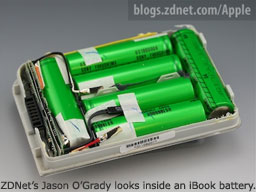
There's got to be more to those $100+ batteries than
a fancy enclosure and $10-15 worth of AA cells. And there is. These
batteries have solder tabs on them, so there are soldered bits of
wire running between the cells. And a small circuit board with
circuitry that could be built into a notebook computers - if it
were designed to accept ordinary AA cells.
The industry is talking about safer batteries and standard form factors - but a standard already exists. It's called the AA Li-Ion cell. It's been a standard size for decades, and if you eliminate the need to solder wire to the cells or enclose them in fancy cases, you eliminate a lot of potential for heat damage. Not to mention the cost of that fancy battery enclosure.
Here's a crazy idea for the computer industry: Just use the AA cells that we can buy anywhere. Build the charge level indicators into the computer instead of a battery enclosure, eliminate the enclosure completely, and put in a bay for AA cells.
Possible Drawbacks
It's a simple solution to a stupid problem, a problem created by corporate greed.
There are only a few problems I can see with using plain old AA Li-Ion cells in notebook computers:
- You can put them in backwards, a problem with way too many batteries.
- You can't leave charged Li-Ion cells loose in a bag, as they can short out and - drum roll - combust.
- Users might not use matched sets of batteries.
Nobody every went broke underestimating the stupidity of some people, yet the most widely used batteries - excepting the 9V ones - are completely reversible. You can put them in the wrong way in most devices. Someone needs to address that.
Li-Ion cells should be sold with battery holders that will protect the batteries from damage and keep them from being shorted until they're installed. That would make it easier to safely carry a spare set of batteries.
And it's important to use a matched set of cells. If you have 4 identical batteries and 2 that are older or have a lower capacity, you're losing capacity.
Possible Solutions
Someone needs to come up with a new battery design that's polarized so you can't put batteries in backwards. This is something that won't seriously impact battery prices. Maybe something square or rectangular to keep the cells from rolling away.
Until then, someone could probably make a killing producing a simple battery holder for 12" iBooks and PowerBooks, perhaps Apple's best selling series of 'Books ever. And other models if that one sells. "Just add batteries" could be the ad slogan.
And with no need to solder, install, or even include AA Li-Ion cells, there would be a whole lot less cost to mark up in setting the retail price.
Such an adapter should include information on the importance of using a matched set of cells, maybe even a big, bright warning label you'll see every time you replace the batteries.
The only real expense would be circuitry to communicate charge level and battery temperature to the computer. Other than that, it's petty simple stuff. Eventually this circuitry could be built right into portable computers that run from AA Li-Ion cells.
Finally, Li-Ion batteries should be clearly marked with their capacity, month of production, and have room for the user to scribble in a code indicating that this cell is part of battery set A or B or 1 or 2 or whatever.
There's nothing magical about notebook batteries, but as long as the industry keeps us in the dark about what's really inside them, we're going to pay exorbitant prices for a sophisticated container holding $5 batteries.
Benefits
Can you imagine how simple a battery recall would be for Apple, Dell, or anyone else if you could just pick up a cheap set of Li-Ion AA cells and use them until the pedestrian Sony replacement batteries came back from Apple?
Can you imagine Apple and others trimming $100 or more from the price of every notebook computer because they no longer need an expensive, over-engineered battery holder full of AA cells?
I think everyone would benefit from a move away from proprietary
enclosures for industry standard batteries. How about it, Apple?
Further Reading
- Anatomy of an Apple Battery, Jason O'Grady, ZDNet
- How-To: Rebuild Your Laptop Battery, Engadget
- Inside a Notebook Battery Pack, ZDNet Australia
- Replace the Cells in Your Apple PowerBook G3 (Lombard or Pismo) Battery
Dan Knight has been using Macs since 1986, sold Macs for several years, supported them for many more years, and has been publishing Low End Mac since April 1997. If you find Dan's articles helpful, please consider making a donation to his tip jar.
Recent Mac Musings
- Our Debt to the IBM PC, 01.09. A Mac user looks at the legacy of the IBM PC.
- Surprise, Average Broadband Throughput Is Lower than Maximum Throughput, 01.08. If a service is advertised as 8 Mbps maximum, it shouldn't surprise anyone that the average speed is below that number.
- The Lisa Legacy, 01.08. We should always remember how Apple's innovation paved the way for all future computers.
- The 17" Unibody MacBook Pro Value Equation, 01.07. The new model is a bit faster, a bit smaller, a bit lighter, and has an incredible 8-hour battery life.
- More in the Mac Musings index.
Links for the Day
- Mac of the Day: 15" 'TiBook' PowerBook G4, Jan. 2001 - A new 1" thin PowerBook design with a titanium case, 15" widescreen display.
- Group of the Day: ModBook List covers the Axiotronic ModBook tablet Mac.
- January 9 in LEM history: 01: Macworld keynote - 02: The new iMac - Redefining Apple's market - 03: Safari shows off the Apple difference - Impressions of Safari beta - 04: The colored iPod mini - 06: Installing 'Tiger' on unsupported Macs - Time to replace 5-year-old PowerBook - 07: iPhone and Apple TV - Axiotron Modbook - Mac vs. PC price comparisons are never fair - Backup to the rescue - 08: 2008 Mac Pro value equation
Recent Content on Low End Mac
- MacBook Keyboard Among Best Ever, Glass Trackpad Less than Intuitive, TiBook Desktop Mod, and More, The 'Book Review, 01.09. Also $179 to change battery in 17" MacBook Pro, argument for an Apple netbook, MacBook Air SuperDrive hacked for any Mac, bargain 'Books from $170 to $2,299, and more.
- BYO $240 Hackintosh, HyperCard Resurrection, USB 3.0 10x as Fast, SlimBlade Trackball, and More, Mac News Review, 01.09. Also the brilliance of the Macworld keynote, businesses embracing Macs, Picasa for Mac available, Toast Titanium 10 ships, and more.
- iPhone Reaches Vermont, 15 iPhone Tips, Apple's iGlove, First Editable Office App for iPhone, and More, iNews Review, 01.09. Also WebEx collaboration on the iPhone 3G, hands-free visor kit from Kensington, portable iPod and iPhone power, new cases from Speck, and more.
- Hooked on Classic Macs, Tommy Thomas, Welcome to Macintosh, 01.09. Tommy Thomas is back with a renewed focus on Macs that can run the 'classic' Mac OS.
- Software Should Come with a Fresh Date, Frank Fox, Stop the Noiz, 01.09. Sooner or later, some hardware or OS update will probably break a program you own. Software vendors should be up front about how long they'll support it.
- Thanks for the IBM PC, Dad, L. Victor Marks, My First Mac, 01.09. Dad, thanks for bringing home that first IBM PC way back in 1981.
- What a Legacy: The Origin of the IBM PC, Tom Hormby, Orchard, 01.09. IBM introduced its PC on August 12, 1981, shaking up the entire personal computer industry. Today even Apple makes its computers IBM compatible.
- Heat Management for 'Books and the Last Mac to Run OS 9.1, Phil Herlihy, The Usefulness Equation, 01.08. Tips on keeping a first-gen MacBook Air from throttling back with CoolBook, using G4FanControl with a G4 PowerBook, and the fastest Mac that can boot Mac OS 9.1.
- A History of Apple's Lisa, 1979-1986, Tom Hormby, Orchard, 01.08. Originally envisioned as a business computer to replace the Apple II, the Lisa brought the mouse and GUI to the computer market - only to be felled by the less costly Macintosh.
- Lisa's DNA Is All Over Modern Computing, Ray Arachelian, Apple Seeds, 01.08. Those who label Apple's Lisa a failure are ignoring the computer's legacy that shows up in every personal computer sold today.
- The Innovative Lisa, Dan Knight, Online Tech Journal, 01.08. Apple's Lisa and how it paved the way for the Macintosh.
- Waterfield First with SleeveCase for New 17" Unibody MacBook Pro, Charles W. Moore, 'Book Value, 01.08. Waterfield has a reputation for top quality bags at appropriate prices, and it's already designed a sleeve for the new 17" Unibody MacBook Pro.
- Blackouts and Web Access, Death of a Kanga, the Future of PowerPC Macs, and More, Charles W. Moore, Miscellaneous Ramblings, 01.07. Also another email client suggestion and whether a G3 iMac can handle a 7200 rpm hard drive without overheating.
- How Netbooks Impact Microsoft and Apple, Tim Nash, Taking Back the Market, 01.07. Netbooks are keeping Windows XP alive, which may slow adoption of Windows 7, and perceived value keeps the Mac market share growing at the expense of Windows.
- The Ill-Fated Apple III, Jason Walsh, Apple Before the Mac, 01.07. "...not only was the Apple III mind crunchingly expensive, it was made with none of the passion of the Apple II or Macintosh."
- 2 Apple Failures: Apple III and Lisa, Tom Hormby, Orchard, 01.07. Apple's two not-so-great product lines between the Apple II line and the Macintosh.
- Apple III Chaos: Apple's First Failure, Joshua Coventry, Cortland, 01.07. Apple had known nothing but success with its Apple II product line, but when it tried to enter the business world with the Apple III, the learned the cost of failure.
- More links in our archive.
Recent Deals
- Best MacBook Deals, 01.09. Used 1.83 GHz, $595; 2.0 SD, $650; refurb 2.1 GHz, $849; 2.2, $899; 2.4, $949; new 2.1 SD, $945 after rebate; 2.4, $900 a/r; 2.0 Unibody, $1,199 a/r; more.
- Best G5 iMac Deals, 01.09. Used 17" 1.6 GHz Combo, $400; 1.8 SuperDrive, $450; 1.9 iSight, $575; 20" 1.8 GHz, $500; 2.0, $625; 2.1 iSight, $699.
- Best iPod nano deals, 01.09. New 3G/8 GB, $125 shipped; 4G/8 GB, $134 shipped; 16 GB, $175 shipped (most colors).
- Best Apple TV Deals, 01.08. Refurb 40 GB Apple TV, $199; new, $220; refurb 160 GB, $279; new, $320. Prices include ground shipping.
- Best Mac Pro Deals, 01.08. New 2.8 GHz 4-core, $2,099 after rebate; refurb 8-core, $2,399; new, $2,589 a/r; 3.0 $3,398 a/r; refurb 3.2, $4,099; new, $4,099 a/r.
- Best 12" PowerBook G4 Deals, 01.08. Used 867 MHz Combo, $490; 1.33 GHz, $548; 1.5 GHz SuperDrive, $595.
- Best 17" MacBook Pro Deals, 01.07. Used 2.16 GHz Core Duo, $1,190; 2.33 Core 2, $1,400; 2.4, $1,799; refurb 2.33, $1,799; 2.5, $1,899; new, $1,900; refurb 2.6, $2,299.
- Best Power Mac G5 Deals, 01.07. Used 1.8 GHz single, $500; dual, $629, 2.0, $700; dual-core, $929; 2.3, $999; 2.5 dual, $900; 2.7, $1,089; 2.5 Quad, $1,399.
- Best iPod shuffle Deals, 01.07. Refurb 1 GB '07, $39 shipped; new, $43; '08, $45; refurb 2 GB '07, $59 shipped; new, $58; '08, $63.
- More deals in our archive.
About LEM | Support | Usage | Privacy | Contacts
