
Jean Louis Gassée has proven to be one of the most effective managers in the computer industry. He propelled Hewlett Packard to the forefront of the computer industry in Europe, managed Apple’s new products division during the Sculley era, and served as the CEO at Be. Most recently, he has become the CEO at PalmSource after serving on its board of directors since Palm’s spin off from 3Com in the late 90s.
 Having studied at the prestigious Orsay technical college, Jean Louis was recruited by Hewlett Packard’s European’s division, where he oversaw the marketing of HP’s new minicomputer line throughout Europe. He helped the fledgling division win a reputation in the important European market, a reputation that lasts even today.
In 1981, Apple was preparing for its IPO and was expanding abroad. Gassée was recruited to lead Apple’s French division, Apple France. He was given 25 employees and a very limited budget. His division remained the most profitable division during Gassée’s four-year tenure. John Sculley, then Apple’s CEO, was so impressed with Gassée’s performance that he transferred him to the marketing department, where he oversaw a big shakeup after the departure of Steve Jobs. Apple’s old publicity firm, Chiat Day, was replaced by the agency Gassée had used in France.
Sculley was pleased with Gassée’s performance and made him the leader of product development at Apple. He would have final say about what projects were brought to market or were axed. He was not enamored with Steve Jobs’ vision for the Macintosh. Instead of taking steps to prevent third party developers from adding to the Macintosh, Gassée wished to encourage them. His mantra was openness. He decreed that every Macintosh would be upgradeable and expandable.
Expandable Macs
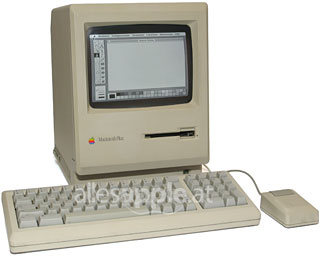
The first vision to be in accordance to Gassée’s new vision was the Mac Plus. It was visually identical to the 512K that preceded it, but it was a much more expandable machine. It was the first Macintosh to feature SCSI (a feature that would be featured on every Mac, PowerBook, and Power Mac Apple would produce until the iMac in 1998), a high speed interface that allowed the computer to use high-speed hard drives, scanners, and any other peripheral that could be connected to the SCSI bus.
The Plus was also the first Mac that allowed for RAM upgrades. Earlier Macs were actually modified to prevent users from upgrading memory.
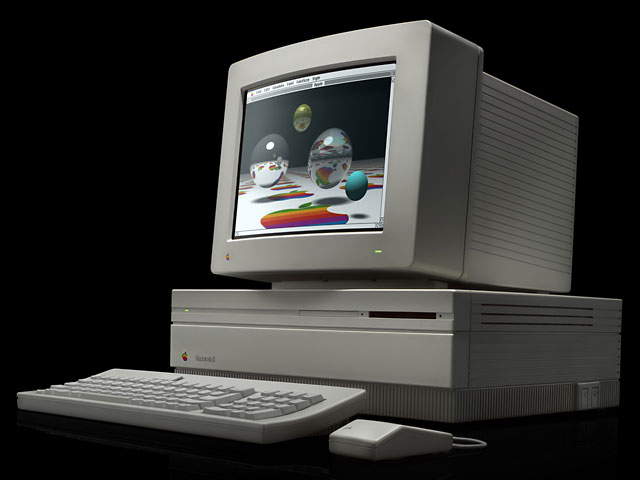 Gassée’s crowning achievement at Apple was the introduction of the Macintosh II. Started in 1985, the Mac II project was to create the next generation Macintosh. It was to be based on a new processor, the Motorola 68020 (which was able to address more RAM than the 68000, ran faster, and could use virtual memory with the addition of a PMMU), would be housed in an expansive desktop case (18.7″ wide, 14.5″ deep, 5.5″ high), and would be expandable.
The new computer was based on a standard bus specification called NuBus. It was originally designed at MIT as part of the NuMachine workstation project. NuBus was very advanced, especially compared to the popular ISA standard of the time. The bus was plug and play capable, very easy to program for, relatively inexpensive, and ready for the 32-bit future. NuMachine was canned, but NuBus stayed on the market after Texas Instruments took it over in 1980. It was eventually adopted by NeXT for its workstation line.
Overall, the new machine retailed for US$5,500, comparable to many less-featured PC clones.
Sales for the Mac II were better than expected and provided a big boost to the Mac in professional markets. It also prompted the development of a fairly vibrant developer community around the new standard.
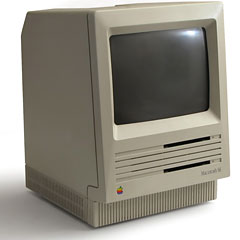
Released at the same time as the Mac II, the Macintosh SE was essentially a repackaged Mac Plus with a few enhancements. The biggest was the inclusion of a proprietary processor direct expansion slot (PDS). It also included a faster SCSI interface, ADB for keyboard and mouse, and space for an internal hard drive. The new machine was introduced at US$3,700 (US$1,000 more than the Mac Plus).
Shortly after the release of the SE and II, Gassée was offered the presidency of Commodore, manufacturer of the formidable Amiga. The Amiga was known for its computing prowess. It had a fully multitasking operating system, was easily expanded, and had a plethora of multimedia software available for it. Consumer video editing made its debut on the Amiga with the relatively inexpensive Video Toaster. Gassée ended up refusing the company, unsure of its future and management.
Macintosh Not-So-Portable
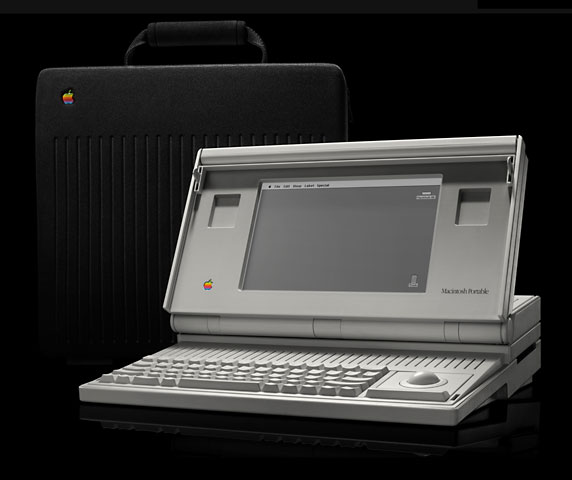 Gassée’s reign was not only a series of shining successes. The first Apple branded notebook started development at the same time as the Mac II, but the Mac Portable did not enjoy its the success. It was essentially a repackaged SE with a faster processor (16 MHz), a handle, and a battery. The Portable had a high resolution 640 x 400 active matrix black and white display and also had an integrated pointing device – its trackball was a portable first. Using a lead acid battery, the Portable could net as much as 12 hours of battery life from a full charge.
In an interview, Gassée said that it was a “no compromise machine”, and he was right. The Mac Portable was faster than many desktops at its 1989 release, but it weighed over 15 pounds and cost US$6,500.
The machine flopped.
Apple After the Macintosh
 Like many other Apple employees, Gassée saw that the Macintosh cash cow would not last forever, so he started several different projects to “find the future Apple”. The most ambitious were the Pocket Crystal project and the Newton project. A less noteworthy project was Jaguar (right), a RISC-based computer that would not be backward compatible with existing Mac software.
The Newton and Pocket Crystal projects both centered around creating portable, intelligent machines. The Newton project, started by Steve Sakoman, hoped to create an A4-sized tablet capable of recognizing and interpreting handwritten commands. The Pocket Crystal, spun off into General Magic and Magic Cap, was to create a personal communicator capable of networking with similar devices and exchanging information and updating information automatically through a technology called TeleScript. Both of these machines aspired to become like John Sculley’s Knowledge Navigator (see my May 31 column), but were both pared down in size and scope to avoid stealing Mac sales.
Gassée, along with much of the engineering staff at Apple, was not encouraged for the future of the 680×0 line of processors. The upcoming 80486 and P5 (later renamed Pentium) chips from Intel were both touted as being significantly faster than the 68k. Gassée decided to move Apple towards a RISC architecture and started the Jaguar project to provide a new RISC-powered computer based on Motorola’s 88000 processor. The early prototypes had as many four processors (they were very inexpensive) and ran a prototype microkernel operating system called Pink, developed by Apple and Novell.
The 88k processors were not compatible with 68k CPUs. The Cognac team, which believed that compatibility with existing Mac software was vital, wrote a 68k emulator to run older Macintosh apps on a wide range of RISC processors.
Eventually Jaguar was canceled, though some of its technologies lived on in the Power Macintosh line of computers.
Changing Fortunes
Microsoft released its first version of Windows in 1985, and Apple felt little threat from the product. Microsoft continued to refine the software, and in 1990 it released Windows 3.0. Gassée was stunned by its sales figures – so was Apple’s board of directors. By 1992, there were 4.5 copies of Windows in use for every Mac in use. Apple’s share price plummeted 20%, and the company had its second loss in history.
John Sculley announced his intention to resign, and Gassée quickly followed suit.
Gassée did not want to leave computing after his departure from Apple. He was interested in the future, which he saw as more multimedia personal computers, and he wanted to get in the game. He went back to Commodore, which was losing money and market share, and offered his services. Commodore refused, and Gassée decided to build the next generation computer on his own.
To Be and Not to Be
 He recruited Steve Sakoman from Apple and began Be Incorporated.
After looking at several different commercial operating systems, Be was unable to find one they could afford. Sakoman and Gassée went to Fry’s Electronics and bought the parts necessary to build a computer centered around the AT&T Hobbit processor Sakoman had used in the Newton. Like the Newton, the BeBox would have more than one processor. The Newton had two, but the BeBox had four. Additionally, the machine was to include several digital signal processors (DSPs). DSPs are similar to FPUs and allow computers to make complex mathematical calculations very quickly.
With a prototype constructed, Sakoman began work on the new operating system that was to run on the machine, and Gassée went to work recruiting new programmers for the company. The first three employees were all refugees from the failed Jaguar project at Apple.
The new operating system, eventually named BeOS, would take full advantage of the BeBox’s design. Like later versions of Mach, BeOS was based on a microkernel design. That meant that there would be a very small kernel that handed request directly to the CPU, and other “servers” would handle everything else. This made the system very stable. Instead of restarting the computer, a user could just restart an individual server. It also made it easier for programs to exchange information with each other realtime. BeOS would distribute its load evenly across any number of processors, and as a result it performed very well with large loads.
Be got a working prototype together and demonstrated it to a few developers and prospective employees to great effect.
AT&T refused to continue developing the Hobbit processor after Apple refused to help fund it. Be was forced to give up its original design and move to a new architecture. The former Jaguar team members were all enthusiastic about using the new PowerPC processor, which combined the 88000’s bus architecture and IBM’s POWER design. The PowerPC was being developed jointly by IBM, Apple, and Motorola, and as a result the processors were even less expensive than Hobbits.
A brand new hardware prototype was created using two PowerPC 603 processors running at 66 MHz, significantly faster than the Power Macs and Pentium PCs available at the time. It took only a short time to port BeOS to the new architecture, and work began on the user interface. Early betas were to have a dock, not unlike NeXTstep, but later revisions replaced the dock with the deskbar, a widget similar to the Windows taskbar. A developers’ beta was ready for release at the beginning of 1994. The new computer generated a huge amount of positive press. The new BeBox (now in an attractive blue and white case) was faster than IBM’s RS/6000 workstation, and BeOS looked and acted like the Mac OS.
Be began to run out of cash, and Gassée went on the prowl for venture capital. Be had yet to give a major public demonstration of its new operating system, and Gassée decided that the Agenda 95 expo would be the best place to attract attention. Sakoman rigged up a demo showing the computer decoding eight MPEG files at once without dropping frames, an incredible feat. Most other personal computers required additional hardware to decode a single MPEG file at low quality. There was also a 3D graphics demo, as well as a presentation about the way BeOS apps could communicate with each other.
The demo got a standing ovation, rare for a computer expo, and Gassée lined up millions of dollars in new investments. The next show that Be was due to participate in was Apple’s Worldwide Developer’s Conference (WWDC) in 1996. A month before the show, Apple decided that Be could not attend because it did not offer a product for the Mac. Gassée was annoyed at the snub and decided to port BeOS to the Power Mac. Not only would this allow Be to attend the conference, but it would open Be up to a huge number of otherwise unavailable customers.
With equipment on loan from Power Computing, BeOS was running on the new hardware in a matter of days, and Be made the show (and even upstaged Apple’s demonstrations of Copland). Apple’s leadership was painfully aware of Copland’s deficiencies. Apple’s CEO, Gil Amelio, would later describe Copland as “just a collection of separate pieces, each being worked on by a different team . . . that were expected to magically come together somehow.”
Eager to beat Microsoft’s forthcoming version of Windows NT for consumers (Cairo), Apple began shopping around for a new operating system to replace the aging Mac OS. For a time, Amelio considered licensing an operating system like Solaris or Windows NT. The cost proved prohibitive, so Apple decided to buy an operating system outright.
For months, the press was atwitter with rumors of Be being acquired by Apple, but Apple surprised everyone at the last minute and announced that it would buy NeXT and use OpenStep as its next generation of Mac OS.
It was a big setback, but Be rebounded. The company decided to move BeOS away from the Power Mac (and the discontinued BeBox) and onto the x86 platform. Be hoped to sell BeOS as a supplementary operating system to Windows. Users could surf the Net and use Office in Windows, then switch to BeOS to edit multimedia files. Be went to many major manufacturers (most notably Dell), but, under pressure from Microsoft, they all refused to bundle BeOS with their systems.
 Discouraged, Gassée began looking for a new niche for BeOS before the company went bankrupt. The Internet Appliance market was the latest fad, and Be jumped in wholeheartedly (ironically, these machines were exactly what Gassée axed at Apple). Their product was called BeIA and included a special interface and modified version of Opera’s browser. The machines got good reviews but sold horribly. Be’s largest hardware provider, Sony, ended up refunding the full price of the hardware.
Be Palmed Off
Be was hopeless and eventually declared bankruptcy, though not before it sued Microsoft for unfairly keeping it out of the PC world.
 PalmSource (where Gassée was a board member since it spun off from 3Com in 1999) acquired Be’s assets, and Gassée became chairman of the company. In the middle of the bankruptcy proceedings, the judge in their case ruled in Be’s favor, giving Be hundreds of millions of dollars. BeOS was to form the basis for Cobalt, the next version of Palm OS.
When the CEO of PalmSource resigned, and Gassée became the interim CEO.
Further Reading
- NuBus, Wikipedia
- Motorola’s 88000 processor, Wikipedia
- Be Incorporated, Wikipedia
- BeOS, Wikipedia
- BeBox, Wikipedia
- AT&T Hobbit processor, Wikipedia
- PalmSource, Wikipedia
- NeXTstep, Wikipedia
- OpenStep, Wikipedia
- IBM RS/6000, Wikipedia
Bibliography
Some of the sources used in writing this article:
- Apple: The Inside Story of Intrigue, Egomania, and Business Blunders, Jim Carlton
- Infinite Loop, Michael Malone
- The Second Coming of Steve Jobs, Alan Deutschman
- Apple Confidential 2.0, Owen Linzmayer
- Odyssey: Pepsi to Apple . . . a Journey of Adventure, Ideas & the Future, John Sculley
- Wikipedia
Keywords: #jeanlouisgassee
Shortlink: http://goo.gl/Q0ph0U
searchword: jeanlouisgassee
