
The first computer worthy of the name “computer” was produced more than 60 years ago. It was a monstrous machine, covering more than 136 square meters and used 18,000 vacuum tubes (the predecessors to the transistor). It was capable of computing the sum of 5,000 numbers ten digits in length per second. It’s name was ENIAC, and it was completed in 1946.
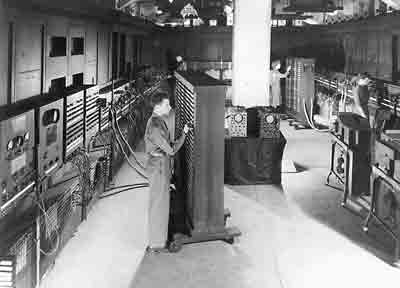 It was as powerful as a modern pocket calculator.
Two years after ENIAC was completed, the Manchester Mark 1 was completed. It was designed by John von Neumann and Alan Turing. Like ENIAC, Mark 1 relied on vacuum tubes, but it had many more than ENIAC and dramatically outperformed its predecessor. Many believed that due to the space required and heat generated by the Mark 1, no other computer would be able to outperform it using conventional vacuum tubes.
Transistors and Integrated Circuits
In 1948, there was a breakthrough. William Shockley, John Bardeen, and Walter Brattain or Bell Labs invented the transistor, the device that heralded the beginning of the computer age. The first transistor was a few centimeters square, composed of three layers of semiconductors, and served the same function as a vacuum tube.
The structure of the transistor did not lend itself well to being placed in large numbers on a circuit board. It would be ten years until scientists developed a solution. In 1958, Jack Kilby created the integrated circuit under the auspices of Texas Instruments. For the first time, thousands of transistors could be placed on the same board.
The race to miniaturize these integrated circuit began in earnest. In 1960, a transistor occupies 1 mm2 of silicon. In 1970 Intel released the 4004, which contained 225 transistors in 60 mm. This new chip was able to make 60 calculations per second. Gordon Moore, then an executive at Intel, predicted that the number of transistors per chip would double every 18 months. His prediction held true, and by 1999 a PowerPC G4 was able to make more than a billion calculations per second.
The first widely available personal computer was the Altair 8800, which used an Intel 8080 chip. It was so primitive (by today’s standards), that it did not have built-in keyboard or monitor support. Users would input their programs using 16 switches on the front panel and read their results through a series of lamps. A user could buy a Teletype interface for the Altair, but it was very expensive, loud, and slow.
The Creation of Apple
 Microprocessors were now widely available – all the market needed were computers and software that could take advantage of them. Apple was created out of the desire to create these machines. It was founded by two Californians, Steve Jobs (21 at the time) and Steve Wozniak (26).
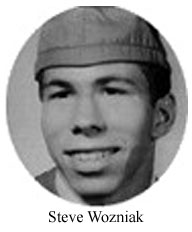
Jobs worked at Atari, then the overwhelmingly dominant video game manufacturer, and Steve Wozniak worked at HP, which manufactured minicomputers and calculators (some of which were as sophisticated and powerful as the first personal computers). The two were good friends: Wozniak would sometimes help Jobs at Atari. He helped Jobs create a version of Breakout, which became the most popular game ever on the Atari.
Steve Wozniak had long wanted a personal computer, though the Motorola and Intel processors available at the time were far too expensive at $175 and $179 respectively. The new 6502 CPU, designed by former Motorola designers, was released and priced at around US$25, a fraction of what the Intel 8080 and Motorola 6800 cost.
Wozniak seized the opportunity and designed a BASIC language for the 6502 and a simple computer to run it. Jobs was impressed by the machine and convinced Wozniak to design a version they could sell. Wozniak agreed, and the Apple I was born.
Shortly afterwards (before they had a machine to sell), Jobs pitched the idea to the Byte Shop owner, Paul Terrel, who liked the idea and placed a 50 machine order.
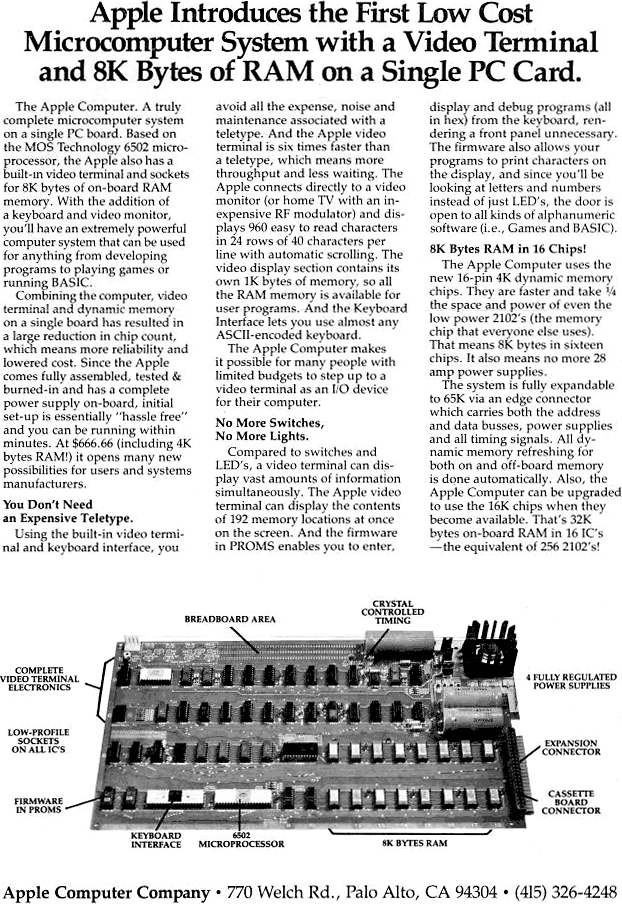
The Apple I was a fairly innovative machine. One of the earliest computers to come assembled, the Apple I only required the user to design a case for the machine (customers of Paul Terrel’s Byte received a custom designed cabinet from a local carpenter) – users of other computers often had to assemble their computers by hand; they did not come preassembled.
Unlike other machines of the time, the Apple I did not use a Teletype terminal. Instead it included a TV interface, freeing users from the notoriously slow displays (60 characters a seconds) used on other personal computers. The Apple I also had built-in support for a keyboard.
There was big flaw in the Apple I – it had no way of storing information. If you created a 3,000 line BASIC program, you would have to reenter it every time you started the computer.
Paul Terrel suggested that Wozniak find a solution, and he did. He created an adapter for the Apple I that allowed it to use a cassette tape recorder for storage. Terrel sold the adapter for $75, along with a 3,000 character BASIC Star Trek game.
The idea was an interesting one, but it was not very effective, because a very high quality recorder was required to make machine-readable tapes.
Apple II
While the Apple I was still available, Wozniak began to design the Apple II. His vision was a computer very similar to the Apple I, but with support for a color display, sound, and greater expandability. He hoped to build a computer fit to run Breakout. He could use color and sound in BASIC and attach paddles through the expansion slots.
All of the features that made the Apple II a good Breakout platform also made it a good personal computer.
Wozniak and Jobs differed on one point: Wozniak wanted to include 8 expansion slots in the new machines, while Jobs only wanted two. He reasoned that a user would only want to add a printer and modem. Wozniak won out (pointing out that professionals might want to interface with multiple devices), and the Apple II shipped with 8 slots.
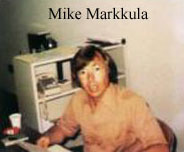 The Apple II was very important to Apple as a company, then led by CEO Mike Markkula. During the lifetime of the Apple II series (over ten years), more than two million were sold. It was the success of the Apple II that prompted IBM’s involvement in the personal computer market.
Steve Wozniak did not design by committee; he relied on his own instincts in the design of computers. The stock Apple II came with 4 KB of RAM (upgradeable to 48 KB) and had a cassette interface.
His inclusion of color was considered by many just a way of attracting game developers to the machine, but color soon became the gold standard and was used in many business applications.
Not only was the Apple II fun, but it was also a very elegant design. Wozniak eliminated every superfluous chip from the design, working to reduce the number of chips in the Apple II and lower its price. The resulting machine was inexpensive enough that most users could afford it.
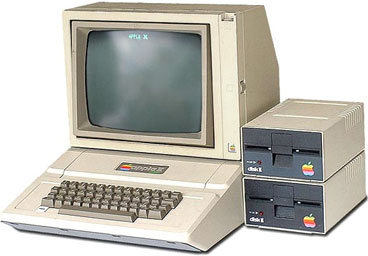 Jobs role in the design of the Apple II was more subtle than Wozniak’s. He helped design the instantly recognizable case that housed the computer. He managed to hide all of the intimidating cables and computer innards to make the machine seem friendly.
In April 1977, the Apple II was unveiled at the West Coast Computer Fair. There was a last minute problem, though. The cases were defective – after 20 minutes of use, they would start interfering with the keyboard. Apple managed to get them replaced, and the replacements arrived two days before the expo.
At the show, Chris Espinosa and Randy Wigginton, two high school students working for Apple, were charged with the development of a couple demo programs that showcased the multimedia prowess of the Apple II. The pair created a Breakout clone and an animator program.
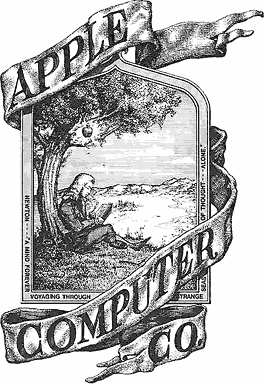
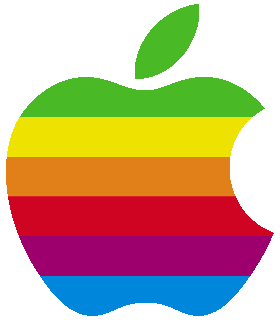 Apple also gave up its old logo (left), Isaac Newton sitting under an Apple tree, and adopted its striped apple-with-a-bite logo. Regis McKenna, then Apple’s PR firm, created the logo with five color stripes to show off the Apple II’s color display. It had a bite taken out of it to differentiate it from a tomato.
With its new logo and fancy display, Apple looked far more professional than the other exhibitors. Apple’s display was close to the entrance of the hall, so all the visitors saw it as they entered. Despite that, the few media representatives there did not even mention Apple’s presence.
Over the next few months, Apple promoted the value of its computers not only to businesses, but also to the general public. Most other computer manufacturers chose to pursue the hobbyist and small business markets; Apple stressed that theirs was a personal computer.

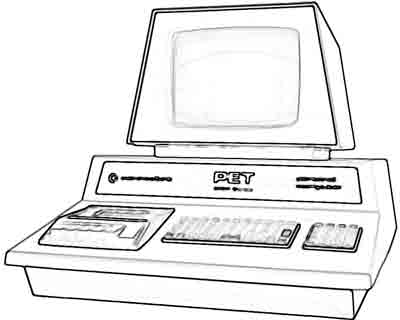 At the same time as the Apple II was introduced, two other computers were unveiled: Radio Shack’s TRS-80 (left) and the Commodore PET (right).
Their biggest advantage over the Apple II was price. They cost less than half as much as the Apple II. Moreover, both machines included tape drives, so their users did not need to carefully calibrate tape recorders to record data.
Wozniak’s Floppy Solution
Mike Markkula set Wozniak to work on devising a more reliable storage system for the Apple II, and he challenged him have it done by New Year’s Day so Apple could showcase it at the 1978 Consumer Electronics Show in Las Vegas.
Steve Wozniak and Randy Wigginton worked day and night during the week of Christmas devising Apple’s first floppy drive. Hours before the company embarked for Las Vegas, the system was finished. True to Wozniak’s reputation, the solution was very elegant and far less expensive than comparable products. After the show, Wozniak prepared the disk drive for release in June 1978. The first two units sold were hand-assembled by Wozniak and Wigginton.
In June 1979, Apple released the Apple II+, which shipped with 16 KB RAM and AppleSoft BASIC. The machine was a huge success. Released at the same time as the Apple II+, the SilenType was Apple’s first printer, a thermal printer that required special thermal paper.
Michael Scott declared the end of the typewriter, even though a hack was required to make the Apple II+ recognize lowercase or accented letters.
Early Software
The first software hit was written for the Apple II, VisiCalc. It was the first spreadsheet available for the personal computer (similar programs had been available on mini computers for some time).
Apple Writer, a word processor, was also very important to the success of the Apple. Unlike text editors of the time, Apple Writer was very easy to use and allowed for the creation of macros, speeding mundane tasks. To make use of uppercase and lowercase characters, the author of the program, Paul Lutus, had to employ a software hack that forced the machine to display both uppercase and lowercase characters.
VisiCalc was the Apple II’s killer application, and Apple II sales soared. With all of the new cash, Apple began three projects that would become its future: Sara, Lisa, and Macintosh.
Computers
Personalities
- John von Neumann, Wikipedia
- Alan Turing, Wikipedia
- Jack Kilby
- Mike Markkula
- Regis McKenna
Bibliography
Some of the sources used in writing this article:
- Apple: The Inside Story of Intrigue, Egomania, and Business Blunders, Jim Carlton
- Infinite Loop, Michael Malone
- The Second Coming of Steve Jobs, Alan Deutschman
- Apple Confidential 2.0, Owen Linzmayer
- Odyssey: Pepsi to Apple . . . a Journey of Adventure, Ideas & the Future, John Sculley
- Wikipedia
Keywords: #eniac #applei #apple1 #appleii #6502 #6502cpu #mostech6502
Short link: http://goo.gl/3saSLs
searchwords: apple1, applei, appleii
