
In the months following Steve Jobs’ dramatic return to Apple on 1996.12.20, the press lost interest in the end of Apple’s eleven year interregnum. Instead, they were interested in Apple’s brand new build to order online store, a first for a major computer industry player, and (to Apple’s embarrassment) Umax’s updated S900 Mac clone that was cheaper than a Power Mac and much faster, since it was designed to accept a 250 MHz NewerTech G3 processor upgrade.
The Apple brand was tarnished, no longer attracting the glowing press attention that once required a TV studio (named Apple TV) on Apple’s Cupertino campus so John Sculley, Steve Jobs, and Jean-Louis Gassée could pontificate on the tech issues on the day.
Under Michael Spindler, Sculley’s successor, Apple’s brand was further diluted. New brands proliferated: Peformas, Power Macs, and LCs for consumers. Power Macs, Quadras, Centrises, and PowerBooks for professionals. Few of the models were inspiring, merely solid. Apple continued to win design awards, but more for refined beige than the Macintosh, a breakthrough information appliance, or the Apple II, a computer for consumers and professionals. These changes did not suit Steve Jobs.
As Steve Jobs slowly consolidated control of the company, one of his top priorities was a rejuvenation of Apple’s image. This ultimately took the form of the immensely successful (and long lived) Think Different campaign.
Apple’s PR Problem
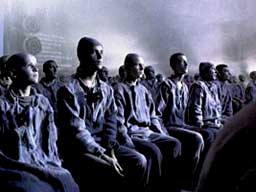
Image from Apple’s 1984 ad.
After Jobs’ departure from Apple on 1985.09.13, Sculley made many changes at the company. One of the first was a realignment of Apple’s marketing strategy. He, and the rest of the Apple board of directors were not particularly fond of the 1984 ad that had introduced the Macintosh during the 1984 Superbowl. Luckily, they were overruled by Jobs, Bill Campbell, Steve Wozniak, and Lee Clow (the creative director at Chiat/Day) – and 1984 became one of the most popular TV commercials in history.
Apple was not so lucky in 1985. The Lemmings ad was unpopular amongst the board of directors and Sculley, but Jobs and his coterie overruled the board again. The ad ran – and it was a flop. It was worse than mediocre (where people would simply fail to notice); it was bad. It offended many of the business people Apple was trying to court with the Macintosh Office and resurgent Macintosh.
Sculley fired Chiat/Day, which had handled Apple’s PR for its entire history, and refocused Apple’s marketing strategy on more conventional ads. The abstract ads were still there, but they were augmented by ads that trumpeted features and price more than brand image.
Perhaps because of the less inspiring image, Apple’s fortunes slumped in the mid-90s. It invested more than a billion dollars into the Newton, a project that was unprofitable and unpopular. It lost hundreds of millions of dollars between 1995 and 1997, cutting thousands of jobs and was eulogized in the press.
Apple might have been a lost cause, but Gil Amelio, the second CEO after Sculley, decided to raise cash, cut costs, and buy NeXT. He installed many of NeXT’s former executives in high positions at Apple, supplanting many of his handpicked subordinates (including Ellen Hancock). Jobs was given a seat on the board and on the executive board, which reported directly to Amelio.
Jobs was disgusted by the malaise at Apple, especially amongst its product development and marketing staff. He had courted the idea of taking the top job at Apple before (he even tried to convince Amelio, who was then a new board member at Apple, to back his coup against Michael Spindler), but now he thought Apple needed him,
On 1997.06.14, Jobs launched a palace coup against Amelio. He gave a damning speech to the Apple board of directors and successfully had Amelio sacked, although he didn’t get the top job himself. Instead, he acted as de facto CEO.
Jobs occupied the board room and a small neighboring office in City Center 3, then Apple’s headquarters building, and began making deep cuts to Apple’s research and development division. Amelio had reduced 350 projects to 50, and Jobs cut that number down to 10. He turned Apple’s convoluted (and often overlapping) product line into a simple product matrix. He also “green lighted” a radical research project at Apple, the Mac NC (for Networked Computer), which eventually evolved into the iMac.
All the structural changes in the world would not save Apple, however. The company’s image had been sullied by its hard times, and it had shed the image of David to IBM’s (or Microsoft’s) Goliath. Apple was a tired company with tired products and boring leaders. The real clout was in new startups like Real and Yahoo!
Jobs, in what was by now typical behavior, took on the problem personally instead of delegating it to one of his subordinates.
New Marketing Strategy
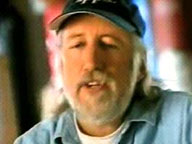
Lee Clow
Jobs invited three ad agency reps to present new ideas. Lee Clow, now the creative director for Chiat/Day, was one of them. On 1997.08.03, he presented a new slogan and aesthetic for Apple’s ads: Think Different (perhaps a reference to IBM’s famous THINK slogan) and montages of artists and creative professionals using the Mac. In an interview with Electric Escape, Clow said that he wanted to feature filmmakers at Dreamworks SKG working on their Macs.
Jobs was enamored with the concept,* though now using anonymous figures. And instead of Dreamworks filmmakers, he wanted to use celebrities and thinkers.
Jobs had long been a fan of black and white portraits and prints. NeXT’s offices were decorated (expensively) with poster-sized prints from Ansel Adams, and Jobs’ manse in Los Gatos was decorated with black and white portraits of his heroes, including Albert Einstein. He began brainstorming on the spot. Chiat/Day was reinstated as the chief advertising agency, and Lee Clow became a regular presence on the Apple campus.
Although the ad was produced entirely by Chiat/Day staff (on Macs, of course), Jobs (sometimes with marketing staffers) reviewed revisions at every step of the process. He used a satellite uplink between City Center 3 and Chiat/Day’s Venice offices to review the clips in full video instead of relying on the mail or compressed files.
The Creative Process

Chiat/Day used a totally computer based creative environment. Jobs gave the group 17 days after approval to complete the entire campaign. That included the television commercial and billboards for major markets such as Los Angeles and New York.
An ordinary campaign for a more obscure client (or even Apple under Amelio) would have taken much longer just to get rights to the images. Jobs was particularly useful when Clow and his team needed to get usage rights from celebrities including Joan Baez (Jobs’ ex-girlfriend) and Yoko Ono (once a neighbor near Central Park when Jobs lived in the San Remo and Yoko in the Dakota).
If Clow had approached these people’s publicists, he would be another adman. When Jobs called, he was a friend and a cult-figure in computer history.
The television commercial was produced using an Avid 4000 system on a Macintosh with Adobe AfterEffects. Jennifer Gulab, who worked on the television commercial, worked very closely with Jobs via satellite link. The two were in contact daily, working out which images would be used (a choice largely based on the availability of images and permissions), the music, and the narration, which was done by Richard Dreyfus.
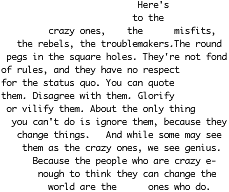
Dreyfus read a free-verse poem, “Here’s to the Crazy Ones”, written by a Chiat/Day copywriter Craig Tanimoto. This was used extensively throughout the entire campaign.
The first rule of the campaign was that there would be no products in the ads. Clow and the rest of the creative team were very concerned with appearing to exploit the artists who’s images they used.
Instead of being paid, all of the participants (or their estates) were given money and computer equipment to be donated to the charities or non-profits of their choice.
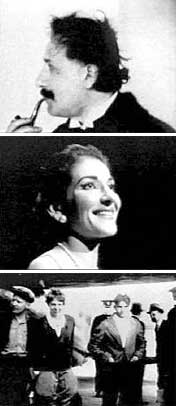
The print and billboard ads were also unique. Instead of sticking to Mac and general computing magazines, Apple bought space in popular magazines and fashion magazines. Outside advertisements were practically unheard of in the computer industry, but Chiat/Day rented hundreds of major spaces in New York and Los Angeles – and still does.
Since they had little time, instead of making full scale replicas of posters for bus stations or billboards in major cities, Jessica Schulman just imposed her mockups onto street scenes to give her colleagues an idea how her designs would look. She also collaborated with Jobs, exchanging images on the Internet and making constant revisions.
Reaction
The campaign debuted on 1997.09.28 and was remarkably popular. Unlike some of Apple’s earlier major campaigns (such as the “Power to be your best”), it received glowing press writeups.
The new campaign was a turning point for Apple. On September 30, two days after the debut, Jobs threw a party for Apple employees at his Palo Alto home where he talked about the campaign and Apple’s future in general. It began as a critique of Think Different but eventually turned into a rousing pep rally for Apple’s image: “our brand is the most – or at least one of the most – valuable things we have going for us now” (DaveNet) and the company’s future in general. It “only took 15 . . . 30 . . . maybe 60 seconds” to reestablish Apple’s counter-culture image that it had lost during the 90s (DaveNet).
The ads won a slew of awards and developed a cult-following. After the first campaign, Apple started sending complimentary posters to public schools across the nation featuring different celebrities (including Pablo Picasso, Jane Goodall, and Ron Howard) to hang in classrooms. The complete packets now sell for hundreds of dollars on some websites.
Apple maintained the campaign until 2002, and some of the early Apple retail stores featured Think Different tableaus and “Here’s to the Crazy Ones” on the walls before Apple moved to Switch.
This article was first published 2007.04.09.
* Rob Siltanen, the creative director and managing partner at TBWA/Chiat/Day at this time, was intimately involved in developing the “Think Different” ads and tells a very different story in December 2011. siltanen says Jabs was “blatantly harsh” at first, but eventually warmed to the idea.
Sources
My main sources were an interview with Lee Clow’s creative team at Chiat/Day produced for Macworld San Francisco, Electric Escape, and The Second Coming of Steve Jobs. Other sources are linked within the article.
Keyword: #thinkdifferent
Short link: http://goo.gl/XduViO
searchword: thinkdifferent
