
Apple has used the SCSI bus since introducing the Mac Plus in 1986. The SCSI bus must have termination power for clean data transmission. Most Macs provide termination power for the SCSI bus, so most SCSI devices for the Mac don’t need to provide it.
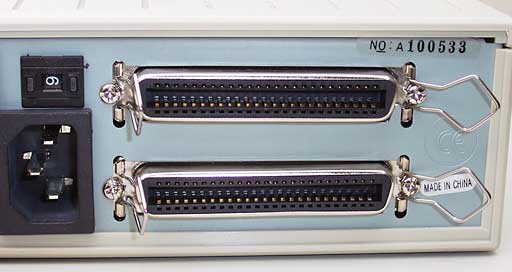
Ports on a SCSI hard drive.
However, the Mac Plus, Mac Portable, 100-series PowerBooks, 500-series PowerBooks, and the PowerBook 1400 don’t supply SCSI termination power (see Which Models Provide SCSI Termination Power?). Neither do Macs using IDE drives, such as the Quadra 630 (a.k.a LC 630, Performa 63x) and many Power Macs (except for the 6100 and 7100-9600, all Power Macs use IDE drives).
This may apply to some Maclones as well. However, Umax assures me this is not the case with the Umax SuperMac C500 and C600. I’ve heard the same for the Motorola StarMax models with IDE drives.
All Apple and some third-party SCSI hard drives provide SCSI termination power. This is essential for these drives to work with the Plus, Portable, and most PowerBooks.
This is an important issue, because if you are using an external drive that provides SCSI termination power on a Mac that doesn’t provide it, your Mac will hang if you turn off the hard drive before turning off the computer. Also, the system may not boot from the external drive if it is not powered before turning on the Macintosh.
The source of the problem is a corrupted SCSI bus. Without termination power, noise on the bus can prevent startup and cause a lockup.
This is one reason Apple has always recommended you power up all SCSI devices before or at the same time as starting the computer, but never after the computer is running.
This is a good argument for buying only SCSI hard drives with active termination, allowing them to determine what level of termination (if any) is required in a given situation. (Of course, only the last device in a SCSI chain is normally terminated. If you have devices with active termination, one of them should be at the end of the chain with termination enabled. Other drives should have termination turned off.)
Additonal Resources
- Termination Explained (Low End Mac Tech Journal)
- Macintosh Makes the Connection, an examination of Mac ports (Low End Mac Tech Journal)
- SCSI Throughput (Low End Mac Tech Journal)
- Which Model Provide SCSI Termination Power? (Apple TIL)
searchword: scsitermination
