
After introducing the inexpensive Classic and LC, the workhorse IIsi, and the wicked fast IIfx in 1990, what could Apple do for an encore?
System 7
For starters, they could release System 7, the first version of the Mac OS that automatically supported running multiple applications at the same time. (This had been optional under System 6.)
System 7 innovations included color icons, separate folders within the System Folder for control panels and extensions, Personal File Sharing, virtual memory (which requires a 68030 or later), and 32-bit addressing, which broke the 8 MB memory barrier.
At the same time, Apple introduced QuickTime, followed by a scanner and a 21″ color monitor in September.
In October, one year after introducing the Classic, LC, and IIsi, Apple rolled out six new models, perhaps its most ambitious product introduction ever.
The New Entry Level
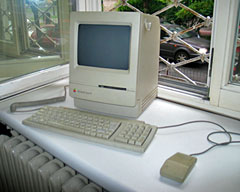
Although the Classic would remain in the line for another year, the Classic II was heir apparent in the compact Mac realm.
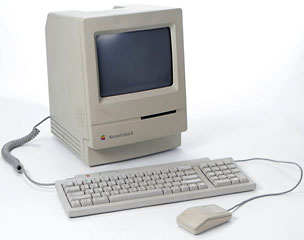
Replacing the beloved SE/30, the Classic II initially appeared a worthy successor. It shared the same 16 MHz 68030 processor and 9″ b&w screen as the SE/30, but in the more stylish Classic case. (The Classic II motherboard was available as an upgrade for Classic owners.)
However, the last Mac designed around that tack-sharp 9″ b&w screen was compromised, sharing many of the same compromises introduced with the Mac LC. The worst, especially as far as the performance oriented crowd was concerned, were its 16-bit data bus, which was a bottleneck for a 32-bit processor, and its 10 MB memory ceiling (the SE/30 supported up to 128 MB). On top of that, the Classic II didn’t have an expansion slot, a feature that had allowed SE/30 users to add an ethernet card, video card, or faster CPU.
Those in the know began to hoard SE/30s, which remained popular on the used market for years.
Still, Apple managed to offer 75% of the performance of the SE/30 for a fraction of the cost of the older model – and it was a real improvement over the 8 MHz Classic with its 4 MB memory ceiling.
Quadra: The Fourth Macintosh Generation
 The Mac started out with the Motorola 68000 processor, briefly adopted the 68020, but soon replaced it with the 68030 (although Apple took a step backward and used the 68020 on the 1990 Mac LC).
Motorola introduced the 68040, a much more efficient CPU with a built-in math unit and a larger data cache. MHz for MHz, the 040 was about two-and-a-half times as powerful as the 68030. Part of this was due to the larger on-chip cache, part to the integrated FPU, but much of it came from other improvements in CPU design.
In many ways, the 68040 paralleled the 80486 of the DOS world. Both had larger caches, integrated math processors, and further optimizations over the previous generation CPUs.
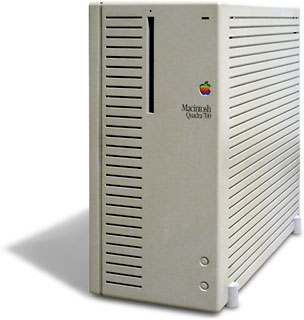
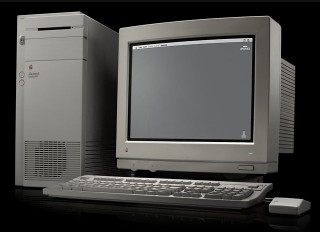
Apple embraced the 68040 in the 25 MHz Quadra 700 and Quadra 900, which benchmarked at 2 to 3.5 times the performance of the 25 MHz 68030-based IIci.
 There were initial teething problems, as a lot of older programs proved incompatible with the larger caches in the 68040, the new buffering schemes, and even sometimes the small changes in memory management. Most could be addressed by disabling the on-chip cache, but that made the ‘040 no faster than the ‘030 – and users wanted the new level of performance.
For sheer power, the Quadras left 1990’s “wicked fast” 40 MHz Mac IIfx in the dust. They also marked the wave of the future – all 68040-based Macs can run Mac OS 8.0 and 8.1, but those operating systems are not officially supported on 68030-based Macs. (A program named Born Again makes it possible to run Mac OS 8.0 and 8.1 on most 68030-based Macs with at least 8 MB of RAM.)
Software vendors were quick to release patches or updated versions of their programs, since Mac power users wanted to use the full power of their Quadras.
There was still a strong community of Quadra users in the late 90s. We were a disappointed when Apple has left us behind after Mac OS 8.1, which we also recognize as a lot more operating system than we anticipated when we bought our 68040-based Macs. The first Low End Mac email list, Quadlist, was created for Quadra users (it has since been rolled into our Vintage Macs group).
PowerBooks: Really Portable Macs
In some ways, Apple blew it with the massive Mac Portable. Sure, up to 10 hours of battery life was great, the active matrix screen was crisp, and the keyboard was excellent, but it was big and very heavy.
Apple took the bull by the horns and released three innovative, far more portable models in October 1991. All models shared an innovative new design with the keyboard located near the screen and a trackball positioned forward of the keyboard for easy access. All units also had 1-bit black & white 640 x 400 screens.
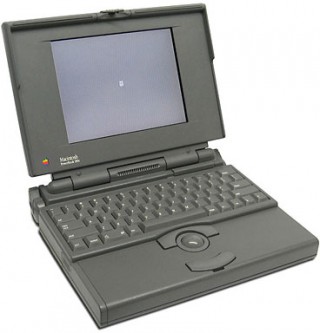 The least expensive, actually built by Sony for Apple, was the PowerBook 100. The PB 100 was essentially a size reduced Portable. It used the same 16 MHz 68000 CPU, could be expanded to 8 MB of RAM using pseudostatic RAM, and sported a 1-bit screen. To reduce costs, the screen was smaller and used passive matrix technology. And to reduce size, the floppy was external. The battery was good for only about 2 hours of use, but the PB 100 was also one-third the weight of “the incredible bulk”.
Unfortunately, this was probably the least popular PowerBook model, and Apple ended up nearly liquidating inventory – at which time everyone suddenly wanted one!
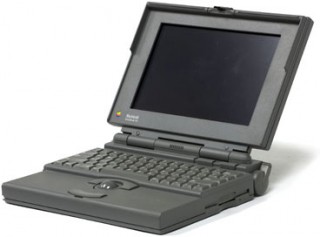 The PowerBook 140 and PowerBook 170 both used the more powerful 68030 CPU. The 140 ran at a pedestrian 16 MHz, providing little benefit over the PB 100, since it was also limited to 8 MB total memory. Like the Portable, the PB 140 and 170 have a built in floppy drive, which many users insisted on.
The hot PowerBook was the 170. Running at 25 MHz with a math coprocessor, the 170 was pretty much like having a IIci in the field. Best of all, the active matrix screen on the 170 was the best any laptop offered in 1991.
These PowerBooks shaped all future portables, since the rear-mounted keyboard and front-mounted trackball (or trackpad later on) are pretty much taken for granted today. Is there any other way to make a laptop?
And for Apple, it meant Mac users no longer had to buy DOS laptops so they could work in the field. In fact, Apple began to dominate the laptop market.
Next – 1992: Performas, Quadras, and PowerBook Duos
Keywords: #system7 #macclassicii #quadra700 #quadra900 #powerbook100 #powerbook140 #powerbook170
Short link: http://goo.gl/ZMPqrI
