
1999: The first Macs were odd computers – integrated machines in an era of mostly modular computers.
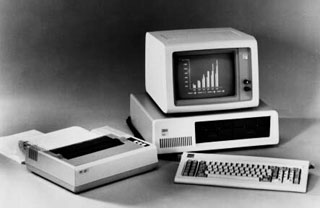 The design we all know from the IBM world dominated: a separate keyboard for input, a monochrome or color display, and a separate box containing the CPU, drives, video card, etc. (I used to work in retail and still recall the woman who wanted to buy “a three piece computer”.)
In most cases, the box was about 18-20″ (45-50 cm) wide, about 5″ (12.5 cm) tall, had several drive bays (usually black, always 5.25″) on the front, and was used to support the monitor.
Except for a few portable systems with tiny 5-7″ monochrome screens, that’s what computers looked like.
Enter the Macintosh
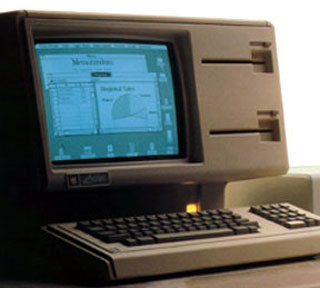 Apple’s Lisa wasn’t that different from the other computers. It was wide, had a 12″ black and white screen, and didn’t look too different from other computers from a distance.
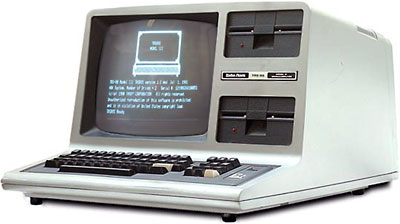 After all, computers with 5-1/4″ drive bays beside the screen went back to the Radio Shack TRS-80 Model III – and probably earlier.
Really, the only things that visually distinguished the Lisa were the graphical display and the mouse.
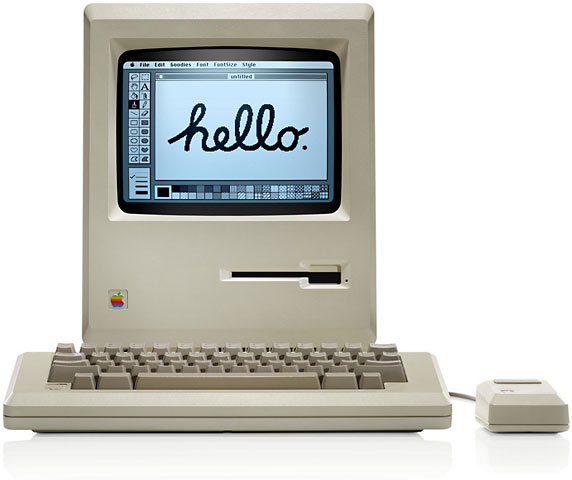 But Apple went beyond that in 1984, when it introduced a vertical computer with an integrated screen. The original Macintosh, like many that followed it, had a 9″ b&w 1-bit screen providing a tack-sharp 512 x 342 pixel display.
Instead of a wide, deep box, the Macintosh was just 9.6″ (24 cm) wide and 10.9″ (27.5 cm) deep. It had a smaller keyboard than the Lisa, since Apple dispensed with the numeric keypad.
Overall, it was a tiny computer, one many DOS geeks considered little more than a toy.
On the other hand, it was compact enough that an industry arose making carrying cases for the it.
 Apple continued to build Macs in that form factor from 1984 until the Classic II was discontinued in 1993. The best of the bunch was the SE/30 (left). It ran a 16 MHz 68030, had a math co-processor, supported up to 128 MB of memory,* and had a single expansion slot.
Because of it’s speed, size, and expandability, the SE/30 became very popular as a server – and as a personal computer. Today there’s still a solid (albeit small) market for used SE/30s.
Beyond Black and White
 Apple took the compact Mac to the next level in 1993 with the Color Classic. It had the same memory and bus limitations as the Classic II (10 MB maximum RAM, 16-bit data path to a 32-bit CPU), was larger than any previous compact Mac, but offered a color display and an expansion slot (which the Classic II lacked).
It’s another popular machine on the used market, and especially nice with a 68040-based accelerator installed. (See our review of the Sonnet Presto.)
The Color Classic begat the Colour Classic II, which ran a 32 MHz processor on a 32-bit bus and raised the memory ceiling to 36 MB. In terms of performance, it was the pinnacle of the compact Mac line.
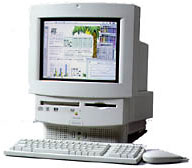 Then Apple blew it – it completely phased out the compact Macs for bigger integrated Macs, the 500 series. These models basically grafted a 14″ monitor and a CD-ROM drive onto an LC III, creating a larger Mac that was very popular in the education market.
I’m not knocking the 500 series, or the PowerPC-based 5000 series that followed it, but they didn’t have the appeal of the old compact Macs.
Enter the iMac
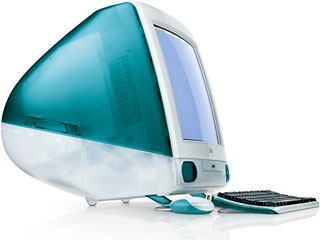 It almost came full circle last summer, when Apple introduced the iMac. Shorter than the 500 series, but deeper and broader, the iMac became the top consumer computer of the year.
In many ways, it returned Apple to its compact Mac roots: the monitor integrated with the CPU and drive, with a separate mouse and keyboard.
Still, nice as the iMac is, it’s not a compact Mac. The main unit needs over twice the desk space of the earliest Macs with its 15.2″ x 17.6″ (38 x 44 cm) footprint. And at 38 pounds (17.3 kg), it’s not something you’re likely to pop in a case and haul from place to place. (I used to do that with my Mac Plus!)
The SE/G3 or iClassic?
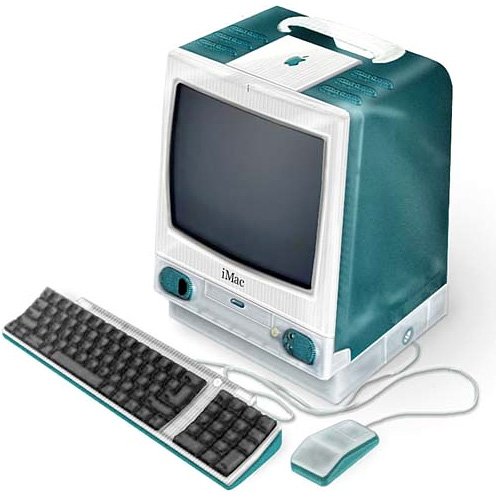 What if Apple were to take everything it’s learned from the iMac, the Blue & White Power Mac G3, and the iBook – and apply it to a new generation of compact Macs? (The image to the right is adapted from one by Jeff Foster that was originally posted on the MacAddict site.)
Of course, it would have all the standard features of the iMac: USB, IDE hard drive, CD-ROM, ethernet, international power supply, 32-64 MB of RAM, accelerated video, FireWire, speakers, etc. However, Apple could leave out the modem or make it an option.
First, it has to be about as small as the Plus, SE/30, and Color Classic – no more than 15″ tall, 10″ wide, and 13″ deep.
Second, the iClassic should come in two versions: one with a grayscale display, the other with an internal color monitor. The monitor should support at least two resolutions: 512 x 384 and 640 x 480. The lower resolution setting would match the Color Classic, while the higher resolution would be about all you could expect on such a small screen.
Additionally, there should be a VGA port on the back that allows either mirroring the internal display or use of a second independent monitor.
Third, it obviously must have a CD-ROM drive. Instead of the traditional drawer-loading style, Apple should look at the kind of slot-loading CD players we have in cars today and search for a drawerless CD-ROM drive. This should make for a much slimmer profile. And the drive would mount right below the screen, just like the floppy drive on the old compacts Macs.
Fourth, the motherboard should be readily accessible, using the slide-out design of the Color Classic, 500 series, and Quadra 630 – or the innovative drawbridge design of the Blue & White Power Mac G3.
Fifth, build in an AirPort antenna to make it more useful in the field.
Sixth, Apple should think different and consider some of the following innovations. Remember, Apple is working toward a more unified architecture, so adapting features from other Macs shouldn’t be difficult.
- One short PCI slot for AirPort, SCSI, a modem (analog, cable, DSL), whatever.
- An optional battery for sleep mode, allowing transport of iClassic without need to reboot. Also acts as short-term UPS during power failure, maybe 5 minutes.
- Instant on feature similar to iBook.
The iClassic would be very transportable and easily connected to a larger screen or LCD projector when necessary. It would make a great dorm room computer – or a nice, inexpensive, compact server.
Apple could market the iClassic as the iMac’s little (slightly more versatile) brother, maybe selling it for $200 less than the larger, heavier iMac.
* Only System 7 and later support 32-bit addressing and RAM beyond 8 MB, and the SE/30 also requires Mode32 software to permit use of 32-bit addressing. Then you can use up to 128 MB of system memory.
“iClassic” image reduced from an original by Jeff Foster, Digital Imagician & Pixel Painter. The image is copyrighted by Jeff Foster and is used with his kind permission.
keywords: #iclassic
short link: https://goo.gl/cPYTW9

