
There’s a lot to like about the iMac: styling, size, price, value, and a willingness to venture into new territory. Face it: No Wintel company has completely abandoned their traditional ports to go exclusively USB.
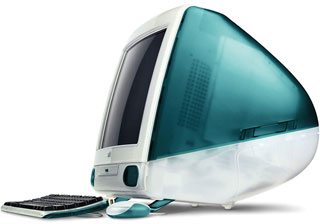 I really like the compact iMac keyboard. By moving the arrow keys from their usual position to below the right Shift key, it’s probably 3-4″ narrower than Apple’s Extended Keyboard. And by putting half-width F-keys right flush with the top row of regular keys, it saves 2″ in that direction.
As the owner of a too-small computer table, I find that attractive.
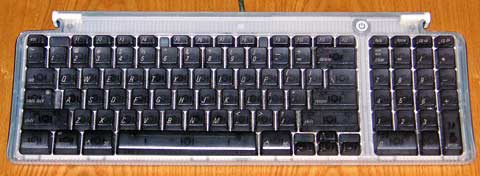
But Apple didn’t just rearrange keys from the Extended Keyboard. This morning I noticed that some key are simply missing. (As always, this is based on photographs of prototypes. There is a chance Apple has made changes to the keyboard since then.) [Update: The keyboard released with the iMac on August 15, 1998 matches the ones in online photos. The above photo shows the iMac keyboard.]
- As with the PowerBooks and Wintel computers, F-keys are numbered F1 through F12. The Mac has had F13, F14, and F15 since the first Extended Keyboard shipped in 1987. I’ve been using F13 as a print key for years, and F15 as a catchall for special macros. (I hope QuicKeys will work with USB keyboards!)
- Help, Home, Page Up, and Page Down remain, but End is gone, as is the [forward] Del key. Again, these are keys I’ve grown used to. QuicKeys sets Home to bring you to the top of a document, End to bring you to the end. But End is gone.
- The loss of Ctrl and Option keys on the right side of the space bar isn’t a big deal, but it may make some key combinations a bit more difficult.
None of these are reasons to dismiss the iMac, which may be Apple’s greatest computing value ever. But for the Mac user used to these keys, especially the QuicKeys user, their loss will be an adjustment.
Additional Resources
- Macally iKey, a full-sized 105-key USB keyboard – no missing keys
- Guide to USB Keyboards, MacUSB
Keywords: #imackeyboard #appleusbkeyboard
seachword: imackeyboard
