
Hello (again).
Do you remember the first Mac, the one that didn’t even have a model number? The amazing 8 MHz 68000 CPU, crystal clear 9″ b&w screen, huge 400 KB floppy drive, and radical mouse?

Fast forward from 1984 to 1998. Using up-to-date technology, Apple created a worthy successor to the original Macintosh as a fully integrated computer. No separate monitor, no rat’s nest of cables, and no external drives necessary.
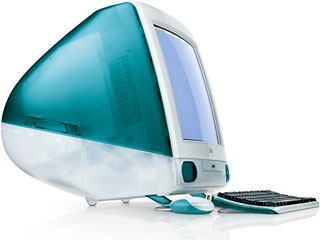
With a 233 MHz PowerPC 750 (the same G3 CPU used in the Beige Power Mac G3), 32 MB of RAM, a 4 GB hard drive, a 24x CD-ROM, ethernet, stereo speakers, and an integral 15″ multiscan monitor, there’s not much you’ll need to add.
Beyond recapturing a vision and providing the same usability other Macs do, the iMac breaks new ground for an Apple desktop with its Bondi (pronounced bon-die) blue color, two USB (universal serial bus) ports and an infrared port – and no floppy drive, SCSI connector, serial ports, or plugs for ADB devices.
- Got an iMac? Join our iMac group or iMacs & eMacs forum.
- Our Mac OS 9 Group is for those using Mac OS 9, either natively or in Classic Mode.
- Our Puma Group is for those using Mac OS X 10.1.
- Our Jaguar Group is for those using Mac OS X 10.2.
- Our Panther Group is for those using Mac OS X 10.3.
The iMac’s firmware is stored on the same card that holds the CPU and memory chips. If firmware hasn’t been updated and your iMac is acting up, swapping the CPU card from a known working iMac will usually fix things. Then update the firmware in the other iMac.
- iMac speed tip: if you have Virtual Memory on and only 32 MB RAM, set VM to 64 MB for faster performance.
- If you are using Mac OS 8.1, be sure to download iMac Update 1.1 later from Apple if you use any non-Apple USB devices. Apple also recommends iMac Update 1.1 for use with Mac OS 8.5 and 8.5.1. Note that OS 8.5.x and Update 1.0 must be installed before the 1.1 update is installed.
- According to Apple, iMac Update 1.2 should be installed on all iMac computers used in NetBoot client environments.
- If you are running Mac OS 8.6, Mac OS ROM Update 1.0 should be installed. You must have 8.6 installed before running this update.
- For more information on firmware updates, see iMac: When to Install Available Updaters.
If you have a hard drive larger than 8 GB, you should partition it so that the first partition is under 8 GB in size (for simplicity, we suggest 7 GB). Failure to do this could eventually result in an unbootable computer, as all System files must be within the first 8 GB of drive space. These Macs can work successfully with larger drives for some time, but once a System files goes outside of the first 8 GB of space, you’ll have nothing but problems.
Mac OS X
If you have a hard drive over 8 GB in size, you must partition it or you will not be able to install Mac OS X. If you are creating the partition within OS X, it must be smaller than 7.4 GB as reported by Disk Utility (because sometimes a GB is billion bytes and sometimes it’s 1,073,741,824 bytes); we suggest simply setting it at 7 GB to avoid having to redo the whole installation if the partition ends up bigger than specified (it happens). Mac OS X must be completely within the first 8 GB of space on your hard drive or you will not be able to run OS X.
Tray-loading iMacs cannot boot from USB drives (see Apple Knowledge Base Article #58430, USB Info and Benefits of Dual-Channel USB).
Non-Apple upgrades and peripherals (such as unsupported USB devices, replacement drives, and third-party memory) may cause problems when installing or booting into Mac OS X.
Be sure that your iMac’s firmware is up to date before you install Mac OS X, and read and follow all of Apple’s “Read Before You Install” instructions to increase the likelihood of getting OS X installed and running on the first try.
The classic Mac OS identifies some 64 MB memory cards as only 32 MB, however OS X will correctly identify them and use all of their memory.
NOTE: The Sonnet HARMONi upgrade card, which includes a faster CPU and FireWire, was incompatible with early versions of Mac OS X 10.4. The FireWire port would tie up 100% of CPU resources. This problem was fixed in version 10.4.7 (if not earlier). If you have a HARMONi card that’s had this issue, be aware that updating to 10.4.7 or newer should fix it.
Cautions
- You cannot plug the iPod shuffle directly into the iMac’s USB port – it will not fit. It will not charge if plugged into a keyboard USB port or an unpowered USB hub. To charge it while using it with your iMac, you must us a USB extension cable, powered USB hub, iPod shuffle dock, or a USB power adapter.
- Be sure to download iMac Update 1.1 or later from Apple if you use any non-Apple USB devices
- iMac iNfo (1998.08.30, dead link) noted that brownouts can put the iMac into a coma. Solution: Buy an uninterruptible power supply.
- You must have the keyboard plugged directly into an iMac USB port to boot with the power key; it will not work if the keyboard is attached to a hub.
- You cannot boot the iMac from an external USB drive.
- The iMac loads the MacOS Toolbox into RAM, unlike other Macs which use it from ROM. You lose the use of 3 MB of memory but gain faster performance.
Details
- announced 1998.05.06; North American release on 1998.08.15 at $1,299; replaced by Revision B 1998.10.17
- Requires Mac OS 8.1 with MIB 1.0 enabler or later, 10.3.x officially supported, 10.4.x can generally be installed using XpostFacto 4
- CPU: 233 MHz PPC 750
- Bus: 66 MHz
- Performance: 4.5 (estimated, relative to 7500/100); 7.8, BYTEmark; 109.5 Speedometer; 696, MacBench 5.0
- RAM: 32 MB, possibly expandable to 768 MB using two DIMM sockets, uses same SDRAM SO-DIMM as PowerBook G3, top DIMM socket accepts 2″ DIMM, bottom socket takes 1.5″ DIMM. All tray-loading iMacs work with modules up to 128 MB. Field reports indicate that they will work with 256 MB and 512 MB modules as long as they are “CL2” modules. With a 512 MB module and a low-profile 256 MB module, it’s theoretically possible that these iMacs could support 768 MB of RAM.
- VRAM: 2 MB SGRAM, expandable to 4 MB or 6 MB using SGRAM SO-DIMMs
- Video: supports resolutions of 640 x 480, 800 x 600, and 1024 x 768 using ATI Rage IIc chip set, 2 MB provides 16-bits at maximum resolution, 24-bits at other settings, will support resolutions to 1600 x 1200 on an external monitor
- Display: 15″ CRT (13.8″ viewable) multiscan to 1024 x 768
- L2 cache: 512 KB 2:1 backside cache
- Hard drive: 4 GB EIDE drive. Maximum IDE drive size is 128 GB without third-party support. See How Big a Hard Drive Can I Put in My iMac, eMac, Power Mac, PowerBook, or iBook? for your options.
- CD-ROM: 24x
- SCSI: none
- PCI slots: none
- PMC (mezzanine/Perch) slots: one
- Microphone: built in (above monitor), standard 3.5mm minijack compatible with line-level input including Apple’s PlainTalk microphone
- USB: 2 USB 1.1 ports on a single controller, require OCHI compatible devices (some early USB peripherals may not be compliant)
- Modem: built-in v.90 56k modem
- Ethernet: 10/100Base-T
- infrared: 4 Mbps IrDA 1.1
- WiFi: AirPort not supported
- Power supply: 200W
- PRAM battery: 3.6V half-AA
- Height: 15.8 in/39.5 cm
- Width: 15.2 in/38.0 cm
- Depth: 17.6 in/44.0 cm
- Weight: 38.1 lb/17.3 kg
- part number: M6709
- family number: M4984A
- Model identifier: iMac,1
Online Resources
- See online resources for: Original iMac (Rev. A)
Suggested Accessories
- UniSwitch, iMacButton, and iSafe makes resetting much easier.
- A more conventionally shaped mouse. We’re huge fans of the Contour UniMouse.
Keywords: #imacreva #originalimac #trayloadimac #imacg3
Short link: http://goo.gl/bPB2ng
searchword: imacreva




