
Once a Leader, Apple Now Follows the Pack
Low End Mac Reader Specials
Memory To Go Special: New 2008 iMac 2GB $42 / iMac Intel Core2 DUO & MacBook Pro 2GB $36 - 1GB $20. MacPro 8 Core Memory 4GB kit $154 / 2GB kit $94 -- Free shipping available.
Download Typestyler, still the Ultimate Styling Tool for Internet, Print and Video Graphics. Works great in Classic with a Native OS X Version on the way. Free Tryout: www.typestyler.com
LA Computer Company: Specials on AppleCare, iMac's, Apple Batteries and Apple A/C Adapters. Also Great prices on Used Apple Computers. Call 1-800-941-7654 Click Here.
OWC: NewerTech NuPower Batteries for iBook and PowerBooks Designed+Built in USA to run longer, LAST LONGER TOO! Free Battery Recycling Return Label; Quality High-Capacity from $99.95
Mac users can finally play Party Poker for Mac. Not only that, they can also learn how to play PokerStars for Mac.
Laptop Hardware Provided by TechRestore - Overnight Mac & iPod Repairs.
Compare products like desktop computers, laptops, and LCD TVs side by side! All the information and reviews to make the best purchasing decision for a new cell phone GPS products or MP3 players. The Ciao network makes searching products easy for you.
MacPro Memory 667Mhz With Apple Spec Heat Sink 2GB $ 82 / 4GB $128 / 8GB $256 - Click to Maximize your Macs...
- 2005.08.12
When you take a phenomenon and look back to put the whole picture in perspective, the landscape can reveal some fascinating shapes and colors.
More or less a decade ago, the Macintosh was a closed, tightly integrated platform. Today, it increasingly looks like a PC - minus hardware clones and the Windows operating system.
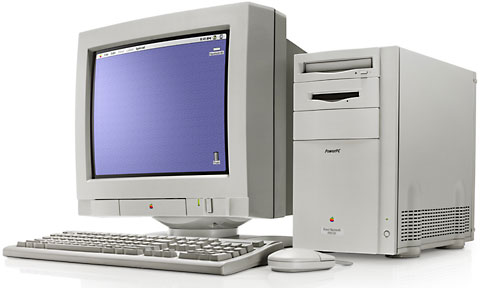
For almost a decade, the Macintosh was in a world of its own. With its object-oriented operating system; Motorola processors; NuBus slots; Apple Desktop Bus; nonstandard serial, network, and video connectors; and SCSI hard drives, the Macintosh was a bit of an oddball in a computer industry that revolved increasingly around the Windows/Intel standard.
Conformity
Apple's focus was on ease of use and performance, even if it meant selling machines at higher prices. Its competitors cared more about price and didn't catch up with Apple's user-friendliness obsession until much later.
In the mid-90s, Apple started building the Mac around a more open architecture by adopting some standard PC components - and by licensing some vendors to build and sell Macintosh clones. The clone licenses were terminated when Steve Jobs came back to Apple a few years later, but the movement toward industry standard components hasn't stopped.
If you look at today's Mac, you can see how the platform has changed. Apple gradually adopted IDE/ATA drives, PCI slots, standard video and network connectors, and USB, among other things. Some "Windowsish" features have become part of the Mac OS. For example, when Mac OS 8 came out, contextual menus and "sticky" menus became part of the Mac OS.
The biggest change ever looked scary at first: Apple announced that it will dump the PowerPC processor in favor of Intel's chips.
Even one-button mouse couldn't resist the revolution when Apple realized that it needed to offer its own programmable multibutton mouse (the Mighty Mouse) to the general public.
In two years, Macintosh hardware will almost be the same as a Windows PC - except that it will run Mac OS X. Apple's philosophy shows itself more in its system software, software-hardware integration, and general innovation than in building the best possible machine.
Mistakes?
Was Apple wrong with its initial choices?
That's a tough call to make, especially since every step toward industry standards has been followed by loud boos from some of the Mac's most loyal fans.
If Apple sacrifices overall hardware quality for better prices and slowly realizes that it sometimes has to follow the PC herd, it also means that the company is eliminating barriers to the Mac's adoption. Fundamentally, it means that standardization can be a key to survival, especially when Apple's market share stands at 2.5%.
Many questions remain: Why choose more expensive components when, in the end, Apple's philosophy shows through its system software? Why ignore the multibutton mouse for so long when there was demand for it? Why choose the PowerPC architecture, only to dump it after hitting a development ceiling?
The answers may not be obvious.
More importantly, how much further can Apple take the Mac towards standardization without hurting its credibility? The switch to Intel chips leaves many of us scratching our heads, especially when we remember Apple's claims that the PowerPC was technologically superior to anything x86.
Identity
Are we just running PCs with a Unix-based operating system? Are we realizing that as the years go by, our platform is taking the road to conformity?
Do we still "Think Different"?
How different are we thinking nowadays?
One of the elements that makes the Mac attractive is the impression that Mac users are different from the masses, the black sheep who escape the conformity of Microsoft's powerful software monopoly.
In a way, it's hard to admit that the dissimilarity dwindles with time. It makes some Mac users feel like rebels without a cause, and a few even think that if Apple keeps adopting PC standards, getting a PC may be the right thing to do in the future. I find this argument ridiculous, but I have heard it often enough to know that there are Mac users who are serious about it.
In my opinion, Mac OS X that stands out as the main reason to stick with Apple. The security offered by the current Mac OS, its ease of use, its larger commercial software selection than most Unix systems, and Apple's swift development give the Mac a unique mix.
Apple's innovations have to be kept in mind, too. It's always great to be among the first to benefit from the neatest products to hit the market, such as the iPod.
I do have the impression that Apple could make a little effort
to strengthen the Mac identity again. A new campaign designed to be
the successor to Think Different would certainly be appreciated, so
that when we acquire our next Macs some of us "forget" that they
have "Intel inside".
Recent articles by Michel Munger
- Thunderbird 2.0: A simple, powerful, free email client, Macinthoughts, 04.25. Mozilla Thunderbird doesn't suffer from feature bloat like most commercial email programs. It puts the focus on doing what you need efficiently.
- A decade of progress, Macinthoughts, 04.09. 10 years ago, Windows 95 was a mess, System 7.5 was becoming unstable, and Apple's future was in doubt. Today OS X is rock solid, Vista has learned from Apple, and Apple is a runaway success.
- Entourage, the best overall email software on the market, iBasics, 12.08. Microsoft's email client is easy to use, integrates with Office, is sluggish, and can only be purchased as part of Office.
- Eudora, the Mac's most powerful email client, iBasics, 12.01. If you're looking for lots of power and don't mind an unconventional interface, give Eudora a try.
- More in the Macinthoughts index.
Links for the Day
- Mac of the Day: Centris 650, Feb. 1993 - The replacement for the Quadra 700 has room for an internal CD-ROM.
- List of the Day: Old Mac MP covers 604-based multiprocessor Macs and clones.
- September 7 in LEM history: 98: Banner exchanges - 00: Tips from the Mac manager - Getting a Mac job - 01: Apple and the gray market - Repositioning the 'Books - 04: Tray loading iMac a good choice for OS X? - Pismo CPU upgrades - 06: Mac mini value equation - Setting up a Mac Classic II - Putting the Intel transition in perspective - 07: Region free DVD viewing, - My Newton - Solving Mac disk and hardware problems - 2 apps every MacBook should have
Recent Content on Low End Mac
- Anticipation: New iPods Now, New Macs Later, Kev Kitchens, Kitchens Sync, 09.05. The season of new iPods is at hand, but new Macs may wait until 2009.
- Buy a MacBook Now or Wait?, MacBook touch Patents, Samsung X360 Takes on MBA, and More, The 'Book Review, 09.05. Also 20 years of portable Macs, data backup and preservation, universal U-Charge battery charger for Mac 'Books, bargain 'Books from $150 to $2,699, and more.
- Listen to Just the Music with the V-Moda Vibe Earbuds, Tommy Thomas, Welcome to Macintosh, 09.05. Well built, the noise canceling earbuds will let you hear all the nuances of your music without letting through background noise.
- Source of iPhone 3G Problems, Army Uses iPods as Field Translators, Gains with Business, and More, iNews Review, 09.05. Also UK bans iPhone ad as 'misleading', iPhone password easy to bypass, GM to offer radios with USB in 2009 models, weather tracking software, and more.
- Macs Gain Ground in August, Consumers Most Likely to Buy Macs, LaCie USB Speakers, and More, Mac News Review, 09.05. Also migrating Time Machine to a new drive and two new keyboards from Logitech.
- Best iPod touch Deals, Low End Mac Deals, 09.05. Refurb 8 GB, $199; new, $284; refurb 16 GB, $299; new, $370; refurb 32 GB, $399; new, $453.
- Best 15" MacBook Pro Deals, Low End Mac Deals, 09.05. Used 1.83 GHz Core Duo, $999; 2.16, $1,125; new, 2.2, $1,450 after rebate; refurb 2.4, $1,699; 2.5, $1,999; 2.6 Santa Rosa, $1,849; rebates on new.
- Best iMac G4 Deals, Low End Mac Deals, 09.05. Used 15" 700 MHz CD-RW, $279; 800 Combo, $300; 1 GHz $390; 17" 800 MHz SD, $439; 1.25 GHz, $449; 20", $569.
- Overclocking a Mac mini Got Me Hooked on Souping Up Macs, Adam Geller, My First Mac, 09.04. Stories of hot rodding iBooks, G3 iMacs, and PCI Power Macs on the cheap.
- Apple Will Not Abandon Optical Drives, the Mac Drought, Purposeful Mac Acquisition, and More, Dan Knight, Low End Mac Mailbag, 09.04. Also Mac OS X 10.5 on a G4-upgraded Blue & White G3 and problems using a flat panel display with a Quadra 700.
- Only Leopard Runs Routine Maintenance Tasks after Startup or Waking from Sleep, Charles W. Moore, Miscellaneous Ramblings, 09.04. Mac OS X 10.5 runs routine system maintenance scripts as soon as possible after starting up or waking up your Mac. Earlier versions of OS X do not do this.
- Tomorrow's Solid State Drives and Notebooks, Dan Knight, Mac Musings, 09.04. Flash drives are great but have some shortcomings. Some thoughts on building better SSDs and notebooks to use them.
- Best Mac mini Deals, Low End Mac Deals, 09.04. Used 1.25 GHz G4 SD, $549; 1.42 Combo, $409; new 1.83 Core2 Combo, $569 after rebate; 2.0 SD, $769 after rebate.
- Best 12" PowerBook G4 Deals, Low End Mac Deals, 09.04. Used 867 MHz Combo, no APX, $490; 1 GHz, $550; SuperDrive, $625; 1.5 GHz w/o APX, $660; w/APX, $675.
- Best 17" PowerBook G4 Deals, Low End Mac Deals, 09.04. Used 1 GHz, $779; 1.33 GHz, $799; 1.5 GHz, $859; 1.67 GHz, $910.
- 11 Mac Browsers Compared, Simon Royal, Mac Spectrum, 09.03. The latest versions of Internet Explorer, Opera, Safari, Shiira, iCab, Radon, Firefox, Netscape Navigator, SeaMonkey, Flock, and Camino tested in Leopard.
- Save Internet Radio, USB and Hard Drives, Hardware Manufacturers vs. Linux, and More, Dan Knight, Low End Mac Mailbag, 09.03. Also Mac won't book after cleaning, newer versions of OS X improve wake from sleep, downgrading to OS 8.6, unreadable pages on Low End Mac, and more.
- Another Free POP3 Provider, Recharging a Dead PRAM Battery, Current Kanga Value, and More, Charles W. Moore, Miscellaneous Ramblings, 09.03. GMX email now available in US, Panasonic UJ-841S drive won't burn discs, restoring a dead PRAM battery in a Pismo, and thoughts on Kanga value today.
- Best eMac Deals, Low End Mac Deals, 09.03. Used 700 MHz Combo, $120; 1.25 GHz SuperDrive, $150; 1.42 GHz, $349.
- Best Mac OS X 10.5 'Leopard' Deals, Low End Mac Deals, 09.03. Mac OS X 10.5, single user, $99; 5 users, $140; 10.5 Server, 10 users, $395; unlimited, $850.
- Best MacBook Air Deals, Low End Mac Deals, 09.03. Refurb 1.6 HD, $1,499; new, $1,690 after rebate; refurb 1.8, $1,699; new, $1,919 a/r; refurb 1.6 SSD, $2,099; new, $2,294 a/r; refurb 1.8, $2,299; new, $2,400 a/r.
- Psystar Strikes Back, Countersues Apple, Frank Fox, Stop the Noiz, 09.03. Psystar is trying to paint Apple as a monopoly and force it to license the Mac OS.
- More links in our archive.
About LEM | Support | Usage | Privacy | Contacts
