
Sometimes it takes a while to put one and one together to make two. In this case, the iPhone plus Apple TV equals the future of computing.
What Is the iPhone?
Is the iPhone just another smart phone? Is it just a better video iPod with WiFi and a cell phone? Or is it a new computing platform?
I think it’s the latter, something the Newton, Palm, and other platforms have been working toward for over a decade. Something first envisioned in The Mote in God’s Eye by Larry Niven and Jerry Pournelle in 1974 – before the first Apple computer, TRS-80, or Commodore PET existed:
“Sinclair wants to do some outside work while we’re dirtside.” He took out his pocket computer and wrote quickly with the attached stylus.
The pocket computer could be clipped to a belt, much as a modern cell phone, and it communicated wirelessly with a mainframe or computer network.
The First Pocket Computer
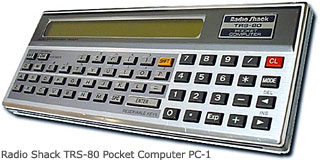 The first step toward a pocket computer was the US$230 Radio Shack TRS-80 Pocket Computer PC-1 introduced in July 1980. The 7″ wide, 2-3/4″ high, 0.7″ thick PC-1 weighed just 6 oz. and was built by Sharp, which called it the PC-1211. Accessories included a clip-on thermal printer and a cassette interface.
The PC-1 was primitive: It has a one-line display capable of showing 24 characters and was programmed in BASIC. It had only about 2 KB of RAM. But it was a pocketable computer.
Radio Shack and Sharp released several Pocket Computers over the years, and other companies, including Panasonic and Hewlett-Packard, also entered the market. However, none were especially successful.
Notebook Computers
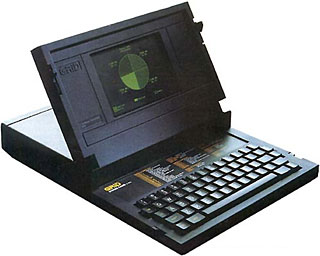 The first notebook or laptop computer was the 1982 GRiD Compass 1100, an Intel 8086-based portable computer with a 320 x 200 electroluminescent display, 340 KB of bubble memory, and a 1200 bps modem. The Compass pioneered the hinged screen design found in all notebook computers.
However, the Compass ran GRiD’s own operating system, was a heavy 11 lb., cost US$9,000, and didn’t have a battery – it had to be plugged into an AC outlet.
The Sharp PC-5000 and Gavilan SC were the first battery operated notebooks. Both were announced in 1983 and shipped in 1984. Both ran MS-DOS, but neither was fully IBM compatible.
In 1987, Toshiba introduced the T1000 and T1200, two of the most successful early IBM compatible notebook computers.
 Handheld PCs
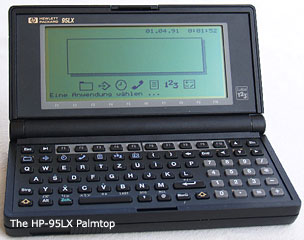
Take the idea of a notebook computer and shrink it down to something that fits in your hand. That was the idea behind Hewlett Packard’s HP-95LX “palmtop” computer, which was totally lustworthy when it was introduced in 1991.
The HP-95LX was essentially an x86 DOS laptop shrunk down to 6.3″ by 3.4″ by 1″. It has a 16 line, 40 character display on its 240 x 128 pixel LCD screen. MS-DOS 3.22 and Lotus 1-2-3 are built in, and the HP-95LX includes 512 KB of RAM.
 Personal Digital Assistants
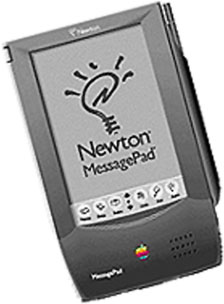
The term “personal digital assistant” (PDA) was first used when Apple CEO John Sculley introduced the Newton at the 1992 Consumer Electronics Show in Las Vegas. The big difference between a PDA and a pocket computer was that you could input data into a PDA using a stylus instead of typing on a keyboard.
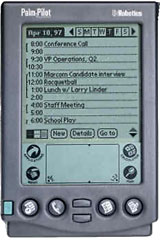 Newton was big for a PDA. The original MessagePad measured 7-1/2″ x 4-1/2″ x 3/4″ and weighed a bit under a pound. Later PDAs, such as the 1996 Palm Pilot (right), were much smaller – designed to fit comfortably in your palm (hence the name).
Interestingly, the Palm Pilot 1000 and 5000, the first Palm models, used a 16 MHz Motorola 68328 CPU (related to the 680×0 CPUs found in Macs from 1984 through 1993) and had an operating system in many ways inspired by the Macintosh.
The first Palms measured 4-3/4″ by 3-1/8″ by 0.7″ and weighed a svelte 5.6 oz.
Mobile Phones
Often called cell phones, the history of handheld mobile phones (in contrast to car phones) goes back to 1983, and early handhelds were big, heavy, and expensive. Over the decades, they evolved into the pocketable phones we have today.
At first, mobile phones were just phones. Over time, they added address books, tools (such as calculators), games, ring tones, cameras, and text messaging. Today the majority of mobile phones have cameras.
Smart Phones
Smart phones combine the functions of PDAs and mobile phones in a single device. Perhaps the best known is the BlackBerry, which was introduced in 1999. It’s primary competitors use the Palm OS or Windows Mobile.
The iPod
Coming in from a completely different direction, digital audio players (commonly called MP3 players) first came to market in 1997, and the first mass market MP3 player, the Rio PMP3000, arrived in Sept. 1998.
Early MP3 players used flash memory, which was expensive, significantly limited the number of tunes one could store, and could be troublesome to connect to personal computers. Compaq addressed the storage issue with its Personal Jukebox, which used a standard 2.5″ notebook hard drive.
 Apple didn’t enter the market until 2001, when the iPod arrived with a 1.8″ 5 GB hard drive – enough space to store 1,000 tunes. Initially sold as a Macintosh peripheral, the iPod later gained Windows support and moved from requiring a FireWire port (standard on Macs but rare on Windows PCs) to USB 2.0 (ubiquitous on Windows PCs and standard on Macs for several years now).
The iPod has grown in capacity (80 GB today) and capabilities (current iPods can display photos and videos), and Apple has also come to dominate the flash memory DAP market with the iPod shuffle and iPod nano.
A couple mobile phones have added iPod functionality, but that hasn’t been especially popular.
WiFi
The final piece of the puzzle is wireless networking. AirPort, Apple’s brand name for 802.11b wireless (or WiFi), was announced with the first iBook in July 1997, and the first AirPort cards shipped a few months later. Today WiFi is a standard feature on notebook computers – and not uncommon on desktops, as it eliminates the need to run ethernet cables.
WiFi has evolved from 802.11b to 802.11g (5x as fast) and now to 802.11n, which is faster yet.
What Is the iPhone?
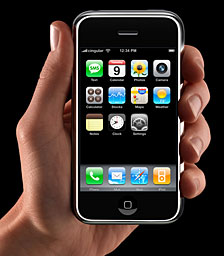 Combine all of these pieces, and you begin to see what the iPhone is. Yes, it’s a mobile phone. Yes, it’s an iPod. But it’s also far more than a PDA. The iPhone is a full fledged computer running Apple’s OS X operating system.
Think about that. It’s not a PDA running a lightweight version of Windows or an operating system designed just for PDAs. It’s OS X, a version of the Mac OS tweaked for the iPhone’s smaller screen and touch input.
Because of that, it’s far more than a smart phone. It’s a cell phone, iPod, and OS X computer with WiFi in an iPod-sized package. No mixing a keyboard and a dialing pad. No need for a stylus.
In many ways, you could consider it the merging of mobile phone technology, the iPod’s capabilities, and a subcompact Tablet PC with WiFi capabilities. Yes, Apple is finally introducing a tablet Mac – only it’s the size on an iPod!
The Other Shoe
What is the biggest obstacle to the iPhone becoming your main computer? The size of the screen.
And what’s Apple’s solution for putting stuff from your computer on a big screen? Apple TV.
 Think about it. Apple TV is designed for higher-end displays, not the old fashioned analog CRT televisions we’ve all grown up with. High resolution – not as high as an iMac, perhaps, but high enough that you can use it for watching videos, accessing the Web, and probably even email and word processing comfortably.
And how are the iPhone and Apple TV going to work together? 802.11n WiFi.
And that addresses another of the iPhone’s drawbacks: There just isn’t enough storage for it to be used as a real computer all the time. Solution: The hard drive inside Apple TV, which several companies are already offering upgrades for.
No, I don’t think you’re going to use the iPhone/Apple TV combination to edit your iMovies, but for a lot of people a lot of the time, it could be all the computer they need.
Just a thought, and this isn’t anything I’ve heard coming from Apple, but it seems the perfect synergy of hardware. We’ve got Macs for heavy duty work, MacBooks for when we need that kind of power in the field, the iPhone for when you just need lightweight Internet access and extreme portability, and Apple TV for when you want to view your content on your television.
At least that’s what I get when I put one and one together – two pieces that seem to perfectly complement each other.
And I’m really looking forward to seeing other directions Apple may take with the iPhone’s technology.
