
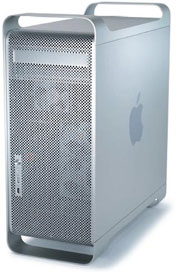
 The Power Mac G5 was introduced on 2003.06.23 – the same day Intel officially unveiled the 3.2 GHz Pentium 4. In terms of increased clock speed, that means Intel had a 6.7% speed bump the same day that Apple announced a 40% improvement in clock speed (from 1.42 GHz to 2.0 GHz), allowing it to call the Power Mac G5 the world’s fastest personal computer at the time.
Apple is using the 64-bit PowerPC 970 processor from IBM, since Motorola abandoned its G5 development plans long ago. The PPC 970 is based on the same POWER CPU core as IBM’s supercomputers.
.
The PowerPC 970
Both the Power Mac G5 and the PowerPC 970 CPU were designed from the ground up to support symmetric multiprocessing (using two or more CPUs to run processes in parallel). The PPC 970 uses the same Velocity Engine instructions as the AltiVec engine in Motorola’s G4 processor, and it’s fully compatible with existing 32-bit software.
The motherboard architecture uses the new HyperTransport technology. System memory is so fast (400 MHz RAM on an 800 MHz to 1.0 GHz bus) that there’s no need for a level 3 cache.
.
First Mac to ship with SATA
New to Apple is Serial ATA (SATA), which supports up to 1.5 GBps bandwidth for internal hard drives, and built-in USB 2.0, which finally gives Mac users full speed access to some of those wonderful USB 2.0 peripherals developed over the previous couple years. The Power Mac G5 also adopts the new twice-as-fast AGP 8x bus for video cards.
One headphone jack, one USB 2.0 port, and one FireWire 400 port are located on the front of the G5 for easy access, something Power Mac users have been dreaming of for years.
.
A new thermal design
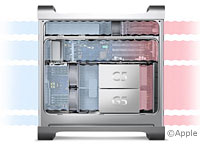 The G5 is in a new aluminum enclosure that’s vented in the front and back. The case includes four thermal zones and nine fans to handle cooling, each independently controlled for speed. Apple claims the Power Mac G5 is “twice as quiet” as the Power Mac G4. The case is taller and slightly narrower than the Power Mac G4 and just a little deeper. It’s also nearly three pounds lighter.
The 1.8 GHz single CPU model was discontinued and replaced by a Late 2003 dual processor model selling for $100 more on 2003.11.18. This model provides 90% of the raw horsepower of the 2.0 GHz model at 87% the price, making it slightly a better value for those who don’t need that last 10% of speed.
.
What you need to know
- Only for 1.6 GHz G5 Power Macs: You should have the most recent firmware installed in your Power Mac G5. The newest version is Power Mac G5 Uniprocessor Firmware Update 5.1.5f2,. Apple recommends removing any third-party RAM before installing this firmware update.
. - This model is known for being noisy, sometimes being compared to “a jet taking off”. Some users online have reported success installing aftermarket fans for noise reduction.
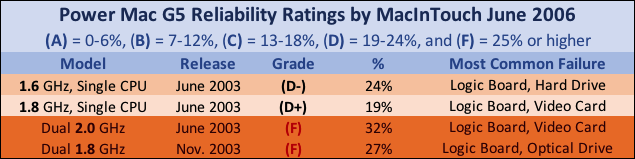
. - Power Mac G5 Reliability
- G5/1.6 single (June 2003), D- (24%, logicboard, hard drive)
- G5/1.8 single (June 2003), D+ (19%, logicboard, video card)
- G5/2.0 dual (June 2003), F (32%, video card, logicboard)
- See: Power Mac G5 Overview and Hardware Reliability (Article + MacinTouch 2006 Stats)
.
 .
.
- Heat Buildup and lack of maintenance can also lead to hardware failure. The underside of the logic board, or at least parts of it, are at risk or are susceptible to heat pockets. A heat pocket is an area where hot air is trapped and cannot easily escape. Although there is a blower-style fan which pulls air up to cool the underside of the logic board which is located next to the hard drives, it cannot compensate for dust buildup or old thermal paste. See suggestions on keeping the Power Mac G5 running cool.
. - Known compatible SSDs:
- Sandisk SSD Plus 2.5″
- OWC Mercury Electra 3G/6G 2.5″
- Older Intel SATA SSDs or legacy style SATA SSDs
- Crucial MX500 M.2 SSD + M.2 to 2.5″ SATA SSD Adapter (by IcyDock)
- Fanxiang, S&K, Drevo, and other Chinese AHCI style SSDs
- See: Adding SATA to your PowerPC Mac
.
- Top-tier GPU upgrades: ATI Radeon X850XT vs Nvidia GeForce 6800 Ultra DDL
. - Modernizing your Wifi: Add Wifi 4-Draft and Bluetooth 2.1 to your PowerPC Mac
.
How it stacks up in Geekbench 2
- Geekbench 2 (Leopard): 1601 (2.0 GHz dual), 1544 (1.8 dual), 1049 (1.8 single), 860 (1.6 single)
. - Geekbench 2 (Tiger): 1699 (2.0 GHz dual), 1590 (1.8 dual), 1127 (1.8 single), 968 (1.6 single)
.
Details
- Announced June 23rd, 2003
- Shipped August 18th, 2003
- Also introduced November 18th 2003: Dual 1.8
- Model Identifier: PowerMac7,2
- Apple Model Number: A1047 (EMC 1969)
- All Power Mac G5s shipped in Silver anodized Aluminum color
- Model number: M9020 (1.6 GHz), M9031 (1.8 GHz), M9032 (2.0 GHz)
- All Discontinued June 9th, 2004
.
Unsupported macOS
Although it is not supported officially, the Power Mac G5 can run Mac OS X Snow Leopard via a MacRumors build, as well as Sorbet Leopard.
.
Mac OS
- Requires Mac OS X 10.2.7 Jaguar through Mac OS X 10.5.8 Leopard Officially.
.
Core System
Legend: L1i = L1 Instruction Cache, L1d = L1 Data cache
- ($1999): 1.6 GHz PowerPC 970, 1 CPU, 1 Core, 64-Bit, 800 MHz System Bus
130 nm, 64 KB L1i, 32 KB L1d, 512 KB L2, 162x SIMD, AltiVec, ~34-38W TDP
. - ($1999): Dual 1.8 GHz PowerPC 970, 2 CPUs, 2 Cores, 64-Bit, 900 MHz System Bus
130 nm Per-CPU: 64 KB L1i, 32 KB L1d, 512 KB L2, 162x SIMD, AltiVec, 42W TDP
. - ($2399): 1.8 GHz PowerPC 970, 1 CPU, 1 Core, 64-Bit, 900 MHz System Bus
42W TDP, 130 nm, 64 KB L1i, 32 KB L1d, 512 KB L2, 162x SIMD, AltiVec, 84W TDP
. - ($2999): Dual 2 GHz PowerPC 970, 2 CPUs, 2 Cores, 64-Bit, 1 GHz System Bus
130 nm Per-CPU: 64 KB L1i, 32 KB L1d, 512 KB L2, 162x SIMD, AltiVec, 122W TDP
.
Memory
- 1.6 Ghz: 256 MB – 4 GB 333 MHz PC-2700 DDR SDRAM ~2.666 GB/s
- Note: Only the 1.6 Ghz “Base” model maxes out at 4 GB RAM. 4 RAM slots total.
.
- Note: Only the 1.6 Ghz “Base” model maxes out at 4 GB RAM. 4 RAM slots total.
- 1.8 GHz and up: 256 MB – 8 GB 400 MHz PC-3200 DDR SDRAM ~3.2 GB/s
- These models have a total of 8 RAM slots each.
.
- These models have a total of 8 RAM slots each.
Video
- For ($1999 and $2399):
- GeForce FX 5200 Ultra, 64 MB DDR SDRAM @~10.4 GB/s, Rankine, 128-Bit Bus
- 45 Million Transistors, 150 nm process size, AGP 8x @ 2.14 GB/s
- 325 MHz GPU clock, 325 MHz Memory clock (650 Mb/s effective), ~20W TDP
- 4 Pixel Shaders, 4 TMUs, 4 ROPs, DX 9.0a, OpenGL 1.5, Pixel 2.0a Vertex 2.0a
- ($2999): ATI Radeon 9600 Pro, 64/128 MB DDR SDRAM @~9.6 GB/s, R300, 128-Bit Bus
- 60 Million Transistors, 130 nm process size, AGP 8x @ 2.14 GB/s
- 400 MHz GPU clock, 300 MHz Memory clock (600 Mb/s effective), ~18W TDP
- 4 Pixel Shaders, 4 TMUs, 4 ROPs, DX 9.0a, OpenGL 1.5, Pixel 2.0a Vertex 2.0a
.
- (Optional): ATI Radeon 9800 Pro, 128 MB DDR SDRAM @~21.6 GB/s, R300, 256-Bit Bus
- 117 Million Transistors, 130 nm process size, AGP Pro 8x @ 2.14 GB/s
- 378 MHz GPU clock, 338 MHz Memory clock (678 Mb/s effective), ~60W TDP
- 8 Pixel Shaders, 8 TMUs, 8 ROPs, DX 9.0, OpenGL 2, Pixel 2.0 Vertex 2.0
Drives
- ($1999): 80 GB 7200 rpm Serial-ATA (SATA), Superdrive 4x (DVD-R/CD-RW) via ATA
. - ($2399+): 160 GB 7200 rpm Serial-ATA (SATA), Superdrive 4x (DVD-R/CD-RW) via ATA
.
Expansion/Misc.
- 1.6 GHz model Only: 3x Open-Length, 33 MHz 64-Bit PCI Slots in place of PCI-X slots
- 1.8 Ghz and up: 3x Full-Length PCI-X slots: 1x 133 MHz 64-Bit, 2x 100 MHz 64-Bit
- 1x AGP Pro 8x Slot (2.1 GB/s)
- 1x IDE (ATA-6/ATA-100) Port, 2x SATA 1.5 Gb/s (v1.0) Ports
. - 56k v.92 Modem (RJ-11 style connector)
- Front 3.5mm headphone jack
- Optical Audio In/Out
- 1x Rear 3.5mm Audio Out
- 1x Rear 3.5mm Mic/Audio In
- Compatible with line-level input, not compatible with Apple’s PlainTalk microphone
- 2x FireWire 400
- 1x FireWire 800
- 3x USB-A style USB 2.0 ports
- 1x Gigabit Ethernet (RJ-45 style connector)
- WiFi: antenna and connector for 802.11g AirPort Extreme card
- PRAM battery: 3.6V 1/2AA
- Power Supply: 450W (661-2903) for single CPU models, 600W (661-2904) for duals
- IEC 60320 C14 Inlet is used for power connection interface on all 3 models.
- See: Which Power Supply Works in My Power Mac G5?
- Kensington Security Lock
Physical
- size (HxWxD): 20.1″ x 8.1″ x 18.7″ (51.1 x 20.6 x 47.5 cm)
- Weight: 39.2 lb. (17.8 kg)
Online Resources




Keywords: #powermacg5
Short link: http://goo.gl/bSYoal
searchword: 2003powermacg5
