
We try to avoid calling any Mac a Road Apple while it’s in production, so we conducted our post mortem after the Cube was “put on ice”.
 Like several other Road Apples, the Power Mac G4 Cube was not a terrible design. In fact, it was an impressive piece of hardware in many ways. Still, Apple discontinued the Cube due to lackluster sales less than a year after releasing it.
What went wrong?
From Apple’s perspective, the Cube offered all the power most users would ever need in a stunningly attractive and very different package. From the standpoint of visual design and computing power, the Cube had all the marks of a winner.
Yet it died.
The Cube’s run of bad luck began with its US$1,799 price. Every Mac site in the world quickly pointed out that the least expensive Cube, attractive as it was, cost $300 more than the far more expandable 400 MHz Power Mac G4. Was it worth the extra money for at most 12% more speed and less expansion options? We didn’t think so. We asked Apple to consider a less expensive Cube with a slower processor to provide a better value.
Of course, Apple wanted us to compare the 450 MHz Cube with the 450 MHz Power Mac G4, which sold for $700 more. It was a comparison we rarely made, since we didn’t really see the Cube competing on the basis of performance. Worse yet, benchmarks consistently shows the Cube had about the same power as the less costly, more expandable 400 MHz G4.
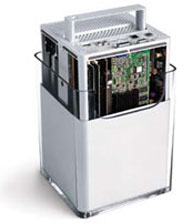 Still, the Cube was brilliantly conceived. Most Mac users don’t need expansion slots when so many features are standard. With FireWire and USB, it’s easy to add external peripherals. And the whole powerhouse computer was packed in a remarkably small, quiet (no fan!), stunningly attractive case.
Ah yes, the “cracked” case. Most of the perceived cracks were mold lines, but some were real (my Cube had a real crack). They didn’t affect performance, but in a computer designed as a visual statement, they were a serious flaw.
Poor value. Mold lines. Two strikes.
Apple eventually dropped the price of the basic G4 Cube to US$1,299 and introduced a more expensive model with CD-RW, but the perception of poor value was ingrained. Several of us on the Mac Web saw the value, promoted the Cube at the new price, and some of us even put our money where our mouth was. Those who owned Cubes were not disappointed with their performance.
But the design was flawed.
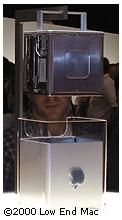
Perhaps the most annoying flaw was the power switch on the top of the Cube. Touch it by accident and watch the Cube shut down.That was annoying every time it happened – and even once was too often.
To keep the Cube small and allow for air cooling, the power supply was a fairly large external unit. That wasn’t a flaw in itself, but it meant one more piece of hardware to clutter up the office. The external speakers were yet another way the compact Cube cluttered up the user’s desk.
The Cube’s greatest design flaw came from design brilliance. To make the whole machine fit inside the clear enclosure and to facilitate removing the hardware without requiring the user to disconnect every cable, all the wires plugged into the bottom of the Cube. All the wires: power, video, two USB ports (one for the speakers), two FireWire ports, the modem, and ethernet. It created a real rat’s nest of wires – and made it almost impossible to really plug-n-play USB and FireWire components, since those ports were inaccessible unless you turned the Cube on its side.
Poor perceived value. Mold lines. Design flaws. Three strikes and the Cube was finally out.
I won’t mourn the Cube. It was a clever design and a gorgeous piece of hardware. It should have done better, and Apple left the door open to future Cubes.
Apple solved the value and mold line problems; I hope future designs inspired by the Cube solve the design flaws. [This article was originally published in July 2001.] Although Apple’s designers would probably disagree with me on this, I believe the flaws came about in an attempt to make function follow form. To retain a pristine enclosure with as few openings as possible, all the ports had to be inaccessibly placed at the bottom – and maybe the power switch had to be on the top.
Next time, I hope Apple will be a bit more sensible and design a compact machine with a more protected power switch and more readily accessed ports. (Why not place one USB and one FireWire port on or near the front? It would certainly make plug-n-play easier.)
Details
- 450 MHz Cube introduced 2000.07.19 at US$1,799; discontinued 2001.07.03
- 500 MHz Cube announced 2000.07.19 at US$2,299; shipped August 2000; discontinued 2001.07.03
- The Cube began shipping 2000.08.12.
- supports Mac OS 9.0.4 through OS X 10.5 Leopard
- CPU: single 450/500 MHz PPC 7400 (a.k.a. G4)
mid-April 2001 reports indicate a switch to the cool running 7410 - bus: 100 MHz
- CPU performance: 139, Speedmark
- FPU performance: unknown
- RAM: 64 MB standard, expandable to 1.5 GB using PC100 SDRAM (3.3V,unbuffered, 64-bit, 165-pin, 100 MHz) in 3 DIMM slots
- VRAM: 16 MB
- Video: ATI Rage 128 Pro in AGP 2X slot (was Rage 128 prior to December 1999); supports resolutions to 1920 x 1200 with 32-bit support, VGA connector, and digital video output
- L2 cache: 1 MB 2:1 backside cache
- hard drive: 20 GB 5400 rpm Ultra ATA/66
- DVD-ROM standard, CD-RW available as of 2001.02.22
- no PCI slots
- internal v.90 56k modem
- two 400 Mbps FireWire ports (one internal)
- two 12 Mbps USB ports for keyboard, mouse, and peripherals
- 10/100Base-T ethernet
- antenna and connector for AirPort card
- size (HxWxD): 9.8″ x 7.7″ x 7.7″
- weight: 14.0 lb. (6.6 kg)
Keywords: #maccube #powermaccube #powermacg4cube
Short link: http://goo.gl/o0aajW
searchword: cuberoadapple
