
When we think of ethernet today, we think of wired networking with RJ-45 ports and plugs. These connectors look like an oversized phone jack. But that was only one of several competing connectors in the early days of networking.
Ethernet History
The RJ-45 connector is not what ethernet is. Ethernet is a frame-based protocol for communication between networked devices, such as computers, printers, and network attached storage drives. The protocol itself is hardware agnostic; that is, it doesn’t care whether you’re running coaxial cable, twisted-pair wiring, fiber optics, or going wireless.
In the early days of networking, ethernet competed with token ring, FDDI, ARCNET, and other protocols rarely mentioned today. Until the rise of 802.11 WiFi, ethernet dominated to the point that it is the de facto protocol for wired networks – and twisted-pair ethernet with RJ-45 conenctors has become by far the most common form of ethernet.
Robert Metcalfe is considered the father of ethernet. He and David Boggs began developing the protocol at Xerox PARC in 1973 and presented their first draft standard “some time before March 1974.” Xerox patented ethernet in 1975 and began using it at PARC in 1976. The first version of ethernet ran at 3 Mbps over coaxial cable and was limited to 256 devices on the network.
After Metcalfe left Xerox in 1979, he founded 3Com and worked to convince DEC, Intel, and Xerox to jointly promote ethernet as an industry standard for networking. The new version of ethernet ran at 10 Mbps and used 48-bit addresses. Twisted-pair ethernet was developed a few years later, replacing costly, less flexible coaxial cable with the same type of inexpensive wiring used for telephone systems. Using RJ-45 connectors, this became as 10Base-T ethernet.
For many years following this ethernet cards often included both coaxial and 10Base-T ports.
Ethernet at Apple
The Quadra 700 and Quadra 900, both introduced in October 1991, where the first Macs with ethernet ports. Apple had three options:
- Choose coaxial or twisted-pair ethernet exclusively.
- Include both coaxial and twisted-pair ethernet, which would increase costs.
- Do an end run around the issue by using an Attachment Unit Interface (AUI)
There was already an established AUI standard. Unfortunately for Apple and for Mac users, it used the same 15-pin DA-15 connector that Apple had standardized on when it introduced the Mac II and external monitors in 1987. Using the same physical connector would have created havoc.
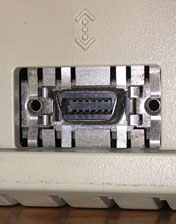
Quadra 700 AAUI port
To address this, Apple invented its own AUI, the Apple Attachment Unit Interface (AAUI), which it used for most Quadras, a few PowerBooks, several LaserWriters, and almost all pre-G3 Power Macs.
Apple’s AAUI ethernet port was marked with <··>, as seen in the photo of an AAUI port on a Quadra 700. (The Q700 was designed as a minitower, but it could also be put on its side. This is why the port marking appears sideways.)
The flexibility Apple gained by not choosing coaxial or twisted-pair wiring saved the company money – and meant that Mac users couldn’t network with ethernet without investing in an AAUI adapter. 10Base-T ethernet so dominated that in 1995 Apple began including it alongside AAUI. With the Power Mac G3 of November 1997, Apple discontinued its proprietary network connector.
We have a full list of Macs and LaserWriters that included AAUI but not 10Base-T at the end of this article.
What AAUI Means for Mac Users
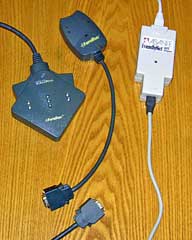 What this means for Mac users is that Macs and LaserWriters with built-in ethernet from the 1991-1995 era can’t use 10Base-T ethernet without an adapter (such as those shown to the right), which means an extra expense. And nowadays you’ll spend some time spent trying to locate an AAUI-to-10Base-T adapter.
There were several brands, such as the Asanté and Farallon ones shown here. Some have very short “tails” between the AAUI plug and the module itself, and some (such as the Asanté shown here) have lots of wire.
One of my favorites was also one of the most expensive. The Farallon EtherWave Transceiver not only connected a Mac with AAUI to 10Base-T ethernet, it also provided a second 10Base-T ethernet port, allowing you to daisy-chain a second ethernet device. This could be invaluable in an office setting to avoid the expense of running yet another length of cable to your hub. (Farallon also made an EtherWave Transceiver that bridged LocalTalk to ethernet. Very cool!)
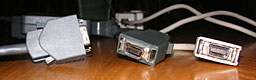 The biggest problem I’ve run into with AAUI adapters is that the clips that hold them to the port on the Mac or LaserWriter come loose too easily. If you’re moving your hardware even an inch and lose your network connection, it’s the first thing you should check.
Where to Look for AAUI Adapters
Macs with AAUI and no 10Base-T
- Centris 610 (not entry-level model), 650 (not entry-level model), 660av
- Quadra 610, 650, 660av, 700, 800, 840av, 900, 950
- Power Mac 6100, 7100, 8100
- PowerBook 500 Series
LaserWriters with AAUI and no 10Base-T
- LaserWriter IIg
- LaserWriter Pro 630
- LaserWriter 12/640PS
- LaserWriter 16/600PS
