
Original article by: Daniel Jansen
First available in the Power Mac G4 in late 1999, the G4 processor is to the G3 as the 604 was to the 603 – and then some! Like the 604, and unlike the G3, G4 is designed for multiprocessor operation. It also runs about 25% faster for basic floating point math calculations and has a built-in vector processor known as AltiVec. MHz for MHz, it was the most powerful CPU on the market in its day,
PowerPC 7400
 The G4 (a.k.a. PowerPC 7400), manufactured exclusively by Motorola, initially shipped at 350 to 500 MHz, although Motorola had issues creating enough 500 MHz CPUs for Apple’s needs. Because of this, the 400, 450, and 500 MHz models Apple had announced were scaled back to 350, 400, and 450 MHz – without a price reduction, which had users up in arms. It wasn’t until February 2000 that the Power Mac G4 was once again available in a 500 MHz version.
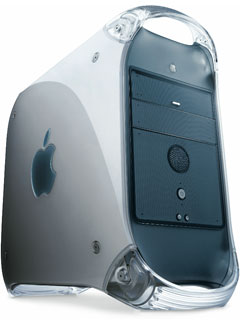 The 7400 has a new high-bandwidth system bus known as MPX, which more than doubles memory access speed on logic boards that support MPX. Only the Yikes! Power Mac G4 does not support this.
New features include the ability for one CPU to send data directly to another without using system memory, the ability to use a 2 MB level 2 cache (previous PowerPC designs were limited to 1 MB), 128-bit internal architecture (vs. 64-bit for other PowerPC chips), 64- or 128-bit access to the cache (two different versions of G4; 64-bit is for backward compatibility with older systems), and the AltiVec “Velocity Engine” multimedia extensions.
The 7400 supports a 2x to 8x bus multiplier, but the initial run tops out at 9x. This means a computer with 100 MHz motherboard could support a 800 MHz G4, and also that the Beige G3 with its 66 MHz system bus could support a 533 MHz G4 – except that the 7400 never passed the 500 MHz mark. Older Macs that use a CPU daughter card could support a 400 MHz 7400 on their 50 MHz bus.
The G4 has a total of 7 execution units: two for integer work, plus one each for load/store, branch/system, floating point, AltiVec ALU, and AltiVec Permute. Preliminary SPECfp scores are about 30% higher than the G3 at the same clock speed.
AltiVec has the ability to increase performance of certain functions, especially those found in things like QuickTime and Photoshop, by up to 16x, although programs will have to be modified to take advantage of the new AltiVec instructions.
PowerPC 7410
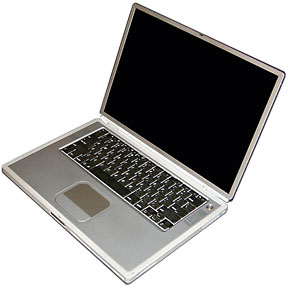 The second generation G4 arrived with the first PowerBook G4 in January 2001, running at 400 MHz or 500 MHz. The 7410 also supports a 9x bus multiplier, giving it a small edge over the 7400, and it also supports a 133 MHz system bus. In most other respects, the 7410 is simply a lower power version of the 7400.
PowerPC 7450
Often known as the G4e (for enhanced) or G4+, the PPC 7450 was a major redesign of the G4 architecture. With 33 million transistors, it had over 3x as many as the 7400, and AltiVec performance was also improved. The new CPU was first used on the 733 MHz Digital Audio Power Mac G4 when it was released in January 2001 – the same time as the PowerBook G4.
Where the 7400 and 7410 used a level 2 (L2) cache on the system board, the 7450 includes a 256 KB L2 cache that runs at full CPU speed. Even though it is smaller than the 512 KB, 1 MB, and 2 MB external caches used by earlier G4 chips, because it runs at CPU speed, it generally offers superior performance.
The 7450 also includes 4 integer math execution units (3 simple + 1 complex), which is twice as many as the 7400 and 7410. It also doubles the number of AltiVec units, adding simple and complex to floating and permute.
PowerPC 7445 and 7455
The big improvements in the January 2002 G4 include a 256-bit on-chip cache bus, twice as wide as on earlier G4 iterations. It was the first CPU in a Mac to pass the 1 GHz mark, and the 7455 supports a level 3 (L3) external cache up to 2 MB to further boost performance.
The 7445 came in speeds from 600 MHz to 1.42 GHz, as did the 7455.
PowerPC 7447 and 7457
The 7447 boosts the onboard L2 cache to 512 KB and uses a 130 nm process to reduce power consumption. The 7457 adds support for an external L3 cache with up to 4 MB of memory.
The 7447 offered speeds from 600 MHz to 1.42 GHz, and the 7447A bumped that to 1.5 GHz. The 7457 had a more limited range of speeds from 867 MHz to 1.267 GHz.
PowerPC 7448
The last G4 processor Apple used was thee 7448 found in the final generation of 15″ and 17″ PowerBooks running at 1.67 GHz. Only the hi-res 15″ and 17″ models use this CPU, which has 1 MB of L2 cache onboard and a 200 MHz front side bus.
The 7448 ranged in speed from 1.0 GHz to 1.7 GHz. It was the most powerful G4 CPU ever.
The Dual-Core G4
In 2004, Freescale changed the G4’s name to e600, so the 7448 was the last true G4. In 2007, the e600 became available in a dual-core version, the MPC8641D, where each core had 1 MB of L2 cache on the CPU. Clock speeds ranged from 1.0 to 1.5 GHz.
But by this time, Apple had jumped ship to Intel.
PowerPC Family Overview
CPU         speed*    instructions  L1 cache  L2 cache
601       60-120 MHz   3 per cycle     32 KB  external to 1 MB
603       75-160 MHz   2 per cycle    2x8 KB
603e     100-300 MHz   2 per cycle   2x16 KB
604      100-180 MHz   4 per cycle   2x16 KB  external to 1 MB
604e     166-233 MHz   6 per cycle   2x32 KB  external to 1 MB
604ev    250-350 MHz   6 per cycle   2x32 KB  external to 1 MB
G3/750   200-450 MHz   3 per cycle   2x32 KB  external to 1 MB
750CX    366-466 MHz   3 per cycle   2x32 KB  256 MB onboard
750CXe   400-700 MHz   3 per cycle   2x32 KB  256 MB onboard
750FX    600-900 MHz   3 per cycle   2x32 KB  512 MB onboard
750GX   733-1100 MHz   3 per cycle   2x32 KB  1024 MB onboard
G4/7400  350-600 MHz  19 per cycle+  2x32 KB  supports 2 MB L2 cache
7410     466-533 MHz  20 per cycle+  2x32 KB  supports 1 MB L2 cache
7450     667-733 MHz  20 per cycle+  2x32 KB  256 KB onboard, up to 2 MB L3
7455    600-1420 MHz  20 per cycle+  2x32 KB  256 KB onboard, up to 2 MB L3
7447A   600-1500 MHz  20 per cycle+  2x32 KB  512 KB onboard, no L3 cache
7457    867-1267 MHz  20 per cycle+  2x32 KB  512 KB onboard, up to 4 MB L3
        7457 used in some third-party Mac upgrades, never by Apple
7448     1.0-1.7 GHz  20 per cycle+  2x32 KB  1024 KB onboard, no L3 cache
G5/970   1.6-2.0 GHz  38 per cycle+  2x32 KB  512 KB onboard
970FX    1.8-2.7 GHz  38 per cycle+  64+32 KB 512 KB onboard
970MP    1.8-2.5 GHz  38 per cycle+  64+32 KB 1 MB per core
__________
* as used in Apple or Maclone
+ each AltiVec unit can perform up to 16 simultaneous calculations
PowerPC family: 601, 603/603e, 604/604e, G3, G4, G5
Other Resources
- Great CPUs, past and present, John Bayko. See especially sections on 8080/85, Z-80, 6502, 6809, 680×0, 80×86, ARM (used in Newton), PA-RISC, Sparc, Alpha, PowerPC, and Itanium.
- MacTips, RISC, CISC, and Your Mac
- PC Magazine, Motorola and PowerPC (also covers 680×0 series)
- PowerPC 601 v. 603, MacKiDo
- How the G4 Compares to the G3, Scott Barber
- AltiVec, MacKiDo
- G4, MacKiDo
- PowerPC G4 and other news from Microprocessor Forum, Henry Norr, MacInTouch
- Pipelines, MHz, latency, caches, and more, MacKiDo
- AltiVec Performance Comparison, Apple
- MPC7400 PowerPC Microprocessors, Motorola
Keywords: #powerpcg4
Short link: http://goo.gl/8wkAzJ
searchword: powerpcg4
