
The M5 MacBook Air was updated with a new chip when it was introduced on March 3rd, 2026. Other than that, the new MacBook Air doesn’t seem much different from it’s predecessor.
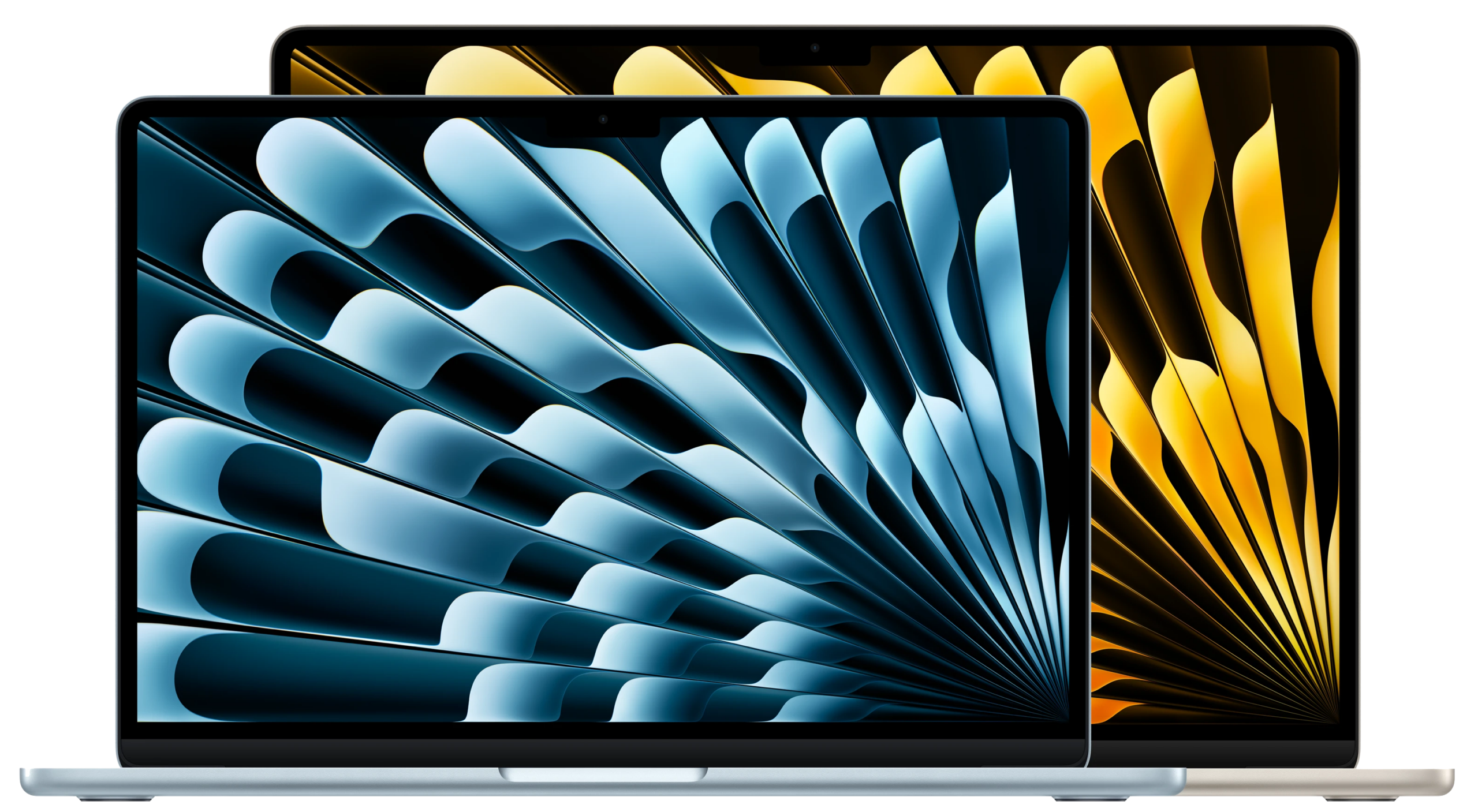
The real changes are under the hood with the M5 chip, changing the paradigm of MacBook Air workflows. Five generations into Apple Silicon, the MacBook Air is a night and day difference versus where it began – gone are the days of underpowered CPUs and weak graphics chips.
Even without active cooling, the M5 MacBook Air is hot on the heels of the M5 MacBook Pro. In a Cinebench GPU test between the same chips, the M5 Air is ~92% the speed of the M5 MacBook Pro’s, clocking in at ~22,000 vs ~24,000. Often there are incremental upgrades for chips year over year, however, the M5’s GPU is massively better versus the M4.

Moreover, the base storage configuration was bumped to 512 GB which can be now configured up to 4 TB (+$1200). Apple also introduces their own N1 wireless networking chip for Wi-Fi 7, Bluetooth and Thread, which significantly reduces battery usage when handling location tracking. Clocking in at up to 46 Gb/s, Wi-Fi 7 can theoretically match or exceed the speed of Thunderbolt 4.
Memory bandwidth increases to 153 GB/s on the new M5 chip with cutting-edge mobile memory tech, using 4800 MHz LPDDR5X-9600. There’s also a new 40-Watt dynamic charger (60W Max) which replaces the previous 35-Watt Dual USB-C compact adapter.
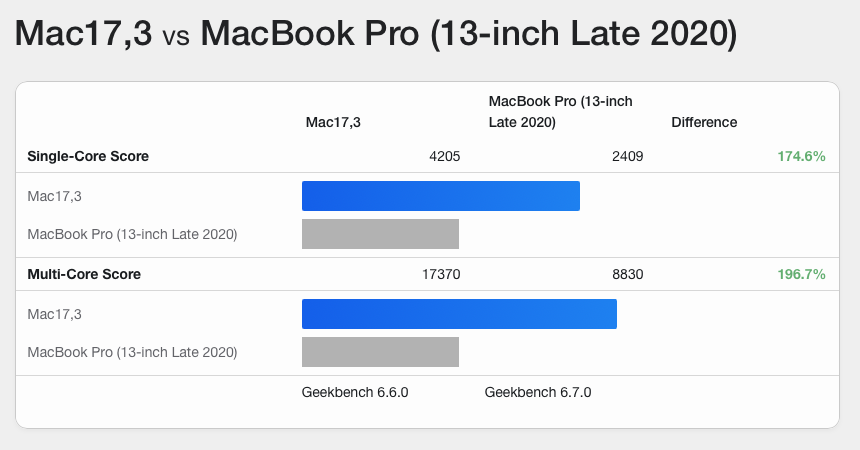
Roughly two M1 Chip’s worth of performance – all in one.
While 174% more isn’t 200%, it’s so close, it’s astounding how far Apple Silicon has come in the last 5 years. Mind you, this is comparing a 13-Inch M5 MacBook Air to a 13-Inch M1 MacBook Pro.
- See: Mac17,3 vs MacBook Pro (13-inch Late 2020) – Geekbench Browser
Apple Intelligence

macOS supports Apple intelligence on any Mac with Apple Silicon. This feature is also available on most iPads with an M-chip, as well as iOS devices running iOS 18 and later with an A17 Pro chip or better (iPhone 15 Pro/Pro Max, or all iPhone 16 models+).
- By combining generative AI with personal context, Apple Intelligence can deliver some useful, private and secure features. These include system-wide writing tools, Genmoji, Image playground, an upgraded Siri, photo cleanup, notifications, and ChatGPT integration.
What You need to know
- If you’re someone who’s transitioning over from an Intel Mac, or will be using Intel Mac apps, Apple has an app called Rosetta 2 for Apple Silicon Macs. Once installed, this isn’t something you directly interact with. Rather, you may simply open an Intel app, and it’ll open. Rosetta 2 does an Intel to Arm “ahead of time” translation, using an instruction set in the M5 chip. The first time the Intel app launches it’ll be noticeably slow, as Rosetta caches and stores code. Once this process is done, the App should work just as normal.
. - What was previously called a “Performance Core” in a base M5 chip in Late 2025 is now called a “Super Core” as of Early 2026.
.- All M5 chips have High-Performance “Super Cores”, but only the base M5 chip has Efficiency cores.
. - The M5 Pro and M5 Max chips have Super Cores + Performance Cores now.
- All M5 chips have High-Performance “Super Cores”, but only the base M5 chip has Efficiency cores.
 Closed Lid Mode: All ‘Books support “lid closed” (or clamshell) mode, which leaves the built-in display off and dedicates all unified memory to an external display or two. To use closed lid mode, your ‘Book must be plugged into the AC adapter and connected to an external display and a USB or Bluetooth mouse and keyboard (you might also want to consider external speakers). Power up your ‘Book until the desktop appears on the external display and then close the lid. Your ‘Book will go to sleep, but you can wake it by moving the mouse or using the keyboard. The built-in display will remain off, and the external monitor will become your only display.
To resume use of the internal display, you need to disconnect the external display, put the computer to sleep, and then open the lid. This will wake up your ‘Book and restore use of the built-in display.
Battery life is claimed to be 15 hours of wireless web, and up to 18 hours of video streaming.
Details
- Announced March 3rd, 2026
- Available March 11th, 2026
.
- Available March 11th, 2026
- Model Identifier: Mac17,3 (13-Inch)
- Model: A3449 (EMC 8877)
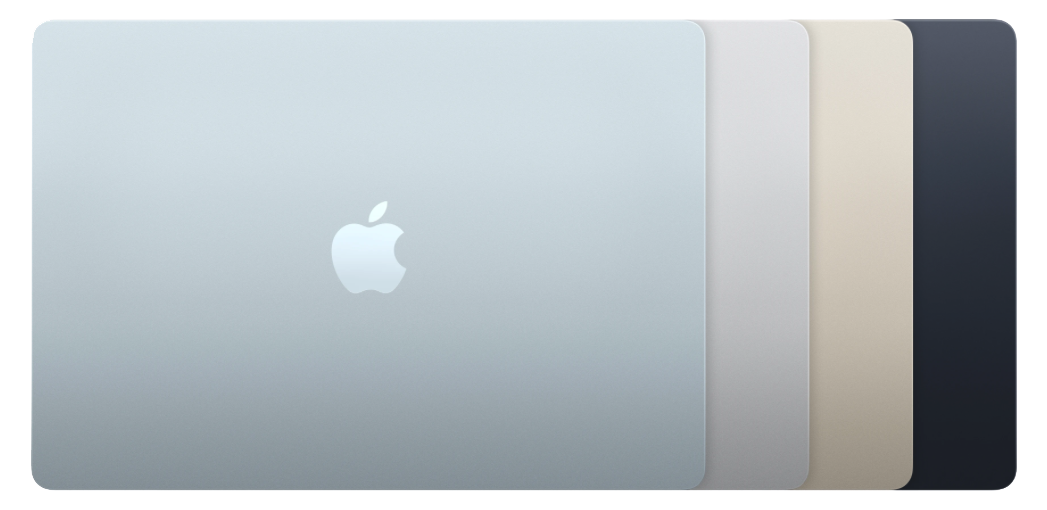
- MDHH4LL/A (Sky Blue, 512 GB) $1099
- MDHE4LL/A (Midnight, 512 GB) $1099
- MDHA4LL/A (Starlight, 512 GB) $1099
- MDH74LL/A (Silver, 512 GB) $1099
.
- Model: A3449 (EMC 8877)
- Model Identifier: Mac17,4 (15-Inch)
- Model: A3448 (EMC 8878)
- MDVQ4LL/A (Sky Blue, 512 GB) $1299
- MDVH4LL/A (Midnight, 512 GB) $1299
- MDVD4LL/A (Starlight, 512 GB) $1299
- MDV94LL/A (Silver, 512 GB) $1299
- Model: A3448 (EMC 8878)
Mac OS
- Requires macOS Tahoe 26.3.1 (Build 25D2128) or later
Core System
Legend: L1i = L1 Instruction Cache, L1d = L1 Data cache, SLC = System Level Cache
Note – All M5 chips have this memory configuration for their cache in their CPUS:
- L1 Per-performance core: 192KB L1i, 128KB L1d
- L1 Per-efficiency core: 128 KB L1i, 64 KB L1d
- **It is currently not known how much L2 cache Super Cores have access to.
. - M5 10-Core ($1099): 10 Cores, 4x 4.42 GHz “M5” Super Cores: 768K L1i, 512K L1d, **MB L2, 8MB System Level Cache
- 6x 2.95 GHz “M5” Energy efficient cores: 768K L1i, 384K L1d, 8 MB L2, 8 MB SLC
- 16-Core Neural Engine
Memory
- 16 GB 4800 MHz LPDDR5X-9600 SDRAM
- 153 GB/s Memory Bandwidth
- 24 GB Memory (+$200), 32 GB Memory (+$400)
- Any memory upgrade will automatically bump you up to a 10-core GPU.
Video
- 8-Core GPU ($1099) 13? only: Integrated Apple M5 with Metal 4 Hardware Accelerated GPU
- 10-Core GPU +($100) option on base ($1099) 13? M5 MacBook Air
- 10-Core GPU is standard on higher-configured 13-Inch models, and all 15-Inch models
.
- 13? ($1099): 16:10 13.6? TFT IPS LED-Backlit LCD, 2560 x 1664 @224ppi, 500 nits
- P3 Color
- True Tone
- Support for 1 Billion colors
- 15? ($1299): 16:10 15.3? TFT IPS LED-Backlit LCD, 2880 x 1864 @224ppi, 500 nits
- P3 Color
- True Tone
- Support for 1 Billion colors
.
- Simultaneous support for 2 external displays plus the built-in display at native resolution plus
- 2x 6K60 simultaneously or 1x 4K@144
- 1x 8K60, or 5K120, or 4K240
- This applies to both 13 and 15-Inch MacBook Airs.
Drives
- Drive Bus: 512 GB NVMe PCIe SSD ~6.5 GB/s R/W, 2x 256 GB NANDs in Parallel
. - Configurable to: 1 TB (+$200), 2 TB (+$600), and 4 TB (+$1200)
- Upgrade price is the same on 13? and 15? models.
Expansion
- 802.11be Wi-Fi 7
- Bluetooth 6
- Thread Networking Technology
- Two USB-C style Thunderbolt 4 Ports
- Support for: USB 4 (up to 40 Gb/s), USB 4 (up to 40Gb/s)
- 3.5mm headphone jack
- Up to 15-18 hrs battery life
- 53.8 W/h Li-Ion battery (13?)
- 66.5 W/h Li-Ion battery (15?)
- Touch ID Sensor
- Magsafe 3 for charging
- 1080p HD 12 MP Center Stage Camera with/ Advanced image signal processor
- Support for desk view
- 3x Mic array w/directional beam foaming
- 4-speaker sound, support for Spatial Audio, Dolby Atmos
- Dynamic tracking support when using supported models of AirPods.
- (15-Inch): 6-speaker sound system with force-cancelling woofers
Physical
- 13? size: 0.44 x 11.97 x 8.46? (1.13 x 30.41 x 21.5 cm)
- Weight: 2.7 pounds (1.24 kg)
- 15? size: 0.45 x 13.40 x 9.35? (1.15 x 34.04 x 23.76 cm)
- Weight: 3.3 pounds (1.51 kg)
- Power supply: 40W Dynamic USB-C charging Brick (60W Max)
- MacBook Air M5 is fast charge “capable” with a 70W+ brick.
- Configure to order:
- 35W Dual USB?C Port Compact Power Adapter
- 70W USB?C Power Adapter
- Photo and Icon Gallery



