
Last week I talked a bit about Linux and the low end. Linux offers some of the same modern foundations of Mac OS X, but it can run well on older computers. Last week I hinted that I would talk about the fatal flaw of Linux.

In Greek mythology, a fatal flaw is a virtue taken to such an extreme that it becomes a vice. For example, a warrior might be courageous in battle (a virtue) but become foolhardy (a vice). A tragic flaw in ancient Greece complements Aristotle’s idea of the Golden Mean. Being timid or foolhardy (too little or too much courage) are vices. It makes for great drama when a character’s greatest strength becomes his or her downfall.
 Linux’s greatest strength – open source licensing – may also be its tragic flaw.
Linux is inextricably intertwined with Open Source. There are a wide range of opinions that come under the rubric of open source, but at the very core, Open Source means that the source code is available for people to look at and modify. The alternative, closed source, provides people with the programs (in Linux these might be called binary executables) but not with the source code that was used to make it.
Open Source Avoids Abandonware
Open Source is a huge advantage for low-end users. Let’s briefly consider a closed source example. In the early 1990s, I found a word processor that was super-fast. WriteNow was the runner-up in the race to become the first Macintosh word processor. MacWrite won, and WriteNow went over to the NeXT platform and became a word processor on NeXT – and later on the Mac.
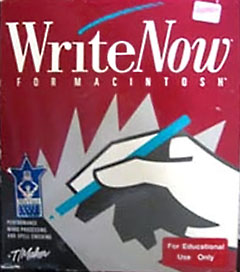
WriteNow was an exceptionally fast program, because it was written in hand-tuned assembly code. That extra time spent optimizing WriteNow means that it’s the fasted word processor on 68k Macs. It didn’t have all the features of Microsoft Word or WordPerfect, but it had a great balance of utility and ease of use. It has the best table tool I have ever used.
Because it was hand-tuned for performance, it would have been a huge job to make it native for PowerPC Macs. WriteNow was a dead-end product – its death was more of a whimper than a bang. WriteNow slowly faded from memory over the years; you can no longer buy it or get any support.
Although it was a great program in the days of System 7, it is unnecessarily retro now. It wouldn’t be all that hard to add a few features and make it a well-rounded performer – maybe make it Appearance Manager aware so it looks good on Mac OS 8.1. Or let it use JPEGs and GIFs in addition to PICTs or EPS files. And, most importantly, add support for drag and drop editing.
If you want to have drag ‘n’ drop with WriteNow, you are out of luck, because it has been abandoned. Open Source precisely avoids the problem of abandoned software. If you had the know-how, the drive, and the source code, you could add the bits needed for a new feature in WriteNow. Drag ‘n’ drop editing works fine on other 68k Mac word processors, so there’s no reason it couldn’t be added.
On Low End Mac, we talk about abandonware. (I’ve signed the petition asking companies to release the code to their abandoned products.) But we have no leverage to make any changes if the companies fail to be generous.
Anyone Can Fix It
But Open Source does more than give you the ability to add modern features. How often has a utility broken when you upgraded your Mac OS? With open source, a developer might be able to fix a few lines and restore stability. But if it’s an older utility, you might just be out of luck again.
Open Source offers a huge competitive advantage over the traditional Mac model of freeware, shareware, and commercial software. By allowing programs to be repaired and updated after their original programmers move on to other projects, open source prevents abandonment.
How could that be a tragic flaw?
Open Source as a Tragic Flaw
Programmers have access to an ever-increasing number of projects, so they have to choose where to spend their time. Most of the programmers in the Open Source realm are volunteering their time and energy. In return, programmers want to do something cool or exciting.
But to create a quality user-experience requires a lot of work that isn’t very exciting or cool. The consistency that Mac users take for granted was not accidental. Linux has made improvements in this area through its two main desktop environments, KDE and GNOME, but only a small fraction of Linux programs meet the interface requirements of those environments. Linux programs, as a whole, lack the fit and finish that makes Macs so enjoyable to use.
Programmers are also an independent lot. Since they have the freedom to do many things with the source code, getting them to agree on a plan can be like herding cats. There’s no way to force Open Source programmers to follow a particular set of guidelines if they don’t want to. So even though open source software is improving, it can never implement new ideas as quickly as proprietary software.
It is hard to guess what the future holds. Linux is growing rapidly and replacing Windows in certain situations. Mac OS X is a combination of an Open Source core (Darwin) with a closed source shell. Perhaps Apple will become the Golden Mean – it will provide a unified experience with the benefits of open source.
As we publish this column, Jonathan Ploudre is preparing to get married. We can’t think of a better reason for him to take a break from writing and wish Jonathan and his future wife the best. He still loves low-end Macs and promises to write more in the future, but we can’t predict when that will be, so Back & Forth will be on hiatus for a while – Macs are important, but building a good marriage is more important.
Keywords: #linux #opensource #tragicflaw
Short link: http://goo.gl/dI51KI
searchword: linuxtragicflaw
