Remember the Mac
Portable?
For those who don't, it was Apple's first crack at mobile computing;
that is, if you didn't count the "luggability" of the original compact desktop Macs, which had almost the
same weight as the Portable.
Actually, the late Jef Raskin's
original conception of the Macintosh was that it should be a portable
machine. As Apple historian Owen W. Linzmeyer notes in Apple
Confidential 2.0, "Raskin expected people to grow so attached to
their Macs that they would never want to leave home without them, so
portability was a key concern. He envisioned a weight just under 20
pounds and an internal battery providing up to two hours of
operation."
I expect Raskin was thrilled when the
PowerBook came along, since from the first it pretty much met or
exceeded these criteria. I've long maintained that the PowerBook (as
well as the iBook) is "the logical Mac" - and it's gratifying to hear
that the "Father of the Mac" also thought so from the get-go.
Returning to the main topic here: Before there was a PowerBook,
Apple built another portable Mac called, logically enough, the Mac
Portable.
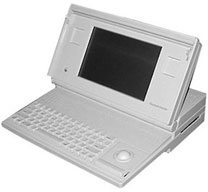
Introduced in September 1989, the Mac Portable had a wonderfully
sharp and clear 9.8" 1-bit 640 x 400 pixel active matrix screen that
could fold flat and a 16 MHz Motorola 68000 CPU. The Portable's
internal lead-acid battery could provide up to ten hours of untethered
computing. It also included a number of features that would later be
used in PowerBooks, such as the ability to put the processor to sleep
rather than shutting the computer down, and an optional trackball and
internal modem
In February 1991, the Mac Portable was upgraded with a backlit display, more
RAM, and a lower price.
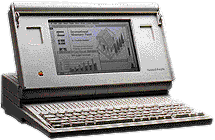 At 15.8
pounds, the Mac Portable needed its carry-handle, but its size and
weight made things like that long-lasting battery (which alone weighed
more than 2 lb.) and use of a standard (cheaper) 3.5" hard drive
possible.
At 15.8
pounds, the Mac Portable needed its carry-handle, but its size and
weight made things like that long-lasting battery (which alone weighed
more than 2 lb.) and use of a standard (cheaper) 3.5" hard drive
possible.
Another sensible innovation was use of a standard 9V "transistor
radio" battery for PRAM. The smaller, half-the-weight-or-less
PowerBooks replaced the Mac Portable in October 1991 were more
convenient for serious road warriors, but more compromised
specification-wise compared with desktop machines.
A Portable Desktop Mac?
I think it would be great if Apple came out with a big laptop in
this general vein, more a portable desktop substitute than a
road-warrioring machine.
"What about Apple's 17" notebooks?" you might ask. Well, they're
nice. I have a 17"
PowerBook, and I love it, and the 17" MacBook Pro is my
pick for most desirable among Apple's current notebook offerings. But
it's compromised as a true desktop substitute portable by the absurdly
thin form factor, which to a considerable degree negates the advantage
of having a large footprint. The 17 incher isn't any more expandable or
upgradable or easy to work on than the 15" PowerBook. There is also
plenty of room for a full 105-key extended keyboard, but instead the
Big 'Book uses the same keyboard as its 15" siblings, leaving huge
expanses of empty plain metal surface at either side.
There are some big PC laptops with up to 19" displays, and even one
or two (more to come soon, it seems) with quad-core processors, but
Apple has thus far chosen not to go this route.
Raw bulk and weight are not the point, nor is just a large screen
size. What I would dearly love to see is a jumbo PowerBook that would
restore and enhance the connectability and expandability standard that
was set by the WallStreet
G3 Series PowerBook back in 1998, with two PC card slots, two
expansion bays (although even one would be a quantum improvement on the
status quo), easy facility of opening up to perform component upgrades
and repairs, and a motherboard design that facilitated both processor
and video accelerator upgrades.
A larger machine should also theoretically be easier and more
efficient to cool. A detachable display and keyboard for better
ergonomics in desktop use would also be cool.
I'll even stick my neck out a little farther and suggest that Apple
might consider replacing the iMac with this type of portable machine.
From time to time I've been nearly convinced that an iMac would make
the best sense and certainly be the best value for the money power-wise
as a workstation, but the biggest sticking point for me is the lack of
battery power. It isn't so much that I use my main production Mac in
portable mode very often (although it's very convenient at times to be
able to) but rather that I prefer to be able to keep computing through
power interruptions, which are not uncommon where I live, and I really
detest losing data because of even a short power interruption.
Perhaps even cooler, since I'm letting my imagination off its leash
a bit, would be a portable machine based on another abandoned Apple
great idea - the PowerBook Duo. The
computer I envision would be totally modular, with a basic CPU core
unit (containing the CPU, hard drive, RAM, and an expansion bus for
docking) that could serve as either the CPU module of a desktop iMac
replacement that would be available without a battery and which could
be sold with a built-in (detachable) monitor, or "headless" to be used
with an external display of the customer's choice. Ease of access to
internal components and upgrade slots would be a priority.
The same CPU unit would also be able to form the basis of a
portable/big laptop with a built-in keyboard and trackpad and a battery
in one or both of the expansion bays. And, of course, it would be
processor upgradable and ideally include PCI and AGP expansion slots,
an ExpressCard 54 slot or two, removable device expansion bays, maybe a
standard 3.5" hard drive (although that would have to be vetted in
consideration of its effect on battery life), multiple RAM expansion
slots, and upgradable video support. Beauty.
What do you think? Would there be a market for such a machine?