
The Growing Windows Threat: Jean Louis Gassée, now the head of product development at Apple, predicted that Apple would maintain its lead in the personal computing world indefinitely. He oversaw the introduction of the critically acclaimed Mac IIci and System 7 (and also several flops) and felt that no company would be able to wrest control from Apple because of the technical superiority of its machines.
- The Growing Windows Threat
- Blue and Pink
- New Macs from $999 to $9,900
- System 7
- The First PowerBooks
- Quadra, the Next Generation
- Performa: Consumer Macs
- Beyond the 680×0
Apparently oblivious to this, Microsoft continued work on Windows, which it had started in 1983. It was originally called Interface Manager and derived from VisiOn, the first graphical environment for the PC. (VisiOn had been developed by VisiCorp, the creators of the VisiCalc spreadsheet.) Windows evolved and was released in 1985.
Apple granted Microsoft access to the Mac OS source code to help Microsoft develop MultiPlan and Word for the Mac. Microsoft studied the code and used many of the same principles in Windows. Apple sued Microsoft for violating their copyright and copying the look and feel of the Mac OS (a defense that had been successfully used by Lotus several years before), but the judge ruled that Apple had given Microsoft permission to use its source code.
Gassée was undaunted by the ruling and confident that Microsoft could never make Windows as easy or fun to use as the Mac OS.
Windows 3.0 was released on May 22, 1990. In addition to a revamped interface (DOS Executive was dumped in favor of File Manager and Program Manager), Windows 3.0 had a few technical improvements. It was now able to use virtual memory and run multiple DOS programs in windows (previously, all DOS applications had to be zoomed to use the entire screen).
It was still not as easy to use as Macintosh, but it was a huge leap from earlier versions. Hardware manufacturers began to bundle Windows with their computers, which began the Mac’s slide into second place.
Blue and Pink
Apple’s board of directors decided that a next-generation of Mac OS would be required to counter the threat that Windows posed. They called a meeting for all of Apple’s engineering executives, and they decided what features would be included in a future version of the Mac OS. All of the ideas that the engineers thought could be implemented in the existing Mac OS were written on blue cards, and all of the features that engineers wanted to implement in a new operating system were written on pink cards.
The Mac OS developers were split up to work on the two projects. The engineers who worked on System 7 (an enhancement of existing code) project dubbed themselves the Blue Meanies, and those who worked on the new Mac OS were called Pink.
 Apple intended Pink to run on the Jaguar. Based on the Motorola 88000 RISC processor, Jaguar (right) was to perform as well as a workstation. The 88k processor was not backward compatible with the 68k processor used in Macs, so software engineers wrote an emulator to run Mac software on the new hardware.
Apple went through a number of cost-cutting measures to reduce the effect of Windows on its bottom line, and Jaguar was eliminated. The only things that survived from the project were Pink and the 68k emulator, which was later ported to the PowerPC.
Investors were cooling on Apple, and share prices dropped by 20%. John Sculley, the man who had fragmented the Macintosh line to meet every need and please every market, resigned. Jean Louis Gassée also left and started Be Incorporated. Another European, Michael Spindler, became CEO and worked to mend the company.
New Macs from $999 to $9,900
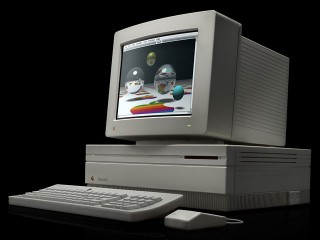 Apple released the first computer designed in anticipation of System 7 on March 19, 1990. It was the 40 MHz Mac IIfx, and Apple dubbed it “wicked fast”. It featured a 40 MHz 68030 processor – faster than many Unix workstations at the time – and could accommodate up 128 MB of RAM.
This performance came at a price – at $10,000 it was the most expensive Mac ever released.
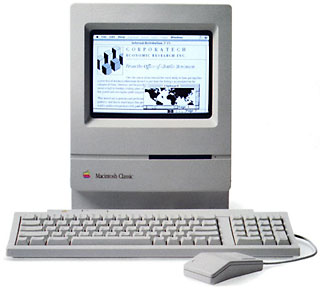 Apple’s next three machines focused on the low-end market and were released on October 15, 1990. The Mac Classic was the cheapest Mac until Apple released the $799 indigo iMac 350 in July 2000. It was a completely redesigned Mac SE and was available with an internal hard drive for $500 more.
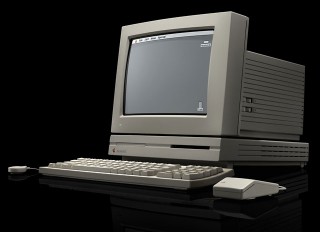 The second machine that Apple released on this date was the Macintosh LC. “LC” stood for Low cost and Color, and it delivered. At $2,500, it cost a thousand dollars less than Apple’s next cheapest color model. It was in an entirely new case (reminiscent of the slim NeXTstation released in the same year). Apple released a special version of the LC for education that was even cheaper – it jettisoned the hard drive in favor of a second floppy drive. The LC included a 68020 processor running at 16 MHz.
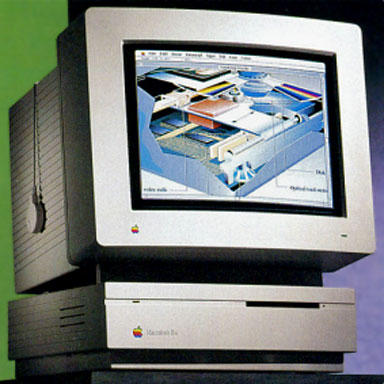 The third machine released in October 1990 was the 20 MHz Macintosh IIsi, which was intended as midrange, lower-priced version of the IIci. It was priced at $3,700.
System 7
Apple raced to finish the next version of the Mac OS, which included many of the same features that Windows already had, including virtual memory and color. (System 6 supported color applications, but the OS itself was black & white.) The Mac OS had become somewhat antiquated. It was hacked to work with Apple’s next-generation computers and did not take advantage of many of their features.
Released in May 1991, System 7 was capable of addressing more than 8 MB of RAM without special software via 32-bit addressing, had a full-color interface, had integrated cooperative multitasking, and had a new System Folder that was easier to troubleshoot. System 7 also had built-in networking and file sharing (something Windows would not have until 1993).
Months after System 7 was released, Microsoft released Windows 3.1. It seemed like a relatively minor upgrade, primarily an interface update. Windows 3.1 became the best selling software package in microcomputing until the release of Windows 95.
The First PowerBooks
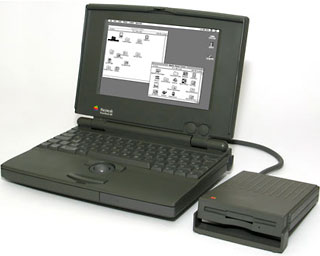 One year after the introduction of the Classic, LC, and IIsi, Apple revolutionized the portable computing market. Having learned from the failed Macintosh Portable, Apple recruited Sony to redesign the machine as a far more portable Macintosh. While Sony designed the 5.1 lb., 8.5″ x 11″ PowerBook 100 (right), Apple worked to create larger, more powerful models based on the 68030 processor (the PowerBook 140 and 170, below). These were meant as desktop replacements.
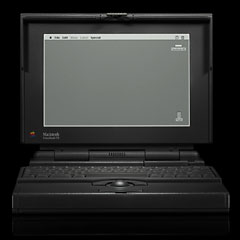 Unlike other notebook manufacturers, the PowerBook designs integrated trackballs into the palm rest in front of the keyboard. This allowed users to use control the cursor without taking their hands off the keyboard. Apple also made extensive modifications to the Mac OS to make it much more power efficient than Windows (it was not until 1996 that Apple fell behind Windows in the notebook market). The PowerBooks were widely praised and sold very well.
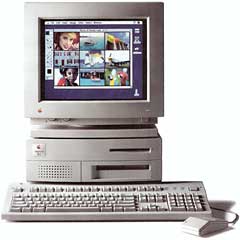 Along with the PowerBooks, Apple released a bevy of upgrades to existing products. It released the 16 MHz 68030-based Classic II (the SE/30, which it replaced, outperformed it but had cost a lot more) and the Macintosh IIvx. The IIvx was the first Mac (and one of the first PCs) that shipped with an internal CD-ROM drive.
Quadra, the Next Generation
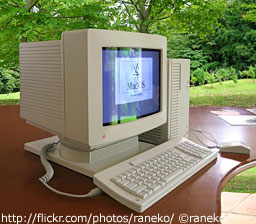
Quadra 700
In a surprise announcement, Apple also released two new machines based on the 68040 processor. These new models would be called Quadras, and they would be Apple’s entry into the workstation market. The first Quadras released were the Quadra 700 and Quadra 900. Both were based on a 25 MHz Motorola 68040 CPU. The new processor was much more efficient than the 68030, with some benchmarks putting it at almost twice as fast as the “wicked fast” Mac IIfx.
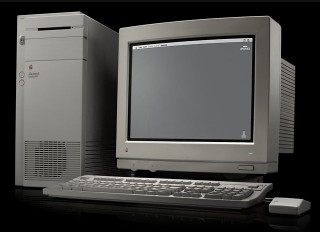 The Quadra 700 was housed in a IIci case and was the first Quadra to be available in large quantities. The 900 was housed in a huge (20″ tall) full-sized tower case and was easily upgradeable. Unlike the 700, which had only two NuBus slots, the 900 had six expansion slots (five NuBus, one PDS).
Performa: Consumer Macs
Apple’s computers had long been associated with home computers (and often marketed as such), but Apple had not released a computer for the express purpose of being used as a home computer since the Apple IIc. The Performa series was rebranded Macs that were bundled with extra software, including AtEase and educational games. The line was launched in September 1992. The first model, the Performa 200, was a rebranded Classic II. The Performa brand would last until 1997.
The same year, Claris released ClarisWorks 1.0, Apple’s answer to Microsoft Works. Sales were fantastic, and it quickly outsold the popular Microsoft package. Breaking from tradition, Apple bundled ClarisWorks with all Performas. It was also ported to Windows, where it was well received. PC Magazine called it, “The best integrated suite, period.”
Beyond the 680×0
The demise of the Jaguar project did not inspire any new confidence in the 68k processor. In the late 1980s, IBM revived its RISC project and released the POWER chip. The processor was powerful and inexpensive, but without a market beyond IBM’s RS/6000 workstation, it had little commercial value. IBM wanted POWER to become a mass-market processor and approached Apple to use a revision of POWER in their desktop computers.
Apple accepted IBM’s offer and recruited Motorola to help manufacture the processor. Motorola and Apple were not willing to give up their investments in the Motorola 88k processor, so they modified the POWER to be bus compatible with the 88k. The group (informally called AIM for Apple-IBM-Motorola) renamed the modified processor PowerPC and released the first PowerPC CPU in 1992.
Apple wanted to release the next generation Macintosh on the tenth anniversary of the first Macintosh and rushed development. Pink would not be ready by then, so Apple decided to retrofit the older Mac OS for the PowerPC. Most of the operating system was to be emulated (the target processor was the 680LC40, the same chip used in a Quadra, but without an FPU), so Apple only had to rewrite the lowest level portion of the operating system for the PowerPC chip and could emulate the rest in software.
- VisiOn, Wikipedia
- VisiCorp Visi On, Nathan Lineback
- VisiOn., the first GUI for the PC, PC Museum
- Pink: Apple’s First Stab at a Modern Operating System
Bibliography
Some of the sources used in writing this article:
- Apple: The Inside Story of Intrigue, Egomania, and Business Blunders, Jim Carlton
- Infinite Loop, Michael Malone
- The Second Coming of Steve Jobs, Alan Deutschman
- Apple Confidential 2.0, Owen Linzmayer
- Odyssey: Pepsi to Apple . . . a Journey of Adventure, Ideas & the Future, John Sculley
- Wikipedia
keywords: #sytem7 #macclassic #maciisi #maclc #powerbook100 #powerbook140 #powerbook170 #maciivx #quadra700 #quadra900 #performa #macclassicii
short link: https://goo.gl/qjDkF1
