This is an edited version of the 1994 manuscript.
The African-American oral tradition has contributed immensely to
greater American society. In addition to the linguistic influence
of Black English Vernacular, many common terms, such as slang words
and phrases, have continuously spilled across cultural boundaries
since the first African disembarked a Dutch man-of-war in 1619. One
particularly interesting African-American linguistic contribution
to American speech is "signification," a rhetorical strategy
commonly characterized by verbal/gestural indirection and wit. [1]
Signification, or signifyin(g), also figures into black literature.
During the cultural and artistic explosion known as the Harlem
Renaissance, several writers produced poetry and prose that
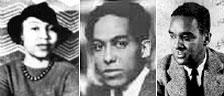
resonated with forms of signification. The literary vanguard of
this movement included Langston Hughes, Zora Neale Hurston, and
Richard Wright.
An astute observer of black culture, Hughes humorously yet
masterfully depicted signifyin(g) speech events, especially the
dozens. Hurston - who has the unique honor of residing in three
literary canons: feminist, African-American, and American fiction -
delved into the black speech community, producing works that paid
homage to the vernacular tradition by employing forms of
signifyin(g) like the comical and didactic "lies" recorded in her
anthropological works. Wright knew intimately the effectiveness of
signifyin(g) and used it not only as an amusing rhetorical device,
but as a cathartic, coping mechanism to counter the psychologically
disruptive effects of American racism.
Each of these writers is a novel contributor to the study of
signification as a rhetorical device esoteric to the black
community. This thesis argues that as a rhetorical strategy,
signification fulfills a basic maxim of mass communication, and
rhetoric: knowing one's audience. Since most American blacks who
lived during the Harlem Renaissance were not too far removed from
slave culture, they still retained knowledge of their ascendants'
oral traditions, of which signifyin(g) is a salient characteristic;
hence, Hughes, Hurston, and Wright were timely in their use of
signification. Signifyin(g) shows the verbal, and rhetorical,
virtuosity of American blacks, underscoring their shared culture.
Above all, it represents black America's linguistic heritage,
showcasing its greatest contribution to the rhetorical tradition:
its American yet African speech patterns.
- The term "signifying" shouldn't be confused with its normally
associated denotation. One purpose of this thesis is to assert an
African-American definition....
Epigraphs
Sums up what I learned in grad school
Research is formalized curiosity.
- Zora Neale Hurston
A true education is the personal exploration of a subject, not
the dull recitation of facts.
- A "friend"
The idea that [writings] which are delightful to read must be of
superficial temperaments . . . is the reverse of the truth. What
has been easy to read has been difficult to write. . . . A limpid
style is invariably the result of hard labor....
- G. M. Trevelyan
Acknowledgments
Thanking those who cared
The problem with acknowledgments is that someone will always be
forgotten. To those who were forgotten, my regrets. To the rest,
merci: Rocky Colavito - the best thesis chair, I think - thanks for
the direction and genuine interest, you are a true writing coach;
Craig Milliman, Garry Ross, and Ray Wallace - thanks, many thanks;
thanks, Jay Means, for thinking I can write; thanks for listening,
Laura M.; thanks for the readings, Patricia M. and Jim C.; Ricky,
Sandy, and Mrs. Brooks - hi; "shout outs" to Kesha and Aaron;
profuse thanks to Daniel, Jerry, and Jim (again!), for solving
computer crises; thanks, Bobbie J.; thanks, Watson reference staff,
Catherine Bonner, and Don Hatley; danke: Ginger, my e-mail
confidante, and Jeannette, my "fifth reader"; hi, Mom.
Separate, special thanks goes to Irma Persons, who served me
faithfully. Your dependable assistance, prayerful patience, timely
encouragement, deep love, and indefatigable devotion are
invaluable. E pluribus unum....
Above and beyond all, heartfelt thanks to God - and yes, there
is a God . . . how else could I have finished such a
Herculean task in two months?
Deep gratitude to Henry Louis Gates, Geneva Smitherman, J. L.
Dillard, and the other men and women dedicated to studying how and
why black people "talk that talk." From their work I drew
substance; I am indebted to their fine scholarship.
Overall dedication goes respectfully to the memory of Zora,
Langston, and Richard: no one can turn a phrase quite like Zora
Hurston; Langston Hughes is "simply" inimitable; Dick Wright is my
kind of autodidact.
© 1994 NSU Press © 1994-1999 Rodney
Lain.