The February 1984 issue of Byte has got to be one of my all-time
favorite computer magazines - it 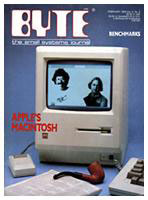 has
in-depth coverage of Apple's Macintosh along with all the usual geeky
stuff.
has
in-depth coverage of Apple's Macintosh along with all the usual geeky
stuff.
Microbytes
Commodore was planning a "Unix-like" OS for a Z8000-based computer,
to be called "Next Generation" and include 256 KB of RAM.
Speculation was that a boost in IBM production could spell trouble
for clone makers, but in reality it was the clone makers that would
come to shape the PC market.
Intel's new 80186 CPU was faster than the 8088 and eliminated the
need for some support chips, which could help reduce PC prices, but in
the end very few '186 machines were made. I remember the Tandy 2000,
but can't think of any others.
Never Give Up the Ship Dept. Digital Research, Zilog, and AMI
agreed to create a version of the Z80 CPU with the CP/M operating
system incorporated into the chip. CP/M was pretty much dead in 1984;
they just didn't know it yet.
Seagate and Vertex announced 100 MB hard drives - that was twenty
times the capacity of the Apple ProFile, a 5 MB hard drive for the
Apple III and Lisa.
The Apple Macintosh Computer
This product preview begins,
- Apple established itself as one of the leading innovators in
personal computing technology a year ago by introducing the Lisa, a synthesis and
extension of human-interface technology that has since been widely
imitated. Now the company has strengthened that reputation with a new
machined, the
Macintosh. In terms of technological sophistication and probable
effect on the marketplace, the Macintosh will outdistance the Lisa as
much as the Lisa outdistanced its predecessors.
Why such an impact? Because the $2,500 Macintosh was far more
accessible than the $10,000 Lisa. And to achieve this price
breakthrough, Apple had to reinvent the Lisa in more ways than you can
imagine.
Rather than go into all the details here, which would make for a
very lengthy article, we've waded through two long articles and six
sidebars, extracted the most interesting information, and posted it in
a separate article as The Original
Macintosh.
Apple Announces 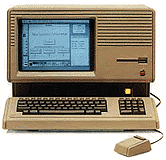 the Lisa 2
The birth of the Macintosh marked the death of the Lisa - and the
birth of Lisa 2, a less costly
replacement for the original that also shared the Mac's 3.5" floppy
drive. The base Lisa 2 would sell for "under $4,000" with
1 MB of RAM, while the Lisa 2/10 added an internal 10 MB hard
drive to the mix.
Lisa 2 could run both the Lisa operating system and the Mac OS.
User's Column
One of the best things about reading Byte over the years has been
Jerry Pournelle's column, then called the User's Column. In this issue,
the longtime Z80-CP/M user talks about the genuine IBM PC they recently
received at Chaos Manor.
Benchmarks
This issue had a special section looking at benchmarks, starting
with an article explaining when benchmarks are and are not meaningful.
Articles looked at benchmarking software, printers, compilers, and
CPUs.
Review: ProDOS
Apple's new OS for the Apple II line, ProDOS, included support for
Apple's 5 MB ProFile hard drive, marking files with the time and
date they were saved, adding nested directories, and use of a RAM disk.
ProDOS was one of the first operating systems to use disk names (like
the Mac) instead of a physical drive ID (like the C: drive in DOS and
Windows).
Review: IBM CS-9000 Lab Computer
There's a tale that IBM had considered the Motorola 68000 CPU for
their personal computer, but went with the Intel 8088 in part because
it made for a cheaper design. The IBM CS-9000 was based on the 68000,
the same 8 MHz CPU found in the new Macintosh.
Not a personal computer by any stretch of the imagination, the
powerful Lab Computer started at $5,000+ and ran OS 1.1 or Xenix, not
any of the established PC operating systems.
Review: Apple Disk Emulators
This review looks at four RAM disks for the Apple II. The models
offered ranged from 128 KB (less than one floppy stored) to 320 KB. Two
were expansion cards that fit inside the computer, while the other two
were external devices. These "disk emulators" averaged 4-5 times faster
than a floppy disk, making them great for programs that did a lot of
file access. Prices? $349-1,095.
Bubbles on the S-100 Bus
About ten years back, bubble memory was the next big thing. Unlike a
floppy or hard drive, bubble memory had no moving parts. Unlike a RAM
disk, bubble memory retained its contents when the computer was turned
off. Clever, but it never caught on.
Ads
Open the front cover to a two-page ad promoting the Apple
ImageWriter, the Apple Card (a credit card), and Catalyst, a program
from Quark that allowed users to install "almost anything written for
the Apple III" to the ProFile hard drive - including copy-protected
software.
Everyone was making DOS computers. Outstanding values included the
Chameleon, a $1,999 portable with two floppies and a 9" screen, and the
TAVA PC, a $1,999 (plus monitor) desktop.
Speaking of clones, Compaq was pushing their new Compaq Plus, which
took the original portable Compaq and added a whoppingly huge 10 MB
hard drive.
If you wanted letter quality printing but still needed a typewriter,
the Bytewriter offered both in one package.
Think 3.5" floppies are too big? Amdek and Hitachi both had ads for
3" floppy drives. According to the Amdek ad, Apple II users could store
286 KB per disk - twice as much as Apple's 5.25" floppy.
Remember Smith-Corona typewriters? Corona Data Systems made DOS
computers, one a PC clone, the other a Compaq clone.
"Dimension. The most powerful, most compatible personal computer you
can buy." The Dimension used the same 68000 CPU found in Lisa and
Macintosh, but it also "contains the microprocessors found in all of
today's popular personal computers" - Z80, 6502, and 8088. Clever idea,
but only a handful were ever produced.
Did you know Epson made some innovative computers over the years? In
this issue, they had a two-page ad promoting their QX-10 Valdocs
system, which had single-key commands to launch programs and perform
common functions such as saving and printing. Alas, the QX-10 was based
on the old Z80 processor and CP/M operating system, which was doomed by
DOS.
Here's a real blast from the past - a Heathkit ad! "I built this
16-bit computer and saved money. Learned a lot, too." That computer was
the Heath H-100, a hybrid machine with two CPUs (8085 and 8088) that
could run two operating systems, creating a bridge between the CP/M
past and the MS-DOS future. Also available preassembled as the Zenith
Z-100, the machine had a great keyboard and a IBM PC incompatible
architecture that supported up to 768 KB of memory and S-100 expansion
cards.
Another PC-incompatible DOS computer was the Texas Instruments
Professional Computer, which had superior graphics and a better
keyboard than the IBM PC. As with the Heath/Zenith machine, that
incompatibility doomed an otherwise excellent computer.
The Sanyo PC Plus was available from Scottsdale Systems for $1,099 -
one of the cheapest DOS machines of the day.
"Can you name the world's third largest supplier of personal
computers?" Back in 1984, Apple and IBM filled the top two slots, while
NEC was #3. Their APC (Advanced Personal Computer) shows why they never
made it to the top - dual 8" floppies, unique architecture, huge size
made this "advanced" machine unattractive to businesses.
For more in-depth coverage of the first Macintosh, read The Original Macintosh.