What is a computer?
A computer is a device that has a processor, can run a program from
memory, contains storage for data, and has methods of input (like a
keyboard, pointer, or touch screen) and output (like a display or
printer). These four features may be built into a coffee maker, but we
don't consider it to be anything more than a coffee maker.
We have developed some stereotypes of what makes something feel like
a computer. The box that is sitting on or under your desk with a
monitor attached is a computer. Computers may also be that clamshell
arrangement that you type on - that is called a laptop computer. A big
university or research lab may have a room filled will large cabinets;
these cabinets may house computers or altogether make just one jumbo
computer.
Despite the four basic features of a computer, we have come to
associate what a computer is with these stereotypes. Another stereotype
is that a computer runs one of a select group of operating systems:
Unix, Windows, Linux, or Mac OS. There may be many other operating
systems, but they are mostly ignored when reporting sales or market
share of computers: No one reports Palm, Newton, or iPaq sales as part
of the number of computers sold. These smaller devices, commonly called
PDAs, simply aren't counted as real computers.
PDAs
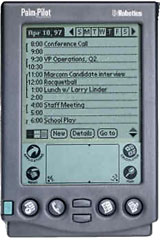 Back when I got my first Palm, I was very proud of all that I could
do with it. I could carry data from my main computer in the form of
spreadsheets or Word files. It had games and ebooks to keep me
entertained. All my addresses and calendar dates were stored on it.
With an attachable keyboard, I could type information directly into it,
just like it was a regular computer. Information was at my fingertips
everywhere I went.
Back when I got my first Palm, I was very proud of all that I could
do with it. I could carry data from my main computer in the form of
spreadsheets or Word files. It had games and ebooks to keep me
entertained. All my addresses and calendar dates were stored on it.
With an attachable keyboard, I could type information directly into it,
just like it was a regular computer. Information was at my fingertips
everywhere I went.
Almost anything on my desktop computer could be synched to the Palm
for reference. It was significantly lighter than any laptop and could
fit in my front pants pocket. I considered it the ultimate mobile
platform.
Even with all they could do, Palms never progressed to being called
computers. Nor did Windows
Mobile devices, which could claim to run Windows, ever grow beyond
being seen as PDAs. Their processors were too slow and the prejudices
too well established regarding what was allowed to be a "computer".
I still use a PDA, but I have toned down my expectations and needs
from the device.
Mobile Phones
The cell phone has taken over most of the functions of the PDA. Most
of them have games, address books, calendars, and even cameras. Today's
smart phones add some additional tools, such as connection to email and
the Internet, but they aren't called computers. They're just smarter
phones - no matter what extras are built into them.
What happens when a new device has all the functions, the extra
processing power, and uses a scaled down version of a stereotypical
operating system? It may not look like a computer. If it can act like
one and do all the work of one, will it ever get classified as one? No,
it won't. It will remain in whatever category it started in.
Subcompact Notebooks
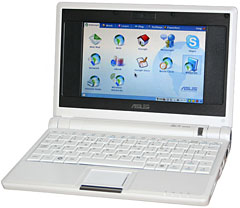 Currently, we have the
definition changing on the other side. The Eee PC laptop from ASUS
is smaller than any "real notebook computer" offered before. It has a
less powerful processor, less storage, and less memory than the typical
notebook, but it is selling so well that HP, Dell, and others feel the
need to have competing models.
Currently, we have the
definition changing on the other side. The Eee PC laptop from ASUS
is smaller than any "real notebook computer" offered before. It has a
less powerful processor, less storage, and less memory than the typical
notebook, but it is selling so well that HP, Dell, and others feel the
need to have competing models.
Laptops are no longer limited to 12" and larger displays; they can
now be as small as 7" (with 800 x 480 resolution on the Eee PC). People
are accepting the smaller size for the obvious benefits in
portability.
Convergence or Overlap?
If the laptop continues to shrink and the PDA/Smart Phone continued
to grow, eventually their specifications and features will meet. Once
they do, what would we use to distinguish the two devices? We will have
small laptops that can place phone calls and phones that can open
spreadsheets.
That point has been reached. The difference will become so blurred
that the stereotype of what is a "real computer" will have to be
adjusted. When this happens, sorting out who has the largest market
share may be redefined overnight.
Less expensive devices can sell in huge numbers. The Eee PC sold 4.3
million units in 2007 and is forecast to sell
at least 5 million units in 2008. In less than a year, this one
product accounts for 2/3 of all ASUS laptop computer sales. Because it
is cheap (US$400) and sales volume is high, it is changing ASUS' market
position worldwide. (for comparison, Apple sold a total of 5.6 million
computers in 2006, 7.7 million in 2007. Apple sold
5.4 million iPhones in the first 9 months on the market and expects
to sell at least 10 million this year.)
Obviously this low-cost laptop is going to be used for web surfing,
email, and word processing. Maybe a few simple games can run on it.
These are mostly the same functions that a smart phone is doing.
Functionally, these two devices are very close, except that the mobile
phone has a built-in camera and can make a phone call. (Yes, some
models of the 7" Eee PC do have a 0.3 MP, 640 x 480 webcam, but that's
not even snapshot quality.)
It is the difference in the size of the keyboard and display that
keeps the smart phone from being called a "computer", not usage.
Does Smart Phone Growth Mean Small Notebook Decline?
Maybe a phone will always be just a phone, regardless of the
capabilities that are added, but operationally and in the trend of
consumer purchases they will become something else. Today you may buy a
laptop to complement your desktop. Tomorrow you will buy a smart phone
for many/most/all of these mobile functions. Just as the smart phone
has replaced the need for a PDA or low-end digital camera, it will
continue biting into the laptop market.
I'm not predicting that the laptop will disappear completely. The
larger screen and keyboard are important for certain tasks. Laptops
themselves will continue to evolve. for example, they have branched off
into behemoths that have 17" and even 20" displays. This is "portable"
power more in line with a desktop computer and far exceeding anything a
smart phone could offer. It is the low-power, smaller-end that will be
gobbled up by the smart phone.
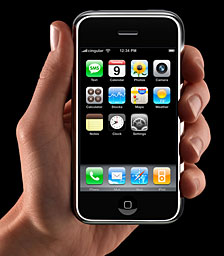
Apple didn't invent the smart phone, but the iPhone has become the
standard by which all smart phones are now judged. The method of access
to functions, the idiot proof nature of the design, and even the look
of the device dominate the market.
Apple Triumphant
The iPhone is yet another aspect of the post-PC war that Apple is
waging.
When the iPod was released, Dell tried to compete with its own brand
of MP3 player, the Digital Jukebox. HP didn't even bother coming up
with its own player, instead it licensed the iPod and tacked on the HP
brand, e.g., HP iPod.
 This time
neither of these old competitors is trying to bring out its own model
to compete directly with the iPhone. Instead Apple is going up against
LG, Motorola, RIM, and Nokia. It would seem like a one-sided battle,
with Apple being the teeny tiny competitor hoping to gain just 1%
market share, but the opposite is true: Windows Mobile is a joke, Palm
has shown little innovation, and Blackberry holds little beyond push
email delivery. The iPhone has already achieved over 25% market share
in the smart phone market.
This time
neither of these old competitors is trying to bring out its own model
to compete directly with the iPhone. Instead Apple is going up against
LG, Motorola, RIM, and Nokia. It would seem like a one-sided battle,
with Apple being the teeny tiny competitor hoping to gain just 1%
market share, but the opposite is true: Windows Mobile is a joke, Palm
has shown little innovation, and Blackberry holds little beyond push
email delivery. The iPhone has already achieved over 25% market share
in the smart phone market.
The phone manufacturers still see their devices as phones with
extras thrown in. Apple has reversed this business model and is
providing an OS X mobile computer with a phone thrown in. By
giving the device the name iPhone, they have disarmed their competition
as to the true nature of the battle.
Apple couldn't halt the progress of additional software for the
iPhone. From the start it was endowed with the innate ability to do
more. There was no hiding this potential once people had it in their
hands. People immediately started cracking the iPhone to release its
potential. Apple is already supporting iPhone software development, and
from this position Apple will continue to shape the nature of the
device, driving the competition to constantly mimic but never catch up
with it.
In many ways, the iPhone and the Eee PC are mirror products across
the smart phone-to-computer divide. They both sold around 4 million
units after they launched in 2007. They both are looking to sell
millions more units by the end of 2008. They both have the competition
scrambling to come out with a truly competitive model. Even the prices
are not all that different.
Their Own Worst Enemies
The Eee PC is stuck in the old PC battleground. While once a
progressive device that had Linux installed as a cost savings,
Microsoft has moved in to offer a discounted (or even a subsidized)
version with Windows XP for the Eee PC. That's right; Microsoft is
incapable of reducing the bloatware known as Vista to fit and must
stick with XP as the OS. (I guess they couldn't get away with selling
Windows Mobile for a notebook computer.)
The newest model Eee PC is going through typical feature bloat to
make it more mainstream. It has a larger screen (10.2" 1024 x 600) and
such. They have already lost the focus on how to continue making it
smaller and more portable. Instead they want to turn it into a regular
laptop to compete with all the other ones on the market.
Apple is way ahead of the others in the smart phone business by the
simple merit of including OS X with the iPhone. I'm sure many
functions had to be stripped out to make the operating system small
enough to fit, but each year, as memory space grows and processor speed
increases, more functions will creep into the iPhone. Apple won't even
have to spend R&D dollars to figure out these improvements: The
software will already be developed for a laptop or desktop
computer.
This is the point of complete convergence, when all the functions on
a mobile device (phone or notebook) match those of a desktop computer.
It has a single low-watt processor to support those things you do when
away from a desk. You dock it to a base station that has 4-10
additional processors, and it can instantly switch to using all these
processors to handle more desktop-oriented tasks. If small enough, it
could dock to a laptop or tablet PC to handle those tasks that need a
larger display and a full-sized keyboard.
Planning Way Ahead
It may seem like Apple has moved onto the phone business, but this
is just another step in the evolution of computers. Apple is building
the groundwork years in advance. Apple is planning at least 3-5 years
ahead. When convergence arrives, that device we used to call a phone
will have become a full-fledged mobile computer.
Apple could face competition from a revitalized Microsoft, but that
company is too ingrained in the bloatware tradition. If Vista is any
guide, Microsoft shows no preparation for the day of convergence. One
of the other phone OSes could be developed for convergence, but the
vision within those companies may not exist to promote such a goal.
Linux may have the most potential for being ready and able to offer
competition to Apple.
I look forward to the day when PDAs finally get recognized for what
they really are, nascent mobile computers. It may take some additional
blurring of the stereotypes before this perception finally clicks in
for everyone. By then I will probably have moved on from my Palm to the
latest version of the iPhone, but I'll still remember where I started
and what a great device it was.