
After releasing the industry’s most radically fresh desktop design and the most popular computer in 1998, what do you do for an encore?
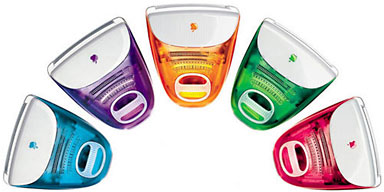 In Apple’s case, you improve it at the start of the year with a faster processor and a choice of colors. The colorful 266 MHz iMac Rev. C was a runaway success in blueberry, strawberry, lime, tangerine, and grape. Unfortunately for Apple, the “powers that be” who determine which computer is the most popular decided to count each different color as a separate model, finally knocking the iMac from the #1 spot as the best selling personal computer.
The iMac sailed right past the 300 MHz mark. Apple introduced a 333 MHz model on April 14. Same colors, just 25% faster. And by the end of the year, even that model would be replaced.
The Blue & White Power Mac G3

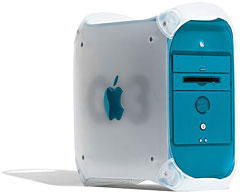 The new Yosemite Power Mac G3 (I called it the G3 Pro at first, others call it the Blue and White G3, B&W G3, Blueberry G3, or the Smurf) was almost as radical a stylistic departure as the iMac had been. It marked the first time Apple had not offered a standard desktop configuration as an option somewhere in the Power Mac line.
The case design is brilliant, even if it is less expandable than some would like. Instead of removing part of the case to add memory or a PCI card, the 4-slot motherboard is on a hinged door (sometimes called a drawbridge) that folds down to the right of the computer. You can even open the case while the computer is running, since the hard drives are mounted in the base of the case.
The blueberry and white case design clearly marks the 300-450 MHz powerhouse as “not your father’s PC”, and there’s room for several internal hard drives, one optical drive, a Zip drive, and up to 768 MB of RAM.
Architecturally, the Blue & White G3 introduced 64-bit PCI slots (three of them) and a 66 MHz PCI slot, which was used by the ATI Rage 128 video card with 16 MB of VRAM. Apple offered a special decoder card for use with DVDs. Like the Beige G3, the Blue & White G3 has a ZIF-mounted CPU, making upgrades to faster G3 CPUs (up to 1.1 GHz!) and G4s possible. This was the last Mac with an ADB port, the first with FireWire, and the first Power Mac without built-in SCSI.
In June, the 300 MHz model was discontinued and a 450 MHz one was added.
Lombard PowerBook G3
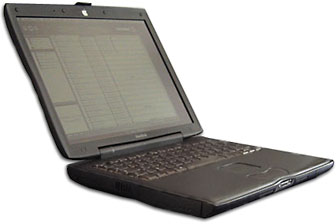 In May, Apple replaced the older WallStreet PowerBook G3 Series with a newer one, code named Lombard. The Lombard G3 was slimmer and about two pounds lighter than the previous PowerBook G3 Series. One way to distinguish Lombard from its ancestor is its translucent brown keyboard (Apple calls it “bronze”).
To get the weight down and make it slimmer, Apple gave Lombard only one drive bay and one PC Card slot. This was the first PowerBook with USB, and it has no ADB port for legacy peripherals. Like WallStreet, it supports two batteries, which provides up to 10 hours of field use.
The new PowerBook retained the title of the world’s fastest laptops, offering speeds of 333 and 400 MHz. The 400 MHz version included a decoder card to facilitate watching DVD.
The iBook
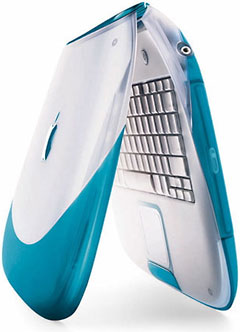 Announced in August, the iBook began to ship in late September. It was the best selling portable computer in both October and November.
The iBook is rugged, designed for the realities of the education market, and has an 800 x 600 pixel 12″ display. The 300 MHz CPU offers plenty of power using the Classic Mac OS, although it strains under OS X.
Promoted as “an iMac to go”, the iBook is rugged, has a six-hour battery rating, and accepts an AirPort card for high speed wireless networking. This helped establish 802.11b WiFi as an industry standard.
Power Mac G4, A Personal Supercomputer
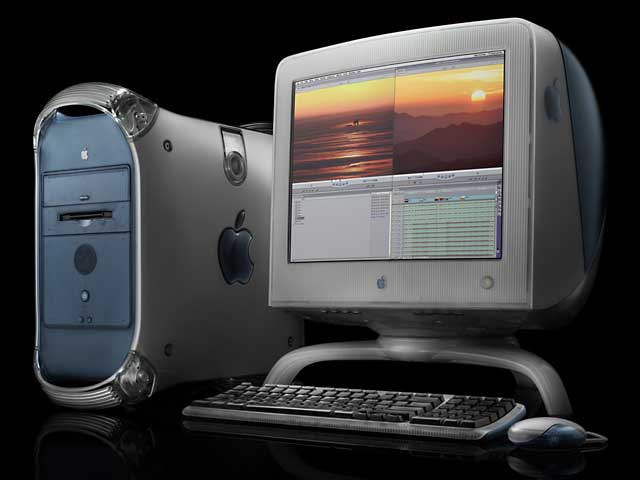 A lot of Apple watchers were surprised to see Apple introduce the Power Mac G4 at the Seybold show on August 31. We were even more surprised to hear that Apple was already taking orders for the 400 MHz version.
The new machine took the styling of the G3, but recast it in a more professional graphite gray and white with silver and clear accents.
 But differences are more than skin deep. The G4 processor has a high performance math accelerator called the Velocity Engine or AltiVec. It smokes any Pentium III computer on the market. In fact, when it was introduced, the US government classified the G4 as a supercomputer, because it could do over one gigaflops (GFLOPS, billion floating point operations per second).
The original 400 MHz G4 and a later 350 MHz model, both known as Yikes, were based on a modified Yosemite motherboard, the one used in the Blue & White Power Mac G3. Best of all, the 400 MHz G4was introduced at the same price point the 350 MHz G3 had occupied.
The 450 MHz G4 and subsequent versions of the G4 were based on the new Sawtooth motherboard, which has a faster memory system, more room for RAM (up to 2 GB), a faster slot for the video card (2x AGP instead of a 66 MHz PCI slot), and an internal FireWire port. A 500 MHz model was announced in August but didn’t ship until 2000.
All the Sawtooth G4s accept Apple’s AirPort WiFi card, allowing them to network without wires.
Apple’s biggest mistake of the year was related to the Power Mac G4. Motorola was unable to produce 500 MHz G4s in quantity, so in October Apple scaled back the Power Mac by 50 MHz. The Yikes model was reduced from 400 MHz to 350, and the Sawtooth from 450 and 500 MHz to 400 and 450 MHz.
Ordinarily that wouldn’t be a big deal, but Apple didn’t reduce the price on these Power Macs, just the speed – and there was a huge uproar, especially when Apple tried to change existing orders and fill them with the slower models. It took about a week for Apple to agree to fill orders as they had been placed.
In December, Apple discontinued the Yikes model and introduced a 350 MHz Sawtooth at the same price. Another plus is that the new model shipped with a DVD-ROM drive instead of CD-ROM.
The Kihei iMacs
Apple replaced the tray-loading iMac with three new models in October. The new design used a smaller case, a slot-loading optical drive, convection cooling (no fan!), and easy access to the memory socket. The base model, available only in blueberry, ran at a comfortable 350 MHz.
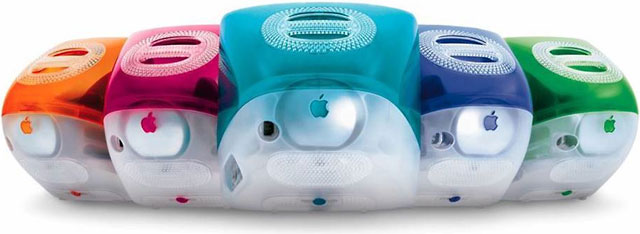
A step up from the US$999 iMac was the iMac DV, which came in all five flavors, replaced the CD-ROM player with a DVD-ROM drive, and added both video out and FireWire ports. Along with the iMac DV Special Edition, available in G4-matching graphite, these were the first computers designed from the ground up to handle digital video. With a special adapter, the DV and DV SE can use an AirPort Card for wireless networking.
In fiscal 1999 (October 1998 through September 1999), iMac sales made up 52% of Apple’s unit sales.
Y2K – No Problem!
Apple had a great opportunity to extend its reach thank to the “millennium bug” (a.k.a. the Y2K problem). In the early days of computing, using memory efficiently was essential, so dates were often stored using only the last two digits of the year. Microsoft copied the use of 2-digit years from CP/M, just as it copied virtually everything that went into MS-DOS 1.0, and when system clocks were added to early PCs, they were designed for the way DOS worked with 2-digit years. These issues persisted in DOS and Windows until 1999, when people began to panic that their PCs wouldn’t run or wouldn’t run properly after 12/31/99.
Apple hadn’t been that shortsighted when developing the Macintosh and the Mac OS. Even the oldest Macs supported dates to 2040, although the Classic Mac OS only supports setting dates into 2019. All PowerPC models can handle dates through AD 29,940, although Unix-based operating systems traditionally use 32-bit time stamps, which creats a Year 2038 Problem. (Modern operating systems typically used 64-bit time stamps, which is more than enough for the next 27 millennia or so.)
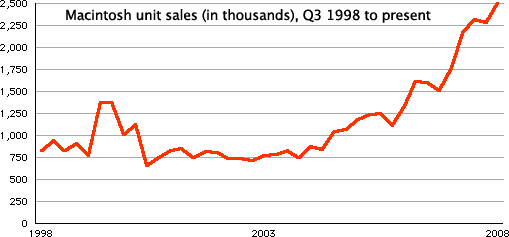
Quarterly Mac unit sales show a definite spike in 1999.
It’s hard to know why Mac unit sales spiked in late 1999 – new models were definitely a factor, but Y2K fear may have played a role as well. Mac advocates pushed the lack of a Y2K bug as a compelling advantage to those preparing to buy new hardware because their old PCs weren’t Y2K compliant.
The Competition
As mentioned above, there was Pentium III, the serialized chip that gave privacy advocates something new to worry about. It wowed the Wintel world, but Photoshop and other graphics demonstrations showed the G4 easily surpassing it in real world tests.
AMD one-upped Intel with its Athlon processor, which reached 700 MHz and provided power users with a real alternative to the Pentium III.
The Compaq Alpha CPU was running out of steam by 1999. Compaq had acquired it as part of DEC, and it had no use for Alpha, as Compaq was wed to Intel CPUs. Alpha was being blown away by the PowerPC, and Compaq would finally give up on the architecture in 2001, selling the Alpha design to Intel. (Compaq would be acquired by HP in the same year, where the brand would live on.)
Windows Me (officially Millennium Edition, often called Mistake Edition) made it to market in September 1999, giving Windows users a Y2K compliant operating system. (Macs never had such an issue, although some programs – especially those ported over from PCs – had Y2K problems.)
Windows 2000 (nee Windows NT 5), an update to Windows NT that would be fully Y2K compliant, didn’t make it out of the gate until February 2000.
Personal Perspective
I was very excited to have a couple of the new G4 Power Macs at work. Bang for the buck, the $1,600 “supercomputers” were amazing – and these were the entry-level Yikes models! Thanks to CPU upgrades, it’s possible to bring the Sawtooth models well past the 1 GHz mark.
I had been been blown away by the PowerBook G3 in both WallStreet and Lombard incarnations, but I especially liked the lighter weight of the Lombard design. In 1999, I wrote, “The PowerBook G3 is already enough computer to displace most desktop setups.”
Next – 2000: Pismo, the Cube, Dual Processor G4s, Slot-load iMacs, and New iBooks
Keywords: #imac #blueandwhitepowermacg3 #blueandwhiteg3 #ibook #lombardpowerbook
Short link: http://goo.gl/FmCREt
searchword: machistory1999
