
Never before had Apple sold a $500 Macintosh. Never before had Apple been poised to grow its market share like it hoped to with the Mac mini. The tiny Mac mini (6.5″ square, 2″ high, 2.9 lb.) has incredibly minimalist design. On the front, there’s just a slot-loading optical drive and a power light. On the rear, almost enough ports to do everything important (two USB ports is kind of skimpy).
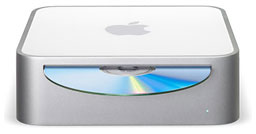
The Mac mini shipped in a smaller box than the regular iPod, which was possible because Apple didn’t include a keyboard or mouse. Instead, Apple says you can plug in your favorite USB keyboard and mouse – or buy Apple’s offerings. Mac OS X 10.4and later include support for remapping the Windows Alt and Option keys to Option and Cmd.
The Mac mini is expandable. Memory can be expanded from 256 MB to 1 GB (but there’s only one memory slot, so if you upgrade, you have to remove what’s installed), and Apple doesn’t recommend that users upgrade RAM (although this will not void your warranty). There’s room inside for Bluetooth and AirPort Extreme (to be installed by Apple or an authorized dealer, not by the user).
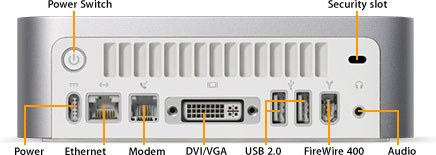
With USB 2.0 and FireWire, it’s easy to add all sorts of peripherals.
Apple cut costs with a single memory slot and by leaving out the keyboard and mouse, but they also made some choices that raise the cost of the Mac mini, particularly the slot-loading optical drive and the use of 2.5″ laptop hard drives that are smaller, more energy efficient, and more expensive per gigabyte than the 3.5″ drives found in most desktop computers.
Due to poor cooling, the ATI Radeon 9200 graphics processor can overheat during intensive gaming, producing what one reader calls “swirling flying triangles”. Letting the mini cool solves the problem. To minimize overheating, be sure to allow plenty of air flow around the Mac mini, don’t stack it with a hot hard drive, and consider running it vertically or with a set of feet to raise it above your work surface, which allows air to reach the bottom, the mini’s primary heat radiating surface.
Apple offered several Build to Order options, such as a 4x SuperDrive for $100 extra, Bluetooth for $50, AirPort Extreme for $79 (or both Bluetooth and AirPort Extreme for $99), a USB mouse and keyboard for $58, or a wireless mouse and keyboard for $99 (these requires Bluetooth). And with a $19 DVI to Video Adapter, you can connect the Mac mini to most modern TVs using S-video or composite video.
If you have a lot of peripherals, you might want to look into a FireWire/USB 2.0 hub. Prices range from $29-49.
At the time, Apple’s least costly display was the 20″ Cinema Display ($999 when the mini was introduced, and down to $799 in late 2005), although the Apple Store also offers flat screen CRT monitor for a lot less. The big question for the rest of the year will probably be which 17″ flat-panel monitor looks best with the Mac mini. We recommend you pick a display with digital DVI input instead of or in addition to analog VGA.
What You Need To Know
- This Mac mini has the ATA/100 standard, so it is not limited to the 128 GB drive limitation of earlier PowerPC Macs.
- The bootable drive size limit for this model is 2.19 TB, via the Apple Partition Map. This ‘mini can read and write (but cannot boot) from any size GUID partition table drive.
Details
- Announced January 11th, 2005 (Press Release)
- Apple model number: A1103 (EMC 2026)
- Model ID: PowerMac10,1
- Order: M9686LL/A (1/11/05 – 7/25/05, 1.25, 256 MB)
- M9686LL/B (7/26/05 – 9/27/05, 1.25, 512 MB)
- M9687LL/A (1/11/05 – 7/25/05, 1.42, 256 MB)
- M9687LL/B (7/26/05 – 9/27/05, 1.42, 512 MB, Airport, Bluetooth)
- M9971LL/B (7/26/05 – 9/27/05, 1.42, 512 MB Airport, Bluetooth, Superdrive)
- Discontinued September 27th, 2005
How it stacks up in Geekbench and Xbench
- Version 2.4.3: 714 (1.25 Mini) / 805 (1.42 Mini) / 918 (1.6 G5)
- Xbench 1.2 (1.24/1/42 GHz, 512 MB RAM)
- overall: 116.01/144.60
- CPU: 1351.97/172.25
- memory: 131.46/130.01
- Quartz graphics: 160.83/179.39
- OpenGL graphics: 111.26/123.11
- Hard drive: 57.38/60.89
Unsupported Mac OS X
- Although it is not officially supported, the Mac mini G4 can run Mac OS X 10.6.8 Snow Leopard using a MacRumors community developed build. It is currently still in development based off the Darwin 10.8.0 kernel compiled from source. See LEM Article.
- It is also possible to install Mac OS 9 “unofficially” using the “Mac OS 9 Lives!” disk image.
Mac OS X
- Requires Mac OS X 10.3.7 (Build 7T11) Panther through Mac OS X 10.5.8.
Core System
This Mac mini shipped with PowerPC G4 Motorola 7447a 130nm CPUs. System Bus is 167 MHz on both models. They use a 360-pin CBGA solder footprint.
Legend: L1i = L1 Instruction Cache, L1d = L1 Data cache
- ($499): 1.25 GHz, 1 Processor, 1 Core, 1 Thread, 1 CPU, 32-Bit PPC Arch
~19.2W TDP, 32K L1i, 32K L1D, 512KB L2, 48.6M transistors
CPU Instructions: Altivec Velocity Engine, VMX, VMX128, AND, XOR, OR
. - ($599): 1.42 GHz, 1 Processor, 1 Core, 1 Thread, 1 CPU, 32-Bit PPC Arch
21.0W TDP, 32K L1i, 32K L1D, 512KB L2, 48.6M transistors
CPU Instructions: Altivec Velocity Engine, VMX, VMX128, AND, XOR, OR
. - ROM: 1 MB NewWorld ROM, other instructions loaded into RAM.
Video
DVI to VGA adapter sold separately (+$19).
- ATI Radeon 9200, 32 MB DDR SDRAM @~6.4 GB/s, RV280, 128-Bit Bus
- 36 Million Transistors, 150 nm process size, AGP 4x @ 1066 MB/s,
- 250 MHz GPU clock, 200 MHz Memory clock (400 Mb/s effective), (~28W TDP?)
- 4 Pixel Shaders, 4 TMUs, 4 ROPs, DX8.1, OpenGL 1.4, Pixel 1.4 Vertex 1.1
Memory
- ($499+): 256 MB 333 MHz PC-2700 DDR SDRAM SODIMMs ~2.666 GB/s
- Configurable to 1 GB, 512 MB standard starting 7/26/2005
Drives
- ($499): 40 GB 4200 rpm ATA/100 IDE (ATA-6)
- 8x Combo Drive (Write: 24x CD-R, 16x CD-RW)
(Read: 8x DVD, 24x CD) - (+$100) SuperDrive available as a CTO/BTO option
.
- 8x Combo Drive (Write: 24x CD-R, 16x CD-RW)
- ($599): 80 GB 4200 rpm ATA/100 IDE (ATA-6)
- 8x Combo Drive (Write: 24x CD-R, 16x CD-RW)
(Read: 8x DVD, 24x CD) - (+$100) SuperDrive available as a CTO/BTO option
.
- 8x Combo Drive (Write: 24x CD-R, 16x CD-RW)
- ($699): SuperDrive (Write: 4x DVD-R, 2x DVD-RW, 4x DVD+R, 2.4x DVD+RW, 16x CD-R, 8x CD-RW) (Read: 8x DVD, 24x CD)
Expansion/Misc
- 2x USB-A Style USB 2.0 ports
- 1x DVI Port up to 1920 x 1080
- 1x FireWire 400
- 100 Mb/s Base-T Ethernet (RJ-45 style connector)
- 56k v.92 Modem (RJ-11 style connector)
- (optional on 1.42 GHz models after 2005.07.26)
- WiFi: IEEE 802.11g AirPort Extreme (Wifi 3, 54 Mb/s)
- (+$79) Optional prior to 2005.07.26
- Standard on 1.42 GHz model after 2005.07.26
- Bluetooth 1.1
- (+$50) Optional prior to 2005.07.26
- Standard on 1.42 GHz model after 2005.07.26
- 3.5 mm Headphone/Sound Jack
- Single internal speaker
- Kensington Security Lock
- Proprietary Apple Power connector
- PRAM battery: 3V CR2032 lithium
- 85W external power supply
Physical
- size:H/W/D 2.0 x 6.5 x 6.5 in/5.1 x 16.5 x 16.5 cm
- Weight: 2.9 lb./1.3 kg
Included In Box
- Mac mini G4
- A 85W external Power Brick, rectangular with Apple logo pressed in
- “Mickey Mouse” style 3-prong IEC 320-C5 Power Connector for power brick
- Mac mini User’s Guide
- Apple Computer, Inc Software License Agreement for Mac OS X (Single Use License)
- Apple software coupons for iLife ’06 + Mac OS X v10.3
- Product registration
- Apple Computer, Inc 1 year limited warranty pamphlet
- Mac mini “Mac OS X Install discs” with Apple Hardware Test (2 discs)
Online Resources
- Full list of online resources for the Mac mini (Early 2005) on a separate page.
searchword: macminig4




