External hard drives are my media of choice for file backups and
transfers between machines when a network connection is not
available or practical.
CDs and DVDs are fine for backups and sending in the mail or
passing on in other ways, so long as you don't have too high
expectations about their archival longevity, but burning stuff to
optical disks is still a hassle and annoyingly slow, even given the
advances that have been made in disk-burning technology (I have an
8x SuperDrive).
I much prefer the fast transfer speeds, easy editability,
low-hassle convenience, and relatively good archival stability of a
hard drive.
My Previous External FireWire Hard Drive
I've had a QPS Que! QuadSlim M2 FireWire hard drive for about
five years (you can still find a
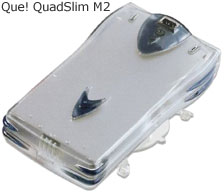
review in the Miscellaneous Ramblings archives). It's basically
a 2.5" ATA hard drive in a sleek little FireWire housing that looks
a bit like a Star Trek Tricorder, the M2 (which is no longer
available) came in a four capacities: 6 GB, 10 GB, 20 GB, and
30 GB.
Mine
was originally a 6 GB unit, but the original Fujitsu 2.5" hard
drive failed without warning after only a few months of relatively
light use - that was the only hard drive failure I've experienced
in 14 years of Mac use. Since then I've swapped in other 2.5" ATA
hard drives of varying capacities, and currently the M2 housing
holds the original 20 GB Toshiba drive that came in my Pismo PowerBook, which now has a 40 GB
Toshiba 5400 RPM drive.
Aside from the hard drive failure (presumably due to a defective
drive), the M2 has been a dependable tool that I've used a lot, and
it remains one of my main backup media. I also keep a bootable copy
of OS X 10.3.9 on the drive, from which I can boot any of my
three workhorse computers - a 17"
G4 PowerBook, the G4-upgraded Pismo, and my 700 MHz G3 iBook.
Why Choose FireWire?
Booting from a FireWire drive is a very convenient option for
troubleshooting and drive maintenance. The drive is hot pluggable
and bus-powered, at least on machines that support powered FireWire
buses. (Unfortunately, the CardBus FireWire adapter PC card in my
WallStreet doesn't support
bus power.)
With FireWire, data transfers are pleasantly quick, and I highly
recommend FireWire external hard drives to any Mac user with a
FireWire compatible computer.
However, all current and recent Macs support USB 2.0, which
supports data transfer speeds in the same ballpark as FireWire 400
(see FireWire vs. USB
2.0 for an explanation of why 480 Mbps USB 2.0 drives have
lower throughput that 400 Mbps FireWire drives). Hopefully, Apple
will continue to support FireWire on Macs indefinitely, although it
has been dropped from the iPod line for quite some time now.
USB 2.0 is a viable alternative to FireWire for many Mac users
for connecting to external storage media, with a wide selection of
USB 2.0 hard drives and drive enclosures available.
While USB 2.0 nominally supports a 480 Mbps data transfer rate,
in practice it has no real-world advantage over standard FireWire's
400 Mbps transfer rate.
FireWire still has the advantage of being bootable on pre-Intel
Macs with built-in FireWire. (While it is technically possible to
make USB 2.0 bootable on these Macs, that involves some tedious
geekery, so it's not something the average user should attempt.)
Ergo, if you need bootability, it's a no-brainer to go with
FireWire.
Why You Might Want USB 2.0 as Well
However, if your your primarily interest is in storage media
connectivity, then USB 2.0 will do the job for you, and USB 2.0
drives have one advantage over FireWire that should be of interest
to users of older Macs that support USB 1.1 but not FireWire - USB
2.0 drives can be mounted and used to transfer files (albeit at a
substantially slower speed).
Actually, the transfer rate is not as glacially slow as you
might expect.
The i-Rocks IR-9200 2.5" Hard Drive Enclosure
 After
that long introductory exposition we finally get to the subject of
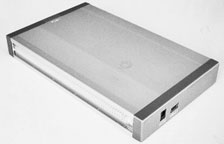
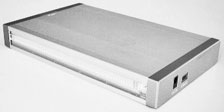
this review: the i-Rocks IR-9200 2.5" Hard Drive Enclosure, which
supports USB 2.0 with OS X 10.2 or later, as well as USB 1.1
back to Mac OS 8.6 (plus Windows, of course).
After
that long introductory exposition we finally get to the subject of
this review: the i-Rocks IR-9200 2.5" Hard Drive Enclosure, which
supports USB 2.0 with OS X 10.2 or later, as well as USB 1.1
back to Mac OS 8.6 (plus Windows, of course).
I've tested several i-Rocks products and have been favorably
impressed by all of them, especially at their modest prices. This
drive enclosure is no exception and often retails for about
US$20.
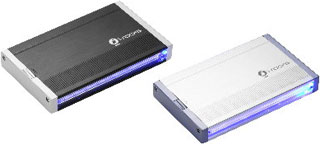
Available in silver or black anodized aluminum with a
"hairline" motif, the IR-9200 harmonizes nicely in appearance with
any modern Mac, and the silver model I tested looks right at home
beside my 17" aluminum PowerBook.
These hard drive enclosures are a great way to make use of hard
drives pulled when upgrading to a higher capacity unit in your
computer, and I've installed a 4.5 GB Fujitsu drive (which I think
originally came in a Lombard
PowerBook) in the review unit. The IR-9200 will accommodate any
2.5" IDE/ATA hard drive up to 9.5mm thick.
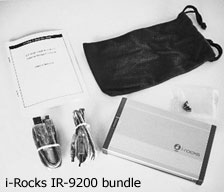 The i-Rocks IR-9200 comes bundled with a USB 2.0 cable, a
USB 2.0 to DC jack 5V power cable, a very handy little drawstring
carry pouch, and a software mini-CD (about which more in a
moment).
The i-Rocks IR-9200 comes bundled with a USB 2.0 cable, a
USB 2.0 to DC jack 5V power cable, a very handy little drawstring
carry pouch, and a software mini-CD (about which more in a
moment).
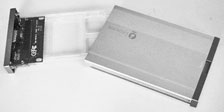
Installing the hard drive in the enclosure was a snap - which is
good, because there is no drive installation documentation provided
in the product package.
The
whole process took less than five minutes, and only a small
Phillips screwdriver was required for tightening the four supplied
screws that secure the hard drive to the IR-9200 internal
chassis.
No tools are required to open the case; just press the release
button, and the inside chassis slides out.
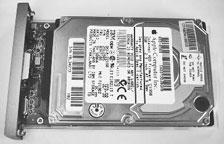 Carefully insert the multi-pin plug on the end
of the hard drive into the socket on the IR-9200's circuit board,
to install and tighten the four screws, and slide the assembly back
into the enclosure case.
Carefully insert the multi-pin plug on the end
of the hard drive into the socket on the IR-9200's circuit board,
to install and tighten the four screws, and slide the assembly back
into the enclosure case.
Before
using the IR-9200 (for USB 2.0 support) , it's necessary to install
supporting driver software on your Mac. A mini-CD containing driver
installers for both OS X 10.2 up and several versions of the
classic Mac OS comes in the box, but that presents a problem for
owners of Macs with slot-loading CD or DVD drives, since these do
not support mini-CDs (and attempting to use a mini-CD in a Mac
slot-loading drive can cause drive damage, so don't do it).
Unfortunately, there is no warning in the IR-9200 documentation
about this issue.
My workaround was to use a big old QPS tray-loading FireWire
CD-burner that I have, which handled the mini-CD with no
hassle.
The driver can also be downloaded from http://www.i-rocksusa.com/support.html,
and a somewhat out-of-date but still useful manual on driver
installation in PDF format can be downloaded from the same
page.
If you don't have a tray-loader available, the best strategy is
probably to find someone who does and get them to copy and burn the
driver installer files onto a standard CD for you. Driver
installation was straightforward, with a standard OS X
software installer, and there are instructions in the included
user's manual if you need them, but it was pretty intuitive. (This
is a hassle that you don't have to deal with using FireWire
drives.)
When
I connected the IR-9200 to the 17" PowerBook, I found that
strangely there was not enough bus power to spin up the drive, so
it was necessary to use the supplied USB 2.0 to DC jack 5V power
cable plugged into my self-powered USB hub. Once sufficient power
had been applied, the Fujitsu drive spun up nicely. The IR-9200 has
two activity LED indicators, a cool blue one for power, and a red
one for drive access status. I've found that the USB 1 ports in
both my Pismo and iBook supply enough juice to spin up the drive
without any help.
I didn't do any formally timed comparisons, but file transfer
speed seems to be not that different from my external FireWire 400
hard drive.
At just $19.99, the i-Rocks IR-9200 USB 2.0 drive enclosure
represents an good value in an external hard drive housing. The
hard drive installer installation was simple (aside from the
mini-CD issue), it works well, and it looks great.
 In the
negative column, the lack of installation documentation for the
drive installation is the biggest shortcoming, along with the lack
of any warning about the mini-CD and its potentially destructive
incompatibility with slot-loading optical drives. If i-Rocks is
serious about supporting the Mac, they should ship the software
driver installer software on a standard CD.
In the
negative column, the lack of installation documentation for the
drive installation is the biggest shortcoming, along with the lack
of any warning about the mini-CD and its potentially destructive
incompatibility with slot-loading optical drives. If i-Rocks is
serious about supporting the Mac, they should ship the software
driver installer software on a standard CD.
The necessity of using two USB cables with some Macs (so the
drive obtains sufficient power) is also a bit of a pain, as open
USB ports are usually at a premium for most of us. There is an
optional 5V/2.3A power adapter available, and that would be a more
convenient way to go.
Link: i-Rock IR-9200 2.5
" HDD Enclosure
External hard drives are my media of choice for file backups and
transfers between machines when a network connection is not
available or practical.
CDs and DVDs are fine for backups and sending in the mail or
passing on in other ways, so long as you don't have too high
expectations about their archival longevity, but burning stuff to
optical disks is still a hassle and annoyingly slow, even given the
advances that have been made in disk-burning technology (I have an
8x SuperDrive).
I much prefer the fast transfer speeds, easy editability,
low-hassle convenience, and relatively good archival stability of a
hard drive.
My Previous External FireWire Hard Drive
I've had a QPS Que! QuadSlim M2 FireWire hard drive for about
five years (you can still find a
review in the Miscellaneous Ramblings archives). It's basically
a 2.5" ATA hard drive in a sleek little FireWire housing that looks
a bit like a Star Trek Tricorder, the M2 (which is no longer
available) came in a four capacities: 6 GB, 10 GB, 20 GB, and
30 GB.
 Mine
was originally a 6 GB unit, but the original Fujitsu 2.5" hard
drive failed without warning after only a few months of relatively
light use - that was the only hard drive failure I've experienced
in 14 years of Mac use. Since then I've swapped in other 2.5" ATA
hard drives of varying capacities, and currently the M2 housing
holds the original 20 GB Toshiba drive that came in my Pismo PowerBook, which now has a 40 GB
Toshiba 5400 RPM drive.
Mine
was originally a 6 GB unit, but the original Fujitsu 2.5" hard
drive failed without warning after only a few months of relatively
light use - that was the only hard drive failure I've experienced
in 14 years of Mac use. Since then I've swapped in other 2.5" ATA
hard drives of varying capacities, and currently the M2 housing
holds the original 20 GB Toshiba drive that came in my Pismo PowerBook, which now has a 40 GB
Toshiba 5400 RPM drive.
Aside from the hard drive failure (presumably due to a defective
drive), the M2 has been a dependable tool that I've used a lot, and
it remains one of my main backup media. I also keep a bootable copy
of OS X 10.3.9 on the drive, from which I can boot any of my
three workhorse computers - a 17"
G4 PowerBook, the G4-upgraded Pismo, and my 700 MHz G3 iBook.
Why Choose FireWire?
Booting from a FireWire drive is a very convenient option for
troubleshooting and drive maintenance. The drive is hot pluggable
and bus-powered, at least on machines that support powered FireWire
buses. (Unfortunately, the CardBus FireWire adapter PC card in my
WallStreet doesn't support
bus power.)
With FireWire, data transfers are pleasantly quick, and I highly
recommend FireWire external hard drives to any Mac user with a
FireWire compatible computer.
However, all current and recent Macs support USB 2.0, which
supports data transfer speeds in the same ballpark as FireWire 400
(see FireWire vs. USB
2.0 for an explanation of why 480 Mbps USB 2.0 drives have
lower throughput that 400 Mbps FireWire drives). Hopefully, Apple
will continue to support FireWire on Macs indefinitely, although it
has been dropped from the iPod line for quite some time now.
USB 2.0 is a viable alternative to FireWire for many Mac users
for connecting to external storage media, with a wide selection of
USB 2.0 hard drives and drive enclosures available.
While USB 2.0 nominally supports a 480 Mbps data transfer rate,
in practice it has no real-world advantage over standard FireWire's
400 Mbps transfer rate.
FireWire still has the advantage of being bootable on pre-Intel
Macs with built-in FireWire. (While it is technically possible to
make USB 2.0 bootable on these Macs, that involves some tedious
geekery, so it's not something the average user should attempt.)
Ergo, if you need bootability, it's a no-brainer to go with
FireWire.
Why You Might Want USB 2.0 as Well
However, if your your primarily interest is in storage media
connectivity, then USB 2.0 will do the job for you, and USB 2.0
drives have one advantage over FireWire that should be of interest
to users of older Macs that support USB 1.1 but not FireWire - USB
2.0 drives can be mounted and used to transfer files (albeit at a
substantially slower speed).
Actually, the transfer rate is not as glacially slow as you
might expect.
The i-Rocks IR-9200 2.5" Hard Drive Enclosure
After
that long introductory exposition we finally get to the subject of
this review: the i-Rocks IR-9200 2.5" Hard Drive Enclosure, which
supports USB 2.0 with OS X 10.2 or later, as well as USB 1.1
back to Mac OS 8.6 (plus Windows, of course).
I've tested several i-Rocks products and have been favorably
impressed by all of them, especially at their modest prices. This
drive enclosure is no exception and often retails for about
US$20.
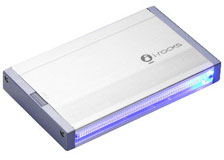
 Available in silver or black anodized aluminum with a
"hairline" motif, the IR-9200 harmonizes nicely in appearance with
any modern Mac, and the silver model I tested looks right at home
beside my 17" aluminum PowerBook.
Available in silver or black anodized aluminum with a
"hairline" motif, the IR-9200 harmonizes nicely in appearance with
any modern Mac, and the silver model I tested looks right at home
beside my 17" aluminum PowerBook.
These hard drive enclosures are a great way to make use of hard
drives pulled when upgrading to a higher capacity unit in your
computer, and I've installed a 4.5 GB Fujitsu drive (which I think
originally came in a Lombard
PowerBook) in the review unit. The IR-9200 will accommodate any
2.5" IDE/ATA hard drive up to 9.5mm thick.
The i-Rocks IR-9200 comes bundled with a USB 2.0 cable, a
USB 2.0 to DC jack 5V power cable, a very handy little drawstring
carry pouch, and a software mini-CD (about which more in a
moment).
Installing the hard drive in the enclosure was a snap - which is
good, because there is no drive installation documentation provided
in the product package.
 The
whole process took less than five minutes, and only a small
Phillips screwdriver was required for tightening the four supplied
screws that secure the hard drive to the IR-9200 internal
chassis.
The
whole process took less than five minutes, and only a small
Phillips screwdriver was required for tightening the four supplied
screws that secure the hard drive to the IR-9200 internal
chassis.
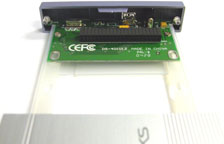
No tools are required to open the case; just press the release
button, and the inside chassis slides out.
Carefully insert the multi-pin plug on the end
of the hard drive into the socket on the IR-9200's circuit board,
to install and tighten the four screws, and slide the assembly back
into the enclosure case.
 Before
using the IR-9200 (for USB 2.0 support) , it's necessary to install
supporting driver software on your Mac. A mini-CD containing driver
installers for both OS X 10.2 up and several versions of the
classic Mac OS comes in the box, but that presents a problem for
owners of Macs with slot-loading CD or DVD drives, since these do
not support mini-CDs (and attempting to use a mini-CD in a Mac
slot-loading drive can cause drive damage, so don't do it).
Unfortunately, there is no warning in the IR-9200 documentation
about this issue.
Before
using the IR-9200 (for USB 2.0 support) , it's necessary to install
supporting driver software on your Mac. A mini-CD containing driver
installers for both OS X 10.2 up and several versions of the
classic Mac OS comes in the box, but that presents a problem for
owners of Macs with slot-loading CD or DVD drives, since these do
not support mini-CDs (and attempting to use a mini-CD in a Mac
slot-loading drive can cause drive damage, so don't do it).
Unfortunately, there is no warning in the IR-9200 documentation
about this issue.
My workaround was to use a big old QPS tray-loading FireWire
CD-burner that I have, which handled the mini-CD with no
hassle.
The driver can also be downloaded from http://www.i-rocksusa.com/support.html,
and a somewhat out-of-date but still useful manual on driver
installation in PDF format can be downloaded from the same
page.
If you don't have a tray-loader available, the best strategy is
probably to find someone who does and get them to copy and burn the
driver installer files onto a standard CD for you. Driver
installation was straightforward, with a standard OS X
software installer, and there are instructions in the included
user's manual if you need them, but it was pretty intuitive. (This
is a hassle that you don't have to deal with using FireWire
drives.)
 When
I connected the IR-9200 to the 17" PowerBook, I found that
strangely there was not enough bus power to spin up the drive, so
it was necessary to use the supplied USB 2.0 to DC jack 5V power
cable plugged into my self-powered USB hub. Once sufficient power
had been applied, the Fujitsu drive spun up nicely. The IR-9200 has
two activity LED indicators, a cool blue one for power, and a red
one for drive access status. I've found that the USB 1 ports in
both my Pismo and iBook supply enough juice to spin up the drive
without any help.
When
I connected the IR-9200 to the 17" PowerBook, I found that
strangely there was not enough bus power to spin up the drive, so
it was necessary to use the supplied USB 2.0 to DC jack 5V power
cable plugged into my self-powered USB hub. Once sufficient power
had been applied, the Fujitsu drive spun up nicely. The IR-9200 has
two activity LED indicators, a cool blue one for power, and a red
one for drive access status. I've found that the USB 1 ports in
both my Pismo and iBook supply enough juice to spin up the drive
without any help.
I didn't do any formally timed comparisons, but file transfer
speed seems to be not that different from my external FireWire 400
hard drive.
At just $19.99, the i-Rocks IR-9200 USB 2.0 drive enclosure
represents an good value in an external hard drive housing. The
hard drive installer installation was simple (aside from the
mini-CD issue), it works well, and it looks great.
In the
negative column, the lack of installation documentation for the
drive installation is the biggest shortcoming, along with the lack
of any warning about the mini-CD and its potentially destructive
incompatibility with slot-loading optical drives. If i-Rocks is
serious about supporting the Mac, they should ship the software
driver installer software on a standard CD.
The necessity of using two USB cables with some Macs (so the
drive obtains sufficient power) is also a bit of a pain, as open
USB ports are usually at a premium for most of us. There is an
optional 5V/2.3A power adapter available, and that would be a more
convenient way to go.
Link: i-Rock IR-9200 2.5
" HDD Enclosure
Go to the Miscellaneous Ramblings Review index.