I was sitting in a temporary office in Bagram, Afghanistan. I would
hopefully be going home in a few days, and I was passing the time
reading the news on my iPhone while my replacement was learning the
ropes.
Then I saw it, a short, simple headline that belied the gravity of
the news it conveyed: Steve Jobs Is Dead.
Steve Jobs changed my life. I was a lawyer living a comfortable life
and making a good living in Raleigh, North Carolina, in the early
1990s. In addition to being a partner, I was also the IT Director of
the law firm. I bought a few books, studied on my own, and became a
MCSE (Microsoft) and CNE (Novell). I eventually received a job offer to
become the VP of IT at a large bank in Atlanta, and it was an offer I
could not refuse.
Overnight, what had previously been my hobby became my livelihood.
In those days, companies were throwing obscene amounts of money at
anyone who appeared to have a little knowledge and any sort of track
record in IT in an attempt to hire the "best" people - "best" being
anyone who was remotely qualified as opposed to the companies on the
lower rungs that had to be satisfied to hire people with no actual
knowledge or experience in IT, but rather just an interest and
willingness to learn.
After my career change, I was managing a staff supporting hundreds
of users on Windows 95 connected to Novell servers. The Novell servers
were solid enough, but it was the Windows desktops that gave us real
job security.
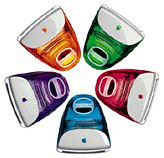 When my wife's home computer
crashed, taking with it much irreplaceable data, we decided to replace
it with a Tangerine
iMac. As time went by, I replaced my Windows desktop with a Mac (a
used Power Mac 7500),
having used a Mac Classic
in law school and having had a few of them at the law firm.
When my wife's home computer
crashed, taking with it much irreplaceable data, we decided to replace
it with a Tangerine
iMac. As time went by, I replaced my Windows desktop with a Mac (a
used Power Mac 7500),
having used a Mac Classic
in law school and having had a few of them at the law firm.
This was in 1999, and Windows never graced my desktop (either the
physical or electronic one) again.
...users quickly saw that the Macs had none of
the problems their previous Windows PCs had.
A couple of years after returning to the Mac full-time, I began
having doubts about my day job. Even though I was on top of the world
in my still relatively new career field, I became increasingly
frustrated at the unnecessary problems we spent all day fixing (and
then fixing again and again), in contrast to the trouble-free
experience I had at home on my Mac. This was magnified by the fact that
we had replaced a number of computers at work with Macs (in fact, we
had replaced every PC we could, the remainder being required to run a
proprietary piece of Windows software), and users quickly saw that the
Macs had none of the problems their previous Windows PCs had.
It was around this time that I penned my first column for Low End
Mac, The Mac as a Business
Solution.
Then Sept 11 happened. My part-time gig as a Judge Advocate in the
Army Reserve became increasingly full-time. I bought my wife the
original iPod when it came out. Using our Macs at home while being
forced to use Windows in the Army convinced me that there was a better
way. Computers should not work against you (Windows); they should work
for you (Macs).
This epiphany came about because of the Macs that Steve Jobs
designed and built. Of course, he did neither personally, but he was
single-handedly responsible for creating and fostering the corporate
(counter?) culture and climate that caused all this, and more, to
occur.
As the advancement of technology passed our Macs by, we bought new
ones, never even considering anything else. We bought iPhones, more
iPods, PowerBooks, iBooks, MacBooks, and an iPad. Even AirPorts and a
Cube.
Eventually, I forgot what it was like to fix computers - literally.
No longer able to rely on my memory due to disuse, when friends and
relatives ask me for help fixing their Windows PCs today, I have to use
Google or Cnet or some other resource to refresh my memory, then get
back to them. Ten years ago, I could do it over the phone the minute
they called. Some things are nice to forget. Thank you, Apple; thank
you, Steve.
President Obama paid one of the greatest tributes to Steve's success
when he noted that much of the world learned of his passing on a device
he invented. As I sat down to collect my thoughts to write this, it hit
me. How remarkable. Not remarkable - how astounding is it that I
learned of Steve's passing, not only on a device he invented, but on a
device he invented that allowed me to learn of his passing while
sitting in a war zone in the middle of the fifth least-developed
country in the world.
One of Steve's first ad campaigns upon his return to Apple was the
"Think Different"
series. We had one of the posters (John Lennon) in our server room at
the bank for years. Steve cultivated an image of Apple as being elite -
and outside (and definitely above) the mainstream back then. However,
it was just the first step in the restoration of Apple. Eventually
"Think Different" gave way to the "Switch" series (for my take on this,
see Are Mac Users Losers?).
No longer a niche for the elite, Apple was now beckoning and
welcoming the masses. And the masses were coming.
Steve made different mainstream.
Rest in peace.