Just eight months earlier, MacUser had lauded the new Centris line.
In this issue, the noted the end of that nameplate. 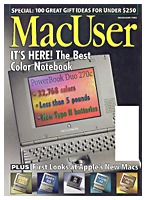 And just like
the April 1993 issue, Apple introduced more new models than you could
easily keep track of.
And just like
the April 1993 issue, Apple introduced more new models than you could
easily keep track of.
Keep It Simple, Apple
Maggie Canon opens this issue looking at the way Apple is
reorganizing its products into four lines: education, mass market,
computer dealer, and PowerBook. Apple had something for everyone -
including several new models unveiled later in this issue.
Easy Ethernet
One of the great lesser known technologies of this era was EtherWave
from Farallon. Unlike regular 10Base-T ethernet cards and adapters,
which have to be wired to a central hub, EtherWave cards and adapters
could daisy chain up to 8 devices - then link that to a hub, if
necessary.
My favorite was the EtherWave adapter that plugged into a
PowerBook's LocalTalk port, drew power from the ADB port, and let you
easily and fairly inexpensively put pre-190 PowerBooks on ethernet.
Very smart.
Going Native
Apple hadn't yet released the Power Mac, but companies including
Adobe, Aldus, Microsoft, Claris, and Deneba were committed to producing
PowerPC native versions of their software.
AppleShare Pro and Apple Workgroup Server 95
Take the monstrous Quadra 950,
put a special SCSI card in the processor direct slot, and load it with
a hybrid of A/UX 3.0.1 (Apple's version of Unix), and you've got one
very hot $11,639 server. Benchmarks showed the AWS 95 smoked a Quadra
950 running AppleShare 3.0.2 when opening files; it also outperformed
AppleShare under a heavy client load.
And Then There Were 4
The big feature article covered Apple's new four-quadrant strategy.
Apple would have one line for the education market (LCs), another for
the mass market (Performa), and yet another for the business market
(Quadra). Alongside the three desktop lines was the PowerBook
series.
To further confuse matters, the same exact computer might appear as
a Quadra, an LC, and under several Performa model numbers. This was
quite the opposite of the simplification Apple has seen since the
return of Steve Jobs in 1997.
Performa 460, 466, 467
At the bottom end, the LC
III was bumped from 25 MHz to 33 MHz, creating the Performa 460 series. (The education
version would be called the LC III+.) The 460 sold for $1,300 with
4 MB RAM and a80 MB hard drive.
Performa 550
Take the 460 motherboard, drop it into a beige all-in-one case with
a 14" monitor, and you have the Performa 550 at $2,000.
Quadra 605, LC 475, Performa 475, 476
Take the tried-and-true LC design and drop in a 68LC040 CPU. That
gives you the most compact Quadra ever - and the model with the most
different names in this lineup. The Quadra 605 and its twins offered very
decent performance for about $1,300.
Quadra 610
The Centris 610 ran a 25 MHz
68LC040. Apple replaced it with the 25 MHz Quadra 610, providing 25% more speed at
the same price. Except for the least costly model, the Q610 had a
full-fledged 68040 CPU, not the math challenged LC version.
The 610 offered the same performance as the 605, had room for an
internal CD-ROM, and accepted up to 64 MB of memory, almost twice as
much as the 605.
Quadra 650
Apple also replaced the 25 MHz Centris 650, giving the world the 33 MHz
Quadra 650.
Duos Done Right
The new PowerBook Duo 250
and 270c had active-matrix
displays, replacing the lackluster passive-matrix grayscale screens of
the Duo 210 and 230. The 270c even added a 16-bit
color screen to the equation.
Both models used 33 MHz 68030 CPUs and weighed less than 5
pounds.
System Software for the '90s
According to Henry Bortman, John Rizzo, and Stephan Somogyi, three
new additions to the Mac OS would give even older Macs the features
they needed for the 1990s.
QuickDraw GX
Desktop printing debuted with QuickDraw GX, which required System
7.1 or later, 1 MB of additional RAM, and at least a 68020 CPU.
And desktop printing was just part of the package. Under GX, each
printer had its own queue, and the user could select printers within
the Print dialog - no need to go to the Chooser if the printer already
had an icon on the desktop. You could even print a document by dragging
it to the desktop printer icon.
I was a book designer back in 1993; we were very excited about the
typographic possibilities of QuickDraw GX. Smart fonts would let you
tighten or loosen the tracking between characters, adjust the font's
weight (more than just regular and bold), and have the computer
automatically use ligatures (substituting "Þ" for "fi" is one
example).
The typographic embellishments of QuickDraw GX didn't catch on, but
the printing technology became a standard part of the Mac OS.
PowerTalk
AOCE (Apple Open Collaboration Environment) was a powerful part of
System 7, but almost nobody took advantage of it. PowerTalk, which was
part of System 7 Pro, set out to change all that.
Having email and a mailbox built into the Mac OS was part of Apple's
strategy. Users would be able to email documents inside other programs,
such as WordPerfect 3.0. Nice idea, but it never really caught on.
The PowerTalk Key Chain was a good idea that vanished for a while,
then reappeared in Mac OS 9. The Key Chain lets you connect to multiple
servers easily and also stores your passwords. It was ahead of its time
in 1993.
AppleScript
When I was a DOS geek, I didn't understand how Mac users did without
batch files. AppleScript provided that kind of power and more to anyone
with System 7.0 or later and 4 MB of memory. AppleScript remains a
powerful, if underutilized, technology today.
Affordable Color Upgrade
Back in 1993, NuBus video cards selling for under $1,000 were
considered affordable - Mac users today think twice about spending an
extra $100 for improved video.
This article looks at cards from E-Machines, Lapis, Radius,
RasterOps, Sigma, and SuperMac. Most supported 24-bit video on 16"
monitors. Most offered good to excellent performance. (The Lapis cards
trailed the pack considerably.)
MacUser's top choices were the SuperTech Spectrum/24 Series IV, the
fastest card tested, and the Radius
PrecisionColor 24Xp, the best value for a 16" monitor.
Platform Choice
John C. Dvorak used to have the back page of MacUser. In this issue,
he compared Macs with Windows computers. His findings"
Mac Advantages
- Robustness. Macs crash less than Windows machines. Dvorak
estimated Windows crashes 2-3 times more often.
- True drag and drop. Macs don't require complex installers.
Most of the time, you just drag a file where it belongs.
- SCSI support. Sure, some PCs supports SCSI, but it's never
as simple as it is on the Mac.
- Mouse feel. "Apple has all sorts of amazing algorithms to
make the mouse easy to use. With Windows, the mouse is jumpy and hard
to control."
- Better looking output. Mac fonts have better hinting
(detail) and Mac documents look better when printed.
Windows Advantages
- Cheapness. It costs less to buy a Windows PC, "but the
machines are much shoddier than the Mac."
- Newer software. More development takes place for
Windows.
- Greater variety of machines. Hard to believe, considering
the dozen or so models Apple had, but then the Windows world has dozens
of companies making beige boxes.
- Cheaper, faster IDE hard drives. Apple finally saw the light
and started using IDE drives with the Quadra 630 and PowerBook 150 in mid-1995.
- Upgradability. Most Windows computers could have their CPUs
replaced with faster ones.
Now that the round mouse is history, I'd have to say Apple retains
all five advantages listed. SCSI has been replaced with USB and
FireWire, but Apple's implementation remains superior.
PCs remain cheaper, in both senses of the word, although you can
often find refurbished iMacs for US$650 or so - and no need to add a
monitor. One way Apple reduced price was using IDE drives, which
eliminates the 4th Windows advantage.
Upgradability has improved. Quadras from that period could take
PowerPC upgrades made by Apple starting in 1994. Even the first
generation Power Macs have G3 and G4 upgrade options. At this point,
neither platform seems to have an advantage.
Dvorak concludes his article by comparing the Mac to Sony Betamax,
something I also did recently. His
recommendation is that Apple bite the bullet and go Intel, just as Sony
finally abandoned Beta and started making VHS recorders.
Eight years later and some people are still making the same
suggestion, while Apple remains committed to a different, better course
of action.
Ads
Apple had an eight-page ad extolling CD-ROM.
Intel had a two-page ad asking, "What's a company like us doing in a
magazine like this?" Wouldn't you know it, practically any program that
runs on the Mac is also available for Windows - so why not go
Intel?
APS was selling an internal 127 MB hard drive for $189, 170 MB for
$199, and 240 MB for $259. Their biggest drive was a 3 GB
Micropolis for $2,499.
MAC Xtra was selling 4 MB 30-pin SIMMs for $146, IIfx SIMMs
for $151, and 72-pin SIMMs for $167. 16 MB 30-pin SIMMs were $639, IIfx
SIMMs were $579, and 72-pin SIMMs were $619. These prices were up
considerably from those in the April 1993
issue.