With all of the articles popping up about the new MacBook Air, I thought that I, alongtime user and proponent of ultraportable laptops should chime in.Like most people writing about Apple's new silver sliver, I don't ownone. However, unlike most of those complaining about its specs (or lackthereof), I have owned and lived ultraportables before and always ownat least one (my current small machine is a used 1.0 GHz 12" PowerBook that was priced too low toignore).
They Don't Get It
First, I'll say a few words about most other people's words on theMacBook Air: They don't get it!

Almost every reviewer has complained about the lack of an opticaldrive even while complementing Apple's Remote Disk technology. Ofcourse there isn't a built-in optical disk: No ultraportable worthy ofthe name has one, and adding it detracts from the primary goals of suchmachines, which are small size and light weight.
The convenience of a built-in drive is well and good on a generaluse laptop, but on a machine designed for the busy run-around life ofan ultraportable, it's just unwanted (and heavy) fluff.
 The sameapplies to complaints about the MacBook Air using a slower processor,slow iPod hard drive, or lowbrow integrated graphics. Nobody is goingto play Doom 3 on one of these (or at least won't buy it for thatpurpose), and a few extra seconds to render a photo or transfer a filereally aren't that important in this market. What does matter,again, is small size and light weight.
Oh yeah, those same lowbrow components that make the machine smallerand lighter also help in the one performance specification thatultraportable buyers really do care about, and that's battery life.Apple claims 5 hours for the MacBook Air, which is the same as theyclaim for the regular MacBook. What isn'tmentioned is the weight and capacity of the two machines' batteries. Iwould be willing to bet that the regular MacBook has a much beefierbattery than the slower, more power-wise MacBook Air.
Ultraportables Are Not Desktop Replacements
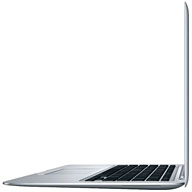 Okay, so we areclear that the MacBook Air is not in any way designed for the desktopreplacement or even general purpose laptop crowd, but for the frequenttraveler. Now I won't go as far as some other reviewers who've saidthat the MacBook Air should be used as a supplement to a desktop Mac,but its designers and its target audience know that this is nomultimedia powerhouse. It also is not an updated PowerBook Duo, as it has no real dockingability to speak of and lacks the muscle to replace a desktop even ifit could dock.
So what is the MacBook Air then? Simple: It's Apple's version of themany other ultraportables on the market.
There are many machines in this class, and each manufacturer has itsown design goals. I think that Sony was probably the first to try theMacBook Air's particular combination of semi-large screen, moderateperformance and oh-so-thin-and-sexy style with the old Vaio Superslim 505of the late 90s. These were mediocre performers, but they made such ahigh-tech styling statement that even Mac users of the time oftenenvied their dimensions. Sure, we had the PowerBook 2400c, which was faster, butit was also 30% heavier and twice as thick, with a lower resolutionscreen of the same size.
Those old Vaio 505s really were that radical in 1998, just asthe MacBook Air is that radical today.
Compromise
Ultraportables are inherently compromised machines, and eachmanufacturer makes different compromises. Obviously, different userscare differently about what is missing, and that is why thesehigh-priced, low-performing machines are available in so many verydifferent form factors. Just look at some of the current PCultraportables. These things range from tiny 7" screen wondersthat run full versions of Vista, to cheap $300 machines that can(barely) run Windows XP to tablets and even 2 lb. wonders that make theMacBook Air feel overweight. Some are as fast as larger machines;others run 10 hours on their large battery packs.
The important thing is that none of them can do everything and stillbe small and light.
Do you want that fast processor? Great, kiss your battery lifegood-bye. Do you want a full size screen and keyboard? Cool, but itwon't weigh 2 lb. or be the size of a paperback. Want it razor thin?You can have it, but kiss your big batteries good-bye.
The MacBook Air, as mentioned earlier, is just Apple's take on thecompromises required.
Apple placed its emphasis on making the machine thin but did notemphasize making it small in other dimensions. Apple went for semi-longbattery life, and with its thin design couldn't fit big batteries, soit specified low-power components and efficient LED backlighting. Appleemphasized an integrated, seamless appearance, so there are no dockingconnectors or extra ports.
It's not that they left off anything important or fall short of ortrump the competition in any way, just that they looked at who theythought would buy it and designed what they thought this person wouldwant.
Is the MacBook Right for Me?
So does it work for me? Clearly I haven't seen one in person yet,though I'm certain I will be wowed. Five hour battery life isn't enoughfor my annual trans-Pacific flight, but that is just one flight peryear, so its not that big of a deal. I watch movies on mycomputer when I travel, but only on longer trips. Apple's external DVDis the perfect solution for my "occasional" drive needs. Theperformance is about right, as I've lived with slow-hard drives before(ThinkPadX41 also uses 1.8" drive) and lower processor speeds, and foranything other than cutting edge games and graphics-intensive work,which I do very little of, the MacBook Air would perform beautifullyfor me.
Actually, the sealed nature of the unit's battery is my onlyconcern. I've read reports that users can fairly easily open themachine and replace it, but clearly it would still require tools and aclean space. I just don't know if I'm willing to make the leap to amachine without swappable batteries. It's not anything relating toApple or the technology, but to the simple fact that lithium ionbatteries lose their capacity over time - and not that much time. Mynewest Li-Ion battery is only about three months old and is alreadydown about 10% in peak capacity. That battery is a replacement for a1-year-old battery that is down to about 40% of its original capacity.I follow all the manufacturer's tips to maintain my batteries, butheavy use wears them out, and there is no way (yet) to avoid that.
Will I buy the MacBook Air? Soon, but not yet. I got badly burnedwith three successive defective Rev. AMacBooks, and after that experience, I will never again buy Rev. Aof anything until its been on the market for at least six months.
After that, yes, absolutely. I've been waiting a long time for anultraportable Mac, since the Duo went away. I was and remain ahuge fan of the 12" PowerBook, though I never considered it (at4.6 lb.) a true member of the club.
The MacBook Air will let me (finally) have a modern Mac that doesn'tweigh me down and allows me to enjoy all of the goodness of OS Xwithout having lug the kitchen sink around for the ride.
Yeah, I will definitely get (a Rev B) one of these. 
Andrew J Fishkin, Esq, is a laptop using attorney in Los Angeles, CA.