Apple introduced the Power Mac G4 on August 31, 1999 with two
different models, Yikes! and Sawtooth.
Yikes!
We'll look at the entry-level Power Mac
G4 first. The "Yikes!" model was in many ways just a Blue & White Power Mac G3 with a G4 CPU and a
gray case. It was a competent computer, but it didn't take
advantage of the faster memory access available with the G4
CPU.
Originally announced at 400 MHz, but scaled back to 350 MHz in
October when Motorola was unable to provide fast G4s in quantity,
this model has the same 1 GB memory ceiling, ATA bus, and even
the same PCI video card as the Blue & White G3.
It makes a decent OS X machine, but G4 Power Macs with AGP video
are much better choices with OS X.
Sawtooth
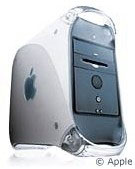 The Sawtooth Power Mac G4 unleashed the new CPU's
potential. In addition to using the faster memory access supported
by the G4, this model also introduced AGP video to the Mac world.
(The AGP bus was twice as fast as the 66 MHz PCI bus on Yikes!)
The Sawtooth Power Mac G4 unleashed the new CPU's
potential. In addition to using the faster memory access supported
by the G4, this model also introduced AGP video to the Mac world.
(The AGP bus was twice as fast as the 66 MHz PCI bus on Yikes!)
The Sawtooth model shipped at speeds from 350 MHz to 500 MHz and
uses ATA66 for both hard drives and the optical drive, giving it
one more advantage over the Blue & White G3 and the Yikes! G4.
It supports a maximum of 1.5 GB of RAM and has two separate USB
controllers.
The AGP bus provides a lot more video upgrade options and
eliminates the bottleneck of PCI video that is especially
noticeable with later versions of OS X. All in all, this is a
fine machine for Mac OS X as it supports lots of memory, has a
fast drive bus, supports AGP video, and accepts a wide range of CPU
upgrades.
Two Brains Are Better than One
With Motorola unable to deliver G4s running faster than 500 MHz,
Apple had a choice. They could either stay where they were or Think
Different. Code named Mystic and commonly called Gigabit Ethernet models, these July 2000 models had
two G4 CPUs and, as you've undoubtedly guessed, gigabit (1000 Mbps)
ethernet.
Other than faster ethernet and dual CPUs, this model was
scarcely different from the Sawtooth/AGP video model.
A Faster Bus
With the Digital Audio models,
introduced in Jan. 2001, the Power Mac moved from a 100 MHz system
bus to 133 MHz - a speed used on almost every G4 model released
thereafter.
In addition to a faster system bus, the Digital Audio Power Mac
typically shipped with a CD-RW drive, a first for Power Macs, and
the 733 MHz model zoomed right past the 500 MHz mark of earlier
Power Macs. This top-end model also came equipped with a
SuperDrive, one that could burn CDs and DVDs.
There were five models: 466 MHz, 533 MHz, 667 MHz (soon
discontinued), 733 MHz, and 533 MHz dual. They all included four
PCI slots plus an AGP 4x slot, one more PCI slot than earlier Power
Macs had.
With the faster system bus, this makes a very nice OS X
computer - particularly the 533 MHz dual CPU model, since OS X
does a great job of balancing the load and distributing work
between CPUs.
A New Look
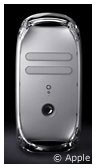 The next generation Power Mac, named
Quicksilver, introduced a new look -
a lighter gray with more elegant drive covers. Introduced in July
2001, the top speed was 867 MHz, and for heavy lifting, the 800 MHz
dual was the way to go. (Alas, under the classic Mac OS, only
Photoshop and a few other programs could take advantage of the
second CPU. OS X, on the other hand, has always been able to
take advantage of dual CPUs.)
The next generation Power Mac, named
Quicksilver, introduced a new look -
a lighter gray with more elegant drive covers. Introduced in July
2001, the top speed was 867 MHz, and for heavy lifting, the 800 MHz
dual was the way to go. (Alas, under the classic Mac OS, only
Photoshop and a few other programs could take advantage of the
second CPU. OS X, on the other hand, has always been able to
take advantage of dual CPUs.)
These were replaced with the Quicksilver
2002 model in January 2002, which was mostly a speed bump.
Single processor models ran at 800 MHz and 933 MHz, and the top-end
1 GHz model had dual CPUs.
Mirror, Mirror
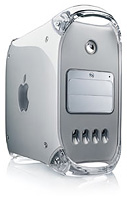 Apple introduced the
Roadmaster, er, Mirrored Drive Doors model
in August 2002. Featuring a new case design, the MDD model had
shiny drive doors and four vents/ports on the front of the case.
(Old timers will recall four decorative ports as a standard feature
of the Buick
Roadmaster from 1936 to 1958.)
Apple introduced the
Roadmaster, er, Mirrored Drive Doors model
in August 2002. Featuring a new case design, the MDD model had
shiny drive doors and four vents/ports on the front of the case.
(Old timers will recall four decorative ports as a standard feature
of the Buick
Roadmaster from 1936 to 1958.)
All three models had dual processors, which ran at 867 MHz,
1 GHz, or Apple's fastest-to-date 1.25 GHz. The MDD models had
three drive busses: ATA33 for media drives, ATA100 for hard drives,
and an unused ATA66 bus that could be used for additional
drives.
The 1 GHz and 1.25 GHz models were the first Power Macs to use a
system bus faster than 133 MHz. The 167 MHz bus was used in all
future G4 Power Macs 1.25 GHz or faster. There was also room for
2 GB of RAM, up from 1.5 GB in earlier models.
The X Factor
The ultimate Power Mac G4 began shipping in January 2003. The
FireWire 800 model was the first Power
Mac that couldn't boot the classic Mac OS; you had to use
OS X, which was up to version 10.2 at the time. Also new to
the Power Mac were room for a Bluetooth module and FireWire 800,
the feature that most readily distinguishes this Power Mac from the
earlier MDD model.
The entry-level model had a single 1 GHz CPU; the faster ones
had dual 1.25 GHz or 1.42 GHz CPUs.
G4's Last Hurrah
Better to end with a bang than a whimper - unless you're the
last Power Mac G4. Apple introduced the final
Power Mac G4 in June 2003 at an unexciting 1.25 GHz CPU speed.
It was released to meet a pent-up demand for Macs that could run
OS 9, and it lacked the FireWire 800 and Bluetooth support of
the X-only model.
There was really nothing the least bit innovative about this
model. It is essentially the same as the original MDD model.
Apple introduced the first G5 Power Mac
the same month.