Over the years, Apple has been advised to split itself into separatehardware and software companies, the theory being that the softwarecompany would better be able to compete with Microsoft by licensing theMac OS to other manufacturers.
Apple never went down that path, but it did attempt to grow Mac OSmarket share in the mid 1990s with an authorized Macintosh cloneprogram. The first clone came fromRadius in March 1995, followed in April by Power Computing, a company formed specificallyto create Mac clones while trying to copy Dell's build-to-order, directshipment model. Motorola, Umax, DayStar Digital, and APS Technologies werejust a few brands in the clone market.
There were some good aspects to the clone program, and somemanufacturers brought innovative new ideas and designs to the Macintoshcommunity, but for the most part the clones were sold on the basis ofprice, which invariably offered more power for less money than Apple'sown computers. Despite a $50 per machine license fee, the hardwarecompetition nearly destroyed Apple, and it was one of the first thingsto go after Steve Jobs' return at the end of 1996. (See Apple Squeezes Mac Clones Out of theMarket for more on the end of the clone era.)
Today our staff shares its experiences with various clones and looksat some of the new niches Macintosh clones filled.
Alan Zisman (Zis Mac): Thefirst "Mac" I bought was aMotorola StarMax clone, powered by aPowerPC 603e CPU running at 160 MHz; I bought it (in 1997) for a numberof reasons - while I was primarily a Windows-user (with some playingaround with early Linux versions), I had always seen Windows as anawkward attempt to bring a Mac-like experience to the PC platform - theMac OS was the gold standard.
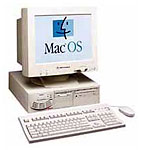 The Motorola clone wasless expensive than equivalentMacs at the time, while running the same then-current Mac System7.5.5 operating system. Unlike "real" Macs, it connected to somestandard PC peripherals - PS/2 mouse and keyboard, VGA display. Thatwas handy, since it meant I could use stuff that I already owned.
Moreover, the publication that I wrote for, Business in Vancouver(for whom I still write a regular "High Tech Office" column), hadrecently bought a bunch of these, replacing a newsroom full of Mac Pluses, I believe.
It was a nice performer - easily as perky as my 166 MHz Pentium. Butsoon after I bought it, it became clear that it's future was limited:Apple released a nice Mac OS 7.6 version, and while it ran on theStarMax, it wasn't officially supported. Soon after, OS 8.0 wasreleased; the various clone manufacturer's licenses allowed them to useSystem 7.x, and Apple was unwilling to extend that license to the newOS. (Apparently, cloner Umax had a license for OS 8, though it expiredin 1998.) Motorola stopped selling Mac clones in 1997.
I remain interested in running Mac OS on non-Apple hardware; thisbecame easier to do when Apple moved to the Intel platform. Apple hastaken vendors to court who tried to sell non-Apple systems running MacOS X, most notably its 2008 suit of Florida-based Psystar. Applehas taken no formal notice, however, of individuals making so-calledhackintoshes for personal use.
Dan Knight (MacMusings): I remember using a Power ComputingPower 120 at work for a few weeks in 1995. We'd been using Power Mac 7100s in the designdepartment and wanted to see what these clones were all about. Well, itoverheated and had the same build quality as a cheap PC - definitelynot up to Apple standards - so back it went.
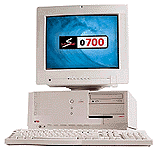 After a Mac Plus, which Iused from 1990 through mid 1993, and a Centris 610, which I used from mid 93 tomid 98, I got my first PowerPC "Mac", a Umax SuperMac J700, bought at fire saleprices as Umax was exiting the clone business. This was much closer toApple build quality, and it used the same CPU daughter cards as Apple'sPCI Power Macs, so I was eventually able to replace the 180 Mhz 604ewith faster and faster G3 cards. I was so impressed with it that Ilater bought a SuperMac S900, thetower version of the J700 with even more PCI slots. I used these untilearly 2001, when I got my 400 MHz Titanium PowerBook G4,which lasted 5-1/2 years.
I have a little experience with Motorola StarMax clones, and theleft about as positive an impression on me as the Power 120.
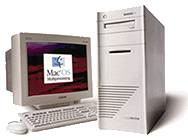 Perhaps the mostinnovative clone was the DayStarGenesis MP, the first "Mac" with multiple processors. I hear thesewere built like tanks, and very few apps were ever written to use morethan one CPU with the Classic Mac OS. Still, Photoshop power users andvideo editors jumped at the version built around four 150 MHz 604eCPUs. Apple was so impressed that it licensed the technology fromDayStar and used it in some Power Mac 8600 and 9600 models - long before the first dual CPU Power MacG4s arrived in Mid 2000. Power Computing and Umax also licensed thetechnology for use in some of their clones.
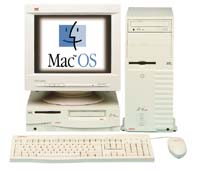 I ended up pickingup the entire original line of SuperMac computers, adding a compactC500 desktop (just 4" tall) andC600 minitower, a machine that Istill use sometimes for working with old hard drives.
Leaman Crews (Plays Well withOthers): My only real experience with Macclones was with the Umax C500. When I was working in the newspaperbusiness, we bought a couple of these at the fire sale prices. Theywere attractive little machines, and the VGA port was very much welcomein an era where Apple was using proprietary connectors on their PowerMacs. [Editor's note: Apple introduced its own 15-pin video connectorwith the Mac II in 1987 and onlywent to VGA in 1999 with the Blue & White Power Mac G3.I believe every clone had VGA ports, and many supported both.]
We had nothing but trouble with our C500s. They would just freeze(no cursor or mouse input accepted, clock stops) two to three times aday. It got to be routine - and definitely got the staff remembering todo Cmd-S to Save as much as possible!
When I moved on to the IT field full-time, I found a couple dozenC500s waiting for me at my new job. They all seemed to share the sameproblem - locking up regularly and for no apparent reason.
We also had some of the Umax towers (the J700, I presume), but Ididn't get any hands-on experience with those. Apparently those ranmuch better. With G3 upgrades and XPostFacto, theywere viable machines well into the 21st century.
Overall, I think Steve Jobs did the right thing by effectivelykilling the clones upon his return by refusing to grant clone licensesfor OS 8.x and higher. The move to clones was an act of desperation inApple's "beleaguered" days, trying to copy a business plan that hadworked so well for Microsoft a decade earlier - but way too late for itto be effective for Apple. The clones cut into Apple's biggest profitcenter at the time (computer hardware sales), and with the generallypoor quality of the machines, they didn't exactly spread the Mac gospelbeyond the faithful.
Charles Moore (several columns): My first and only Mac clone was aUmax SuperMac S900, purchased as a bare-bones, brand new leftover in2000 from Other World Computing's erstwhile build-to-order used/openbox Macintosh store for $300. The S900 was Umax's biggest, baddesthigh-end 6 PCI slot minitower machine that used basically the sameTsunami motherboard as the Power Mac 9500/9600.
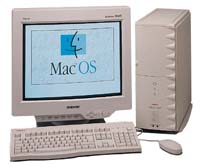 My new SuperMac arrived well packed and inperfect condition - brand new as advertised. I added a scrounged 15"multiscan VGA monitor, a likewise acquired 200 MHz 604e card, and a bigvideo-capture PCI card that one of my offspring had picked upsomewhere. I also had six RAM modules - no two of them exactly alike,but happily in non-identical pairs of 32 MB, 16 MB, and 8 MBrespectively. Combined with the 16 MB of RAM soldered to the S900'smotherboard, that gave me roughly 131 MB of RAM according to the "AboutThis Computer" dialog, which was plenty to run Mac OS 9 Classicdecently.
I had originally ordered a 4x CD ROM drive ($30) with the S900, butthese units turned out to be out of stock, so rather than hold up theorder, I opted for a Sony 2x CD300 drive for $15.
I had tentatively planned to get a G3 or G4 processor upgrade forthe S900 in order to run OS X but never got around to doing that, so OS9.1 was the last OS version I installed on the machine. The 200 MHz604e did remarkably well running OS 9, and the S900 served as a backupto my workhorse 233 MHzWallStreet PowerBook for a couple of years. Its main shortcoming,once I got some hard drive issues sorted, out was that it was noisy,and I preferred the quiet PowerBook, although performance running OS 9on both machines was not radically different, and I never had a reallydecent video card for the S900.
The 7200 rpm 2.15 GB Barracuda hard drive ($59) that I ordered withthe S900 turned out to be troublesome, and eventually I replaced itwith a scrounged 4 GB unit, the brand of which eludes my memory rightnow. I also added a FireWire PCI card adapter.
One big advantage of the S900 compared with its Power Mac 9500/9600counterparts was that it was a lot easier to work on, with quick andeasy access to the internals. I liked it better than a 9500 we had hereat the time.
The S900 was the second-last desktop Mac I ever owned, followed by aPower Mac G4 Cube thatI owned for about six months in 2001 before swapping it even for ayear-old PismoPowerBook that I still have in regular service, albeitsubstantially hot rodded.
I've used the past tense here, but in fact I still have the S900. Ithasn't been booted up in two or three years, and I expect the PRAMbattery is knackered by now, but the computer itself is still inexcellent condition.
Dan Bashur (Apple, Tech, andGaming): Although I have never used a clone, Iclearly remember that era. It was not a great period for Apple, at atime when market share had already plunged to the low single digits(roughly 2-4% of the personal computer market if I recall). There wasone great positive that came out of the clone era though - the creationof multiprocessor Macs. DayStar pioneered this with the DayStarGenesis, and this was quickly licensed to Apple for use in the9500/180MP.
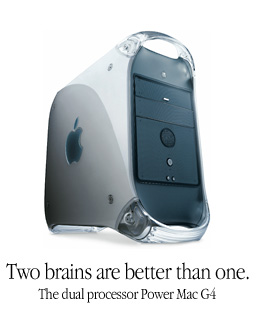 Apple certainly grew the multiprocessor approach tocomputing, and although the G3s were skipped after the 604/604e-basedPower Macintosh 9500 and 9600 multiprocessors models (along with otherclones from DayStar and the like), the G4 (with Apple's "Two Brains are Better Than One" campaign) andMac OS X were built with multiple processors in mind, and the rest ishistory.
With the legacy the Mac clones left behind with Steve Jobs' returnduring the early years of the PowerPC era, it always leaves mewondering what if Apple had been more patient with IBM to manufacturelow power/low heat multicore G5 processors that could have been used ina PowerBook G5? Instead, Intel delivered what IBM couldn't, and everynew Mac today has more than one core running to help fulfill ourever-increasing demand for digitally driven data, entertainment, andproductivity.